


Unfixable Forms (eBook)
330 Seiten
Cornell University Press (Verlag)
978-1-5017-5351-0 (ISBN)
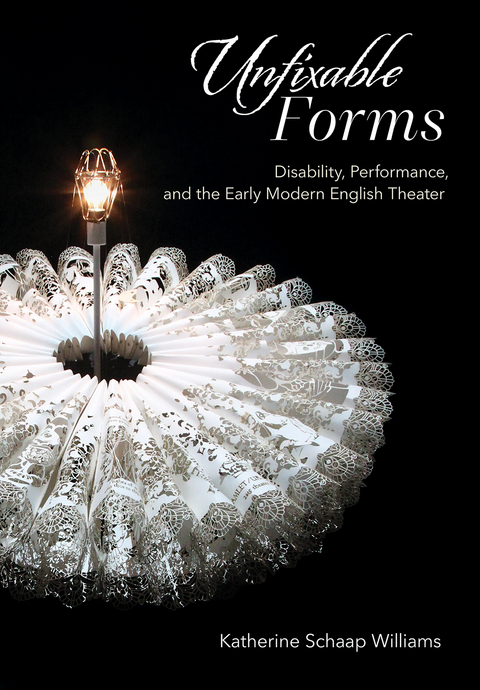
Unfixable Forms explores how theatrical form remakes—and is in turn remade by—early modern disability. Figures described as "deformed," "lame," "crippled," "ugly," "sick," and "monstrous" crowd the stage in English drama of the sixteenth and seventeenth centuries. In each case, such a description distills cultural expectations about how a body should look and what a body should do—yet, crucially, demands the actor's embodied performance. In the early modern theater, concepts of disability collide with the deforming, vulnerable body of the actor. Reading dramatic texts alongside a diverse array of sources, ranging from physic manuals to philosophical essays to monster pamphlets, Katherine Schaap Williams excavates an archive of formal innovation to argue that disability is at the heart of the early modern theater's exploration of what it means to put the body of an actor on the stage.
Offering new interpretations of canonical works by William Shakespeare, Ben Jonson, Thomas Dekker, Thomas Middleton, and William Rowley, as well as close readings of little-known plays such as The Fair Maid of the Exchange and A Larum For London, Williams demonstrates how disability cuts across foundational distinctions between nature and art, form and matter, and being and seeming. Situated at the intersections of early modern drama, disability studies, and performance theory, Unfixable Forms locates disability on the early modern stage as both a product of cultural constraints and a spark for performance's unsettling demands and electrifying eventfulness.
Katherine Schaap Williams is Associate Professor of English at the University of Toronto.
Introduction: Unfixing Early Modern Disability
1. Deformed: Wanting to See Richard III
2. Citizen Transformed: Being the Lame Soldier
3. Performing Cripple in Theatrical Exchange
4. Changing the Ugly Body
5. Playing Time, or Sick of Feigning
6. Making the Monster
Coda: Inviting Performance
| Erscheint lt. Verlag | 15.6.2021 |
|---|---|
| Zusatzinfo | 10 b&w halftones |
| Verlagsort | Ithaca |
| Sprache | englisch |
| Maße | 150 x 150 mm |
| Themenwelt | Literatur ► Anthologien |
| Literatur ► Essays / Feuilleton | |
| Geisteswissenschaften ► Sprach- / Literaturwissenschaft ► Anglistik / Amerikanistik | |
| Geisteswissenschaften ► Sprach- / Literaturwissenschaft ► Literaturgeschichte | |
| Geisteswissenschaften ► Sprach- / Literaturwissenschaft ► Literaturwissenschaft | |
| Schlagworte | Disability in English Renaissance drama, Shakespeare and disability • Disability in English Renaissance drama, Shakespeare and disability, Richard III, literary form, deformity |
| ISBN-10 | 1-5017-5351-7 / 1501753517 |
| ISBN-13 | 978-1-5017-5351-0 / 9781501753510 |
| Informationen gemäß Produktsicherheitsverordnung (GPSR) | |
| Haben Sie eine Frage zum Produkt? |
 EPUB (Adobe DRM)
Kopierschutz: Adobe-DRM
Adobe-DRM ist ein Kopierschutz, der das eBook vor Mißbrauch schützen soll. Dabei wird das eBook bereits beim Download auf Ihre persönliche Adobe-ID autorisiert. Lesen können Sie das eBook dann nur auf den Geräten, welche ebenfalls auf Ihre Adobe-ID registriert sind.
Details zum Adobe-DRM
Dateiformat: EPUB (Electronic Publication)
EPUB ist ein offener Standard für eBooks und eignet sich besonders zur Darstellung von Belletristik und Sachbüchern. Der Fließtext wird dynamisch an die Display- und Schriftgröße angepasst. Auch für mobile Lesegeräte ist EPUB daher gut geeignet.
Systemvoraussetzungen:
PC/Mac: Mit einem PC oder Mac können Sie dieses eBook lesen. Sie benötigen eine
eReader: Dieses eBook kann mit (fast) allen eBook-Readern gelesen werden. Mit dem amazon-Kindle ist es aber nicht kompatibel.
Smartphone/Tablet: Egal ob Apple oder Android, dieses eBook können Sie lesen. Sie benötigen eine
Geräteliste und zusätzliche Hinweise
Buying eBooks from abroad
For tax law reasons we can sell eBooks just within Germany and Switzerland. Regrettably we cannot fulfill eBook-orders from other countries.
aus dem Bereich


