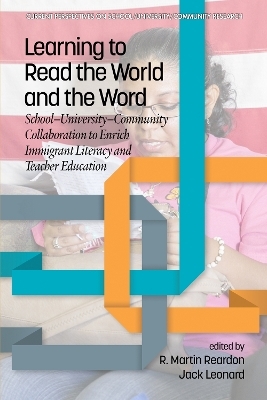
Learning to Read the World and the Word
Information Age Publishing (Verlag)
978-1-64802-536-5 (ISBN)
The perspective espoused by this volume is that collaboration among universities, schools, and communities is a crucial element in ensuring the provision of optimal learning environment for both im/migrant children and their parents. Chapter authors share their practice and theorizing regarding the many questions that arise when schools and universities collaborate with communities and build supportive structures to nurture literacy among im/migrant students. Enlightened teaching and culturally aware approaches from teachers engender support and cooperation from parents. Enlightened leadership is a constant thread through all the endeavors that are chronicled by contributors, as are the implications for socially just outcomes of successful implementation of inclusive pedagogies.
Writing about the Children Crossing Borders study which began in 2003, Tobin (2019) asserted that “the social and political upheavals surrounding migration has (sic) put increasing pressure on the ECEC [early childhood education and care] sector to build bridges between the host and newly arrived communities” (p. 2). Tobin recalled that the original grant proposal for the Children Crossing Borders described young migrant children as “the true transnationals, shuttling back and forth daily between the cultures of their home and the ECEC [programs]” (p. 1)—programs staffed by well-intentioned individuals who nevertheless may “lack awareness of im/migrant parents’ preferences for what will happen in their children’s ECEC program” (p. 2). To extrapolate from Tobin’s summary of the findings of Children Crossing Borders, for both the true transnationals (the children) and their parents, “the first and most profound engagement they have with the culture and language of their new host country” (p. 1) may well be mediated by a teacher who is unaware of the intricacies of the community.
Introduction.
Chapter 1. Learning About Immigration, Deportation, and Family Separation From Picturebooks; Sophia Sobko and Edward M. Olivos.
Chapter 2. Building a Culture of Literacy in a Community and School by Uplifting Student Voice; Eliza Braden, Christie Martin, Heidi Mills, Michele Myers, and Beth White.
Chapter 3. Middle School Student Empowerment Through The Sun Is Also a Star: An American Library Association Collaborative Grant Initiative Exploring the Immigrant Experience; Anne Katz and Vivian Bynoe.
Chapter 4. Language Acquisition and Proficiency for Immigrant Children in K-12: The Lasting Impacts in Higher Education; Kristina Flores Victor, Jacob Benitez, Wendy Martinez, and Jovanna Justo-Sanchez.
Chapter 5. We're Making a Difference—Newcomers, Refugees, and Immigrants: A School-University-Community Partnership; Cheryl A. Torrez and Marjori Krebs.
Chapter 6. Exploring Teacher Residency Candidates' Perceptions of Preparation to Support Immigrant Students in Elementary Classrooms; Clara Vaz Bauler and Emily J. S. Kang.
Chapter 7. Working Toward Biliteracy Family Night: Can Latino Families Engage in Developing Academic Events? Kim H. Song and Gregory S. Child.
Chapter 8. School Districts and Graduate Teacher Training Programs: Mutually Beneficial Partnerships? Scott Kissau, Kristin J. Davin, Michelle Stephan, and Lan Kolano.
Chapter 9. Promoting Social Justice Education Through University-School-Community Collaborations; Giselle Martinez Negrette and Bailey B. Smolarek.
Chapter 10. The Home Language in Preschool: Multilingual Strategies to Support Immigrant Families and Children in Universal Prekindergarten; Zoila Morell, Yasmin Morales-Alexander, Madeline Sanchez, and Maria Olivier-Flores.
About the Editors.
About the Contributors.
| Erscheinungsdatum | 09.05.2021 |
|---|---|
| Reihe/Serie | Current Perspectives on School/University/Community Research |
| Sprache | englisch |
| Maße | 156 x 234 mm |
| Gewicht | 546 g |
| Themenwelt | Geisteswissenschaften ► Sprach- / Literaturwissenschaft ► Sprachwissenschaft |
| Sozialwissenschaften ► Pädagogik ► Sozialpädagogik | |
| ISBN-10 | 1-64802-536-6 / 1648025366 |
| ISBN-13 | 978-1-64802-536-5 / 9781648025365 |
| Zustand | Neuware |
| Informationen gemäß Produktsicherheitsverordnung (GPSR) | |
| Haben Sie eine Frage zum Produkt? |
aus dem Bereich