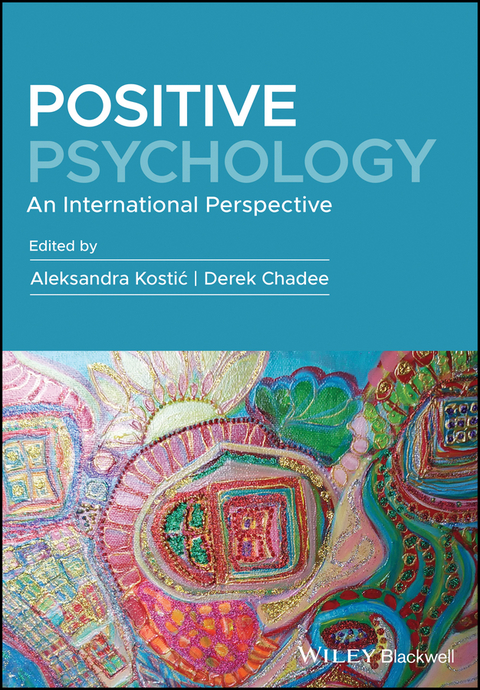
Positive Psychology (eBook)
John Wiley & Sons (Verlag)
978-1-119-66636-3 (ISBN)
Bringing together today's most prominent positive psychology researchers to discuss current themes and issues in the field
Positive psychology is the scientific study of the strengths, rather than the weaknesses, in human thoughts, feelings, and behaviors. For much of its history, psychology has focused on the negative, completely overlooking the positive attributes that allow individuals and communities to thrive. Positive Psychology is a collection of essays that together constitute a much-needed theoretical rationale and critical assessment of the field. This book assesses what we already know and provides directions for the future. Contributors are leading international authors, including Mihaly Csikszentmihalyi, Robert Sternberg, Vittorio Caprara, C. Daniel Batson, Illona Boniwell, among others. These luminaries write in a way that is rigorous enough for academic use but accessible to professionals, policymakers, and lay audiences as well.
The content of Positive Psychology include both theoretical applied contributions focusing on a range of issues including altruism, positive creativity, science of well-being, forgiveness, coaching for leadership, cyberpsychology, intelligence, responding to catastrophes like COVID-19, time persepective, physiological and epigenetic youth civic engagement, ups and downs of love, flow and good life, global perspectives on positive psychology, self and collective efficacy, positive psychology interventions and positive orientation. The book is pitched to senior undergraduates, graduates, academics and researchers and provides insights and perspectives into neglected and unsolved questions.
- Brings together the latest viewpoints and research findings on positive psychology, from the leading thinkers in the field
- Offers both theoretical and applied insights, for a well-rounded reference on this new and fast growing field
- Contains contributions from well known authors like Paul Ekman, Robert Sternberg, and Vittorio Caprara
- Appeals to academic, professional, and lay audiences with an interest in acquiring a profound knowledge of positive psychology
No other book currently on the market addresses such a breadth of issues in positive psychology.
Aleksandra Kosti? is Professor of Social Psychology at Faculty of Philosophy, Department of Psychology, University of Nis, Serbia. She teaches courses on Social Perception, Nonverbal Behavior and Psychology of Interpersonal Behavior. Her research interests include examining the accuracy of the social psychology of nonverbal behaviour, social, emotional, and perceptual judgments, especially the judgments of primary emotions from the face, emotional intensity and antecedent-events and reaction to emotion. She is particularly interested in cross-cultural study of facial expression, questions of universal antecedents of the emotions, research on deception and facial clues to deceit.
Derek Chadee is Professor of Social Psychology and Director of the ANSA McAL Psychological Research Centre at the University of the West Indies. He is a Fulbright Research Scholar and has published several books in the area of social psychology. He has a robust research agenda on the psychology of fear of crime and has published in several international journals including: Journal of Applied Social Psychology, Psychology of Popular Media Culture British Journal of Criminology, International Victimology, Media and Culture, Journal of Cross-Cultural Psychology. He has a strong interest in social psychological theories and his second edition of Theories in Social Psychology, Wiley, is forthcoming in 2021.
Aleksandra Kostic is Professor of Social Psychology at Faculty of Philosophy, Department of Psychology, University of NiS, Serbia. She teaches courses on Social Perception, Nonverbal Behavior and Psychology of Interpersonal Behavior. Her research interests include examining the accuracy of the social psychology of nonverbal behaviour, social, emotional, and perceptual judgments, especially the judgments of primary emotions from the face, emotional intensity and antecedent-events and reaction to emotion. She is particularly interested in cross-cultural study of facial expression, questions of universal antecedents of the emotions, research on deception and facial clues to deceit. Derek Chadee is Professor of Social Psychology and Director of the ANSA McAL Psychological Research Centre at the University of the West Indies. He is a Fulbright Research Scholar and has published several books in the area of social psychology. He has a robust research agenda on the psychology of fear of crime and has published in several international journals including: Journal of Applied Social Psychology, Psychology of Popular Media Culture British Journal of Criminology, International Victimology, Media and Culture, Journal of Cross-Cultural Psychology. He has a strong interest in social psychological theories and his second edition of Theories in Social Psychology, Wiley, is forthcoming in 2021.
List of Contributors ix
Acknowledgment xv
1 Embracing Psychology Positively 1
Derek Chadee and Aleksandra Kostic
2 The Empathy-Altruism Hypothesis 12
C. Daniel Batson
3 Positive Creativity 33
Robert J. Sternberg
4 Science of Well-Being: Notable Advances 43
Jessica Kansky and Ed Diener
5 Positive Psychology: Coaching Leadership Tensions 69
Ilona Boniwell and Wendy-Ann Smith
6 Positive Cyberpsychology: A Conceptual Framework 85
Jolanta Burke
7 Earth to Humans: Get with It or Get Out!: Adaptive Intelligence in the Age of Human-Induced Catastrophes 102
Robert J. Sternberg
8 Time Perspective and Good Feelings 113
Aleksandra Kostic, Derek Chadee, and Marija Pejicic
9 Physiological and Epigenetic: Implications of Positive Emotions 129
Massimo Agnoletti and Sandro Formica
10 Youth Civic Engagement: Exploring Micro and Macro Social Processes 152
Laura Wray-Lake, Burkhard Gniewosz, Celina Benavides,and Sara Wilf
11 The Ups and Downs of Love: What Makes Love Go Well, or Badly? 177
Robert J. Sternberg
12 Flow: A Component of the Good Life 193
Mihaly Csikszentmihalyi
13 Global Perspectives on Positive Psychological Science 201
Stewart I. Donaldson, Saeideh Heshmati, and Scott I. Donaldson
14 Self-Efficacy, Collective Efficacy and Positive Psychology 214
Shari Young Kuchenbecker
15 Creating and Disseminating Positive Psychology Interventions: Going Viral to Staying Vital 236
Everett L. Worthington, Jr.
16 From Serbia with Positive Orientation: The Serbian Studies 260
Vesna Petrovic, Dragan ?uljevic, and Gian Vittorio Caprara
Index 292
List of Contributors
Aleksandra Kostić is a Professor of Social Psychology at the Faculty of Philosophy, Department of Psychology at the University of Niš, Serbia. She teaches courses on Introduction to Social Psychology, Social Perception, Nonverbal Behavior, and Psychology of Interpersonal Behavior. Her research interests include nonverbal communication, emotional experience, time perspective, ethnic identity, and similarities and differences between cultures in perception of category, intensity and antecedents of emotion. She has published four books in Serbian including Facetalk: Signs and Meanings and Studies of Time Perspective in Serbia, Talk Without Words, and coedited four international books in the area of social psychology – Social Psychological Dynamics (2011); Time Perspective: Theory and Practice (2017); The Social Psychology of Nonverbal Communication (2014); and Social Intelligence and Nonverbal Communication (2020).
Derek Chadee is a Professor of Social Psychology and Director of ANSA McAL Psychological Research Centre at The University of the West Indies, St. Augustine Campus. His current research interests include the social psychology of fear of crime and general fear, antecedents of emotions, copycat behavior, and media influence on perception. He has published with the British Journal of Criminology, International Review of Victimology, Crime Media and Culture, Journal of Applied Social Psychology, Journal of Cross‐Cultural Psychology, and Psychology of Popular Media Culture. He has a strong interest in social psychological theories and his second edition of Theories in Social Psychology,Wiley, is forthcoming in 2021.
Massimo Agnoletti graduated in general and experimental psychology at the University of Padua (Italy) and received his PhD at the University of Verona (Italy) where he is a research assistant. His experience is internationally based (Massachusetts Institute of Technology, University of California, Berkeley, Massachusetts General Hospital, Osaka University, University College of London, etc.) and his main scientific focus is on flow experiences, time perspective, psychological aspects in telomeres, and vagus nerve activation.
C. Daniel Batson is an experimental social psychologist. He is currently a Professor Emeritus of Psychology at the University of Kansas. His extensive research on the empathy‐altruism hypothesis is reviewed in Altruism in Humans (2011) and A Scientific Search for Altruism (2019). He is also the author of What’s Wrong with Morality? A Social‐Psychological Perspective (2016).
Celina Benavides, is an Assistant Professor in the Child & Family Studies Department at California State University, Los Angeles. She earned a PhD in developmental psychology at Claremont Graduate University, an MA in human development and psychology at Harvard, and an MA in education and mathematics credential at Whittier College. She conducts research in two related topic areas: the educational experiences and outcomes of students of color, and the role of schools and communities in supporting the positive development of adolescents and young adults, namely through civic engagement initiatives and fostering purpose.
Ilona Boniwell is one of the European leaders in positive psychology, having founded and headed the first master’s degree in applied positive psychology (MAPP) in Europe at the University of East London. She heads the International MSc in Applied Positive Psychology (I‐MAPP) at Anglia Ruskin University, teaches positive management at l’Ecole Centrale Paris and HEC, and consults around the world as a director of Positran. She founded and was the first chair of the European Network of Positive Psychology (ENPP), organized the first European Congress of Positive Psychology in June 2002 (Winchester), and was the first vice‐chair of the International Positive Psychology Association (IPPA). She is now the vice‐president for the Francophone Association of Positive Psychology, serves on the board of directors of the International Positive Education Network (IPEN) and is a coeditor of the Applied Positive Psychology Journal. She is well‐published and author of Positive Psychology in a Nutshell (2006, 2016); coauthor of The Happiness Equation (2008), Positive Psychology: Theory, Research and Applications (2011, 2019), Well‐Being Lessons for Secondary Schools (2012); coeditor of The Oxford Handbook of Happiness (2013); and coauthor of Motivated Adolescents (2015) and PEPS: Positive Education for Parents and Schools (2018).
Jolanta Burke is a chartered psychologist (British Psychological Society) and an assistant professor at Maynooth University, Ireland, where she teaches well‐being. Prior to that, she was a master’s program leader in applied positive psychology at the University of East London, and lectured at Trinity Business School, where she developed a series of highly popular lectures about positive cyber psychology. Her latest books are The Ultimate Guide to Implementing Wellbeing Programmes for School and Positive Psychology and School Leadership: The New Science of Positive Educational Leadership. For her work on well‐being, she was acknowledged by the Irish Times as one of 30 people in Ireland who make it a better place.
Gian Vittorio Caprara is Professor Emeritus at Sapienza University of Rome where he served as chair of the Department of Psychology and dean of the Psychology Faculty. He has been president of the European Association of Personality and is a member of the Academia Europaea. He is author and coauthor of over 500 scientific publications, including several volumes, among which: Personality: Determinants, Dynamics and Potentials (with D. Cervone, 2000); Personalizing Politics and Realizing Democracy (with M. Vecchione, 2017). His research has addressed several topics across personality psychology, social psychology and political psychology.
Mihaly Csikszentmihalyi received his PhD in psychology from the University of Chicago, where he taught for 30 years and served as chair of the Department of Psychology. He is Professor Emeritus of Psychology at Claremont Graduate University, where he founded and codirected the Quality of Life Research Center (QLRC). He is the author of Beyond Boredom and Anxiety: Experiencing Flow in Work and Play (1975), Flow: The Psychology of Optimal Experience (1990), and Creativity: Flow and the Psychology of Discovery and Invention (1996). A wide range of his work was reprinted in the 2014 three‐volume set, The Collected Works of Mihaly Csikszentmihalyi.
Ed Diener is a Professor at the University of Utah and the University of Virginia, a distinguished emeritus professor at the University of Illinois, and senior scientist for the Gallup Organization. He is one of the most eminent research psychologists in the world. With over 400 publications and a citation count over 230,000, he is one of the most highly cited scientists in the world. He has been the president of three scientific societies and the editor of three scientific journals, including being a cofounder of the Journal of Happiness Studies. He was the founding president of the International Positive Psychology Association. He has received major awards in psychology including the Distinguished Scientific Achievement Awards from the American Psychological Association.
Scott I. Donaldson is a postdoctoral scholar in evaluation, statistics, and measurement at the University of California, San Diego School of Medicine, Moores Cancer Center. Scott received his PhD in psychology with a concentration in evaluation and applied research methods and a co‐concentration in positive organizational psychology from Claremont Graduate University. He received his BA in psychology from the University of California, Los Angeles, and his MS in organizational psychology from the University of Southern California. His research focuses on the design and evaluation of behavioral health interventions at work.
Stewart I. Donaldson is Dstinguished University Professor and executive director of the Claremont Evaluation Center at Claremont Graduate University. He is a cofounder of the first PhD and research‐focused master’s programs in positive psychology at Claremont Graduate University. He currently teaches, mentors, and employs numerous students specializing in positive organizational psychology, positive health and sports psychology, and evaluation science. He serves on the Council of Advisors for the International Positive Psychology Association (IPPA) and was chair of IPPA’s World Congress of Positive Psychology in Los Angeles (2013). He has published numerous articles, chapters, and books on the science of positive psychology, including his latest book Positive Psychological Science: Improving Everyday Life, Well‐Being, Work, Education, and Societies Across the Globe (2020).
Sandro Formica teaches Managing Self, Others and Positive Organizations in Hospitality at Florida International University and The Economics of Happiness in selected European universities. His book, “Personal Empowerment: Empower the Leader within You,” is highly experiential and contains over 200 self‐awareness practices and exercises. He is the academic director of the Chief Happiness Officer in the Hospitality and Services Industries certificate program,...
| Erscheint lt. Verlag | 27.4.2021 |
|---|---|
| Sprache | englisch |
| Themenwelt | Geisteswissenschaften ► Psychologie ► Sozialpsychologie |
| Schlagworte | Positive Psychologie • Psychologie • Psychology • Social Psychology • Sozialpsychologie |
| ISBN-10 | 1-119-66636-8 / 1119666368 |
| ISBN-13 | 978-1-119-66636-3 / 9781119666363 |
| Informationen gemäß Produktsicherheitsverordnung (GPSR) | |
| Haben Sie eine Frage zum Produkt? |
 EPUB (Adobe DRM)
Kopierschutz: Adobe-DRM
Adobe-DRM ist ein Kopierschutz, der das eBook vor Mißbrauch schützen soll. Dabei wird das eBook bereits beim Download auf Ihre persönliche Adobe-ID autorisiert. Lesen können Sie das eBook dann nur auf den Geräten, welche ebenfalls auf Ihre Adobe-ID registriert sind.
Details zum Adobe-DRM
Dateiformat: EPUB (Electronic Publication)
EPUB ist ein offener Standard für eBooks und eignet sich besonders zur Darstellung von Belletristik und Sachbüchern. Der Fließtext wird dynamisch an die Display- und Schriftgröße angepasst. Auch für mobile Lesegeräte ist EPUB daher gut geeignet.
Systemvoraussetzungen:
PC/Mac: Mit einem PC oder Mac können Sie dieses eBook lesen. Sie benötigen eine
eReader: Dieses eBook kann mit (fast) allen eBook-Readern gelesen werden. Mit dem amazon-Kindle ist es aber nicht kompatibel.
Smartphone/Tablet: Egal ob Apple oder Android, dieses eBook können Sie lesen. Sie benötigen eine
Geräteliste und zusätzliche Hinweise
Buying eBooks from abroad
For tax law reasons we can sell eBooks just within Germany and Switzerland. Regrettably we cannot fulfill eBook-orders from other countries.
aus dem Bereich