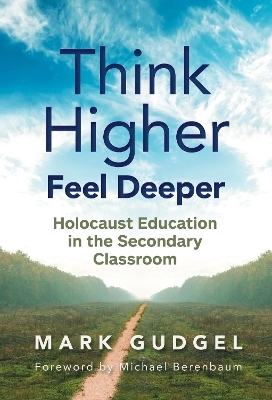
Think Higher Feel Deeper
Teachers' College Press (Verlag)
978-0-8077-6597-5 (ISBN)
Approaching the Holocaust in your classroom can be a difficult, often daunting task. This practical guide for English and social studies teachers features lessons learned from the author's 17 years of experience teaching the subject in public schools, as well as his work with the United States Holocaust Memorial Museum. Using anecdotes and empirical data, Gudgel offers advice for teaching the Holocaust in a way that is nuanced, socially responsible, and historically accurate. He provides guidance on common challenges and questions teachers will encounter, such as correcting misconceptions, using films, and discussing genocide with secondary students. While World War II grows ever more distant in the past, the lessons of the Holocaust are perhaps more relevant today than ever before. It may never be easy to teach about the Holocaust, but it can be done in ways that make it edifying and empowering, rather than causing despair. This approach is as important for educators as it is for their students.Book Features:
Uses a conversational tone with classroom examples and actionable teaching advice.
Designed to make a difficult topic more accessible for teachers at all levels of experience.
Helps teachers think about best practices through a lens of inquiry, pedagogy, and personal experience.
Focuses on what the author believes would have been most helpful when he began teaching about the Holocaust.
Mark Gudgel is an adjunct instructor in education at Nebraska Wesleyan University, a 17-year veteran of public-school education, Fulbright Scholar, and fellow of the United States Holocaust Memorial Museum.
Contents
Foreword Michael Berenbaum xi
Acknowledgments xiii
Introduction 1
1. Defining and Contextualizing the Holocaust With Young People 5
What Are We Talking About When We Talk About the Holocaust? 6
Comparing Definitions of the Holocaust 6
Defining Jews and Judaism 10
Explaining How Nazi Racial Ideology Distorted Judaism 10
Helping (Non-Jewish) Students Understand Jews and Judaism 11
Exploring Layers of History 12
2. The Paradox of Education 15
Building Weapons 16
The Einsatzgruppen 16
Nazi Doctors 18
The Wannsee Conference 20
The Nuremberg Trials 23
3. At War With Misconceptions and Misinformation 26
Misconceptions Abound 27
For Want of Heroism: Rescue Mythology 27
Nationalistic Narratives 29
The Complexity of the Camps 30
Auschwitz Comma And: Going Beyond the Popular Narratives 31
4. Gray Areas, Name Calling, and Human Complexity 34
Five Problematic Words 35
More Problematic Words 37
Oskar Schindler and Other Complicated People 37
Teaching Using Schindler’s List 39
5. Half-Truths My Teacher Told Me 44
Misconceptions, Half-Truths, Errors, and Omissions 45
How Many People Actually Died? 45
The Diary of a Young Girl 47
The Voyage of the St. Louis 50
6. Avoiding Simple Answers to Complex Questions 54
“Why Didn’t They Just Leave?” 55
“Why Didn’t They Fight Back?” 57
“America Saved the Day Again—Am I Right?” 59
“But If You Disagreed With Hitler, Wouldn’t You Get Shot?” 61
“Why the Jews?” 62
“Why Didn’t Anybody Stand Up for the Jews?” 63
“Was the Holocaust the Worst Genocide of All Time?” 65
“When Did the Holocaust End?” 65
7. “Others” 68
The Spectrum of “Others” 69
Teaching About Non-Jewish Victims of the Nazis 72
“Other” Genocides 73
8. Images, Still and Moving 79
A Thousand Words 80
What Images We Choose 80
Photo Analysis 81
Survivor Testimony 83
9. The Most Precious Resource 86
Time Constraints in Our Classes 87
The English Teacher’s Challenge 87
The History Teacher’s Challenge 89
Challenges in Other Curricular Areas 90
Planting Seeds 91
10. Go There 93
Bring a Friend 95
Plan … But Don’t Overplan 96
Working With Destinations in Advance 97
What to Do and See 97
Kids 99
Chaperones 100
Meal Planning 101
Travel Light 103
Communication 103
Funding 104
Other Considerations 106
11. Denying the Impossible 108
Holocaust Denial 109
Many Faces of the Same Hatred 109
Vetting Sources and Avoiding Debate 111
The Tenth Stage of Genocide 112
12. Humor and the Holocaust 116
Mocking the Sacred 117
Humor in Holocaust Cinema 118
Ill-Conceived Jokes 120
“It Kept Us Alive” 120
13. Teaching Brave and Free 123
Some Personal Advice 124
Establish a “Genocide-Free Zone” 124
Know Your Audience 125
From Past to Present 126
Glossary 129
References 135
Index 143
About the Author 151
| Erscheinungsdatum | 01.12.2021 |
|---|---|
| Verlagsort | New York |
| Sprache | englisch |
| Maße | 158 x 229 mm |
| Gewicht | 242 g |
| Themenwelt | Geschichte ► Allgemeine Geschichte ► 1918 bis 1945 |
| Sozialwissenschaften ► Pädagogik ► Schulpädagogik / Grundschule | |
| Sozialwissenschaften ► Pädagogik ► Schulpädagogik / Sekundarstufe I+II | |
| ISBN-10 | 0-8077-6597-X / 080776597X |
| ISBN-13 | 978-0-8077-6597-5 / 9780807765975 |
| Zustand | Neuware |
| Informationen gemäß Produktsicherheitsverordnung (GPSR) | |
| Haben Sie eine Frage zum Produkt? |
aus dem Bereich