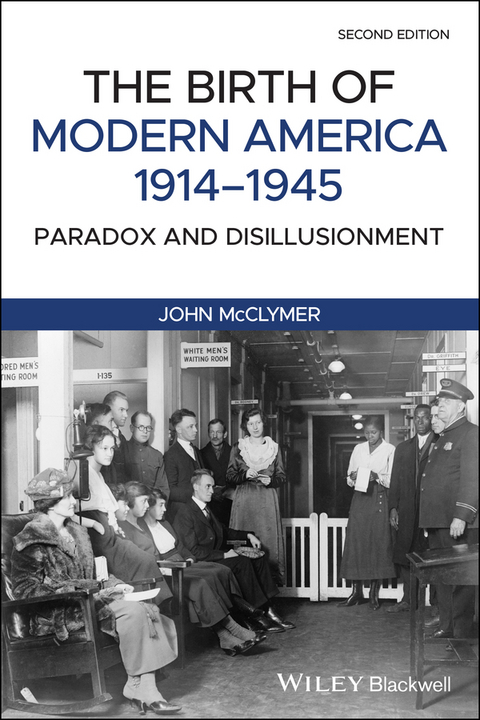
The Birth of Modern America, 1914 - 1945 (eBook)
John Wiley & Sons (Verlag)
9781119081449 (ISBN)
Provides a look at the origins of the culture wars of modern America and the political and economic transformation of the U.S. republic
This book tells, in clear and lively prose, how Americans struggled with modernity in both its cultural and economic forms between the start of World War I and the end of World War II, focusing on the 1920s through 1930s. This edition includes revisions that expand the scope and features increased coverage of topics that will be of great interest to new readers as well as those familiar with the subject.
The Birth of Modern America, 1914-1945, Second Edition begins with a discussion of the promises and perils of the progressive era. The book goes on to look at the Great War and life on the home front and explores many paradoxes that marked the birth of Modern America. Topics covered include: the pervasive racism and nativism during and after WWI; the disillusionment with Woodrow Wilson's rhetorical idealism; the emergence of national media; the Great Depression; FDR and the New Deal; the attack on Pearl Harbor; Hollywood's part during World War II; the United States' decision to drop 'the bomb' on Japan; and more.
- Makes a strong contribution to understanding American society in the interwar years (1920s and 1930s)
- Disputes that American entry into WWII brought the New Deal to an end and argues that wartime measures foreshadowed postwar American practice
- Features more coverage of politics in the 1920s and 1930s
- Includes an Afterword covering the G.I. bill, postwar prosperity, Americans' move to the suburbs, the challenges to peace in Europe and Asia, and the Cold War
The Birth of Modern America, 1914-1945 is an excellent book for undergraduate courses on the 20th Century and advanced placement courses. It will benefit all students and scholars of the Progressive Era, the Depression, 1920s and 1930s America, and America between the Wars.
John McClymer, PhD, is a retired Professor of History at Assumption College (now Assumption University). He is the author of seven books, including The AHA Guide to Teaching and Learning with New Media and Mississippi Freedom Summer. He served as an editor for online projects for The Journal of the Gilded Age and Progressive Era, as a co-editor of H-ETHNIC, and as a member of H-NET's Teaching Committee. Professor McClymer is the recipient of numerous fellowships and grants, including an NEH Curriculum Development grant and two Teaching American History grants in partnership with Worcester Public Schools, the American Antiquarian Society, and Old Sturbridge Village.
About the Author
Introduction
Acknowledgement
Chapter One: The Second Ku Klux Klan
Chapter Two: The Declension of Evangelical Protestantism: The Scopes Trial, Fundamentalism, and Pentecostalism
Chapter Three: What Sadie Knew: The Immigrant Working Girl and the Rise of a Demotic Culture
Chapter Four: The "Seven Lively Arts" Revisited: The Demotic Impulse in Popular Culture
Chapter Five: Passing From Light Into Dark
Chapter Six: Revues and Other Vanities: The Commodification of Fantasy in the 1920s
Chapter Seven: The Great Depression and the New Deal
Chapter Eight: WWII
Epilogue
CHAPTER ONE
The Second Ku Klux Klan
KKK march on Washington, D.C., August 8, 1925 – an estimated 30,000 Klansmen marched down Pennsylvania Avenue.
Source: Bettmann/Getty Images.
Though men and women drop from the ranks they remain with us in purpose, and can be depended on fully in any crisis. Also, there are millions who have never joined, but who think and feel and – when called on – fight with us. This is our real strength, and no one who ignores it can hope to understand America today. — Hiram Wesley Evans, “The Klan’s Fight for Americanism,” North American Review
(March‐April‐May 1926)
How seriously are we to take Evans’ claim? Did the Klan, of which he was the “Imperial Wizard and emperor,” speak not only for the millions who joined but for millions more? Was he right to boast that no one who hopes to understand America in the 1920s can succeed without first coming to grips with the views – and the feelings – of Klan members and sympathizers? Some historians have taken the Klan very seriously. They agree that, while it was in Evans’ interest to claim the greatest possible influence for his organization, he was clearly right to argue that its adherents and sympathizers numbered in the millions. Linda Gordon’s The Second Coming of the KKK: The Ku Klux Klan of the 1920s and the American Political Tradition (2017) makes the case in compelling fashion.
How seriously are we to take Evans’ essay as a statement of Klan views? Historian Loren Baritz noted in 1970 in his The Culture of the Twenties that “The Klan’s Fight for Americanism” was “the best statement of the Klan’s credo that has ever been written.” He also pointed out that the North American Review’s readership was likely to be skeptical of any claims Evans might make. This led Baritz to caution readers that the Imperial Wizard might well have downplayed certain aspects of Klan belief and practice even as he may have overstated its strength. Further, Evans knew that the editors of the Review had invited several noted critics of the Ku Klux Klan (KKK), including W.E.B. DuBois, the founding director of the National Association for the Advancement of Colored People (NAACP), to contribute articles for the subsequent issue. He thus sought to anticipate what these critics might say. This may account for his willingness to admit that, in its early days, Klan leaders “began to ‘sell hate at $10 a package.’” “Hate” and the “invisible government ideas,” i.e., the Klan’s vigilante activities, “were what gave the Klan its first great growth, enlisted some 100,000 members, provided wealth for a few leaders, and brought down upon it a reputation from which it has not yet recovered.” That the KKK survived its beginnings, according to Evans, “is nothing less than a miracle,” explicable only as “one of those mysterious interventions in human affairs which are called Providence.”
Evans would have hardly made such an admission in an official Klan publication, although claims that Providence watched over the KKK were common in that literature. Nonetheless, “The Klan’s Fight for Americanism” makes no apologies for its members’ attempts to impose their views upon “liberals,” immigrants, Catholics, Jews, or peoples of color. Instead it sounds a clarion call for the Klan’s “progressive conservatism” and celebrates its influence in American public life. Still, the question remains: How seriously should we take the Klan’s “credo” as a guide to its appeal? As Robert O. Paxton pointed out in “The Five Stages of Fascism” in the Journal of Modern History (1998):
Although one can deduce from fascist language implicit Social Darwinist assumptions about human nature, the need for community and authority in human society, and the destiny of nations in history, fascism does not base its claims to validity upon their truth. Fascists despise thought and reason, abandon intellectual positions casually, and cast aside many intellectual fellow‐travelers. They subordinate thought and reason not to Faith, as did the traditional Right, but to the promptings of the blood and the historic destiny of the group. Their only moral yardstick is the prowess of the race, of the nation, of the community. They claim legitimacy by no universal standard except a Darwinian triumph of the strongest community.
An American Fascism?
Is it appropriate to label the Klan of the 1920s “fascist”? Surely it is one of the most overused terms in contemporary discourse. Yet, Paxton points to the first Klan as “the earliest phenomenon that seems functionally related to fascism.” “In its adoption of a uniform (white robe and hood), as well as its techniques of intimidation and its conviction that violence was justified in the cause of the group’s destiny, the first version of the Klan…was a remarkable preview of the way fascist movements were to function in interwar Europe.” Nancy MacLean, in Beyond the Mask of Chivalry: The Making of the Second Ku Klux Klan (1994), makes a similar argument: “Not only in its world view, but also in its dynamics as a social movement, the [second] Klan had much in common with German National Socialism and Italian Fascism.” Klan leaders of the 1920s and 1930s acknowledged this kinship themselves, she points out.
Gordon seeks a nuanced understanding of the Klan’s similarities and differences with interwar fascist movements in Italy and Germany. “Applying that label to the 1920s Ku Klux Klan would be unproductive,” but, “noting the overlap between the KKK and various avatars of fascism can, however, be productive.” She sees the Klan as one of a family of “right wing populisms” that flourished after World War I (WWI). One distinguishing trait, she points out, is the KKK’s commitment to electoral politics. It never plotted anything like Mussolini’s March on Rome. Instead, the Klan supported candidates for local and state office, contests in which it enjoyed some success in such places as Indiana, Oregon, and Maine. Also, the Klan forged close ties with evangelical Protestant churches. This link with religion emphatically did not characterize fascist parties in Europe with the notable exception of Franco’s Spain. On the other hand, the KKK demonized the same groups and social movements as its fascist counterparts. It employed the same sorts of demagogic rhetoric. It shared a fundamental opposition to expertise and a visceral contempt for “elites.”1
Gordon’s points are well taken, but creating a family of right‐wing populisms in place of a diverse set of fascisms strikes me as positing a distinction without a difference. So I will follow Paxton’s example and seek to place the Klan within the five stages of fascist development he describes. It is the first two – “the initial creation” and “their rooting as parties in a political system” – that relate to the KKK. The Klan never advanced beyond the second stage and reached that only partially.
“First‐stage fascism,” Paxton notes, “is the domain of the intellectual historian, for the process to be studied here is the emergence of new ways of looking at the world and diagnosing its ills.” Further, he argues, “comparison is of little help to us at this first stage, for all modern states have had proto‐fascist movements and publicists since the 1914–1918 war.” The very ubiquity of these movements suggests “that we can hardly attribute their origin to any one particular national intellectual history.” Instead, Paxton holds, fascist movements emerged everywhere where democracy was sufficiently implanted for disillusionment with it to emerge. Where national peculiarities do come into play is in how fascist intellectuals and spokespeople drew upon particular national traditions to articulate their message.
That message relied upon what Paxton called “mobilizing passions”:
Feelings propel fascism more than thought does. We might call them mobilizing passions, since they function in fascist movements to recruit followers and in fascist regimes to “weld” the fascist “tribe” to its leader. The following mobilizing passions are present in fascisms, though they may sometimes be articulated only implicitly.
- The primacy of the group, toward which one has duties superior to every right, whether universal or individual.
- The belief that one’s group is a victim, a sentiment which justifies any action against the group’s enemies, internal as well as external.
- Dread of the group’s decadence under the corrosive effect of individualistic and cosmopolitan liberalism.
- Closer integration of the community within a brotherhood (fascio) whose unity and purity are forged by common conviction, if possible, or by exclusionary violence, if necessary.
- An enhanced sense of identity and belonging, in which the grandeur of the group reinforces individual self‐esteem.
- Authority of natural leaders (always male) throughout society, culminating in a national chieftain who alone is capable of incarnating the group’s destiny.
- The beauty of...
| Erscheint lt. Verlag | 26.4.2021 |
|---|---|
| Sprache | englisch |
| Themenwelt | Geschichte ► Allgemeine Geschichte ► Neuzeit (bis 1918) |
| Geisteswissenschaften ► Geschichte ► Regional- / Ländergeschichte | |
| Schlagworte | 1920s America • 1930s America • 20th Century America • America • American Culture • American History • American modernity • American Social & Cultural History • Amerika • Amerika im 20. Jahrhundert • FDR • Geschichte • Geschichte der USA • Great Depression • History • history text • modern america • New Deal • Progressive Era • Sozial- u. Kulturgeschichte Amerikas • us history • Woodrow Wilson • World War • World War I • World War II |
| ISBN-13 | 9781119081449 / 9781119081449 |
| Informationen gemäß Produktsicherheitsverordnung (GPSR) | |
| Haben Sie eine Frage zum Produkt? |
 EPUB (Adobe DRM)
Kopierschutz: Adobe-DRM
Adobe-DRM ist ein Kopierschutz, der das eBook vor Mißbrauch schützen soll. Dabei wird das eBook bereits beim Download auf Ihre persönliche Adobe-ID autorisiert. Lesen können Sie das eBook dann nur auf den Geräten, welche ebenfalls auf Ihre Adobe-ID registriert sind.
Details zum Adobe-DRM
Dateiformat: EPUB (Electronic Publication)
EPUB ist ein offener Standard für eBooks und eignet sich besonders zur Darstellung von Belletristik und Sachbüchern. Der Fließtext wird dynamisch an die Display- und Schriftgröße angepasst. Auch für mobile Lesegeräte ist EPUB daher gut geeignet.
Systemvoraussetzungen:
PC/Mac: Mit einem PC oder Mac können Sie dieses eBook lesen. Sie benötigen eine
eReader: Dieses eBook kann mit (fast) allen eBook-Readern gelesen werden. Mit dem amazon-Kindle ist es aber nicht kompatibel.
Smartphone/Tablet: Egal ob Apple oder Android, dieses eBook können Sie lesen. Sie benötigen eine
Geräteliste und zusätzliche Hinweise
Buying eBooks from abroad
For tax law reasons we can sell eBooks just within Germany and Switzerland. Regrettably we cannot fulfill eBook-orders from other countries.
aus dem Bereich