


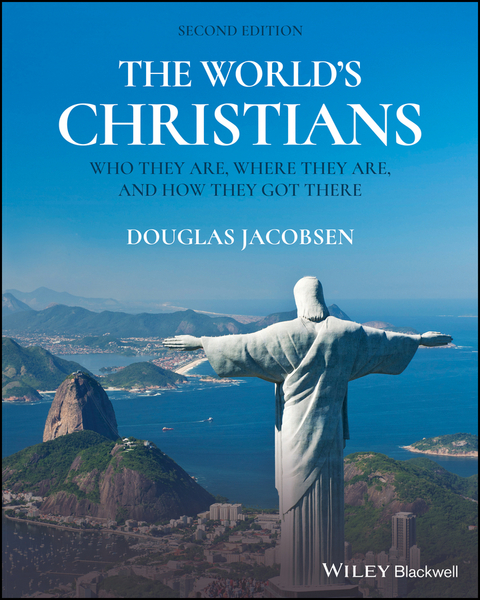
The World's Christians (eBook)
John Wiley & Sons (Verlag)
978-1-119-62612-1 (ISBN)
This accessible textbook describes Christianity, the world's largest religion, in all of its historical and contemporary diversity. No other publication includes so much information or presents it so clearly and winsomely. This volume employs a 'religious studies' approach that is neutral in tone yet accommodates the lived experiences of Christians in different traditions and from all regions of the globe. The World's Christians is a perfect textbook for either public university classrooms or liberal arts campuses.
Divided into three parts, the text first describes the world's four largest Christian traditions (Eastern Orthodox, Roman Catholic, Protestant, and Pentecostal) which together account for roughly 98 percent of all Christians worldwide. A second section focuses on Christian history, explaining the movement's developing ideas and practices and examining Christianity's engagement with people and cultures around the world. The third and longest portion of the text details the distinctive experiences, contemporary challenges, and demographics of Christians in nine geographic regions, including the Middle East, Sub-Saharan Africa, Latin America, Eastern and Western Europe, South Asia, North America, East Asia, and Oceania.
The second edition of this popular text has been thoroughly rewritten to take recent developments into account, and each chapter now includes two primary source readings, highlighting the diversity of voices that exist within the world Christian movement. Like the first edition, the revised text is enhanced with easily understandable maps, charts, tables and illustrative photographs. In summary, this new and improved second edition of The World's Christians is:
DOUGLAS JACOBSEN (Ph.D., UNIVERSITY OF CHICAGO) is Co-Director of the Religion in the Academy Project and Distinguished Professor of Church History and Theology at Messiah University (Pennsylvania, USA). He is the award-winning author of a dozen books on a wide range of topics related to religion.
Introduction
Part I: Who They Are - Four Christian Mega-Traditions
Introduction
1 The Orthodox Tradition
2 The Catholic Tradition
3 The Protestant Tradition
4 The Pentecostal Tradition
Part II: How They Got There - A Global History of Christianity
Introduction
5 The Ancient Tradition: Beginnings to 500
6 The Great Division and the Age of the East: 500 to 1000
7 The Rise of the West and Decline of the East: 1000 to 1500
8 Christianity in a Global Era: 1500 to the Present
Part III: Where They Are - Christianity in Nine World Regions
Introduction
9 The Middle East and North Africa: Barely Surviving
10 Eastern Europe: Nationalism and New Mission
11 Central and South Asia: Confidence and Complexity
12 Western Europe: Thin, but Alive
13 Sub-Saharan Africa: Hope and Despair
14 East Asia: Piety and Politics
15 Latin America: After Monopoly
16 North America: Power, Freedom, Race, and Nation
17 Oceania: Experiments in Identity
Appendix: Counting Christians
List of Illustrations
Figures
| Figure 1.1 | Number of Orthodox Christians living in each region of the world |
| Figure 1.2 | Holy Trinity Orthodox Cathedral (Sibiu, Romania), interior of main dome |
| Figure 1.3 | Holy Trinity Orthodox Cathedral (Sibiu, Romania), nave and iconostasis |
| Figure 1.4 | Interior of small Orthodox church (Kalopanagiotis, Cyprus) |
| Figure 1.5 | Key events in Orthodox history |
| Figure 2.1 | Number of Catholic Christians living in each region of the world |
| Figure 2.2 | Statues of the Infant of Prague (the baby Jesus) for sale at shop near the Church of Our Lady Victorious in Prague (Czech Republic) |
| Figure 2.3 | Interior of the Catholic Cathedral of Our Lady of the Angels (Los Angeles, California) |
| Figure 2.4 | St. Peter’s Basilica in the Vatican |
| Figure 2.5 | The Gero Cross, the oldest known crucifix made in Western Europe north of the Alps |
| Figure 2.6 | Timeline showing key events in Catholic history |
| Figure 3.1 | Number of Protestant Christians living in each region of the world |
| Figure 3.2 | Interior of Reformed Church (Sibiu, Romania) illustrating the architectural centrality of the pulpit |
| Figure 3.3 | The Evangelical Lutheran Cathedral (Helsinki, Finland) |
| Figure 3.4 | God’s Missionary Church (Camp Hill, Pennsylvania) |
| Figure 3.5 | Key events in Protestant history |
| Figure 4.1 | Number of Pentecostal Christians living in each region of the world |
| Figure 4.2 | Aimee Semple McPherson |
| Figure 4.3 | Diagram illustrating sociological structure of the Pentecostal movement |
| Figure 4.4 | The Holy Spirit Church of East Africa (Bukoyani, Kenya) |
| Figure 4.5 | International Church of the Grace of God (Buenos Aires, Argentina) |
| Figure 5.1 | Timeline for ancient Christianity, beginnings to 500 |
| Figure 5.2 | Sketch of structure of a Roman basilica and interior of Santa Maria Maggiore Church (Rome) |
| Figure 5.3 | Two portrayals of Jesus in early Christian art |
| Figure 5.4 | Roman Empire at peak size |
| Figure 5.5 | Timeline of major events for Christianity in the Roman Empire |
| Figure 5.6 | Icon of the martyrdom of Perpetua, Felicitas, and others |
| Figure 5.7 | Church built around Symeon’s pillar |
| Figure 5.8 | Map of Sasanian Empire, c. 250 |
| Figure 5.9 | Church of the Holy Mother of God, a seventh‐century building located in Ashtarak, Armenia |
| Figure 6.1 | The Great Division |
| Figure 6.2 | Map showing the primary geographic locations of the four Christian mega‐traditions that existed in the years 500 to 1000 |
| Figure 6.3 | Chapel of São Frutuoso (Braga, Portugal), a Visigoth church built in the 600s |
| Figure 6.4 | Byzantine and Arab Empires, c. 800 |
| Figure 6.5 | Timeline of the Orthodox Church in the Byzantine Empire, c. 500–1000 |
| Figure 6.6 | Timeline for the Church of the East, c. 500–1000 |
| Figure 6.7 | Da Qin Pagoda (Pagoda of the West), an eighth‐century Christian monastery located about 50 miles southwest of Xian (formerly Chang’an), China |
| Figure 6.8 | Mugao Caves Monastery (Dunhuang, China) |
| Figure 6.9 | Charlemagne’s domain |
| Figure 6.10 | Baptism of Boris I, illustration from a fourteenth‐century chronicle by Constantine Manasses |
| Figure 7.1 | Timeline of general councils of the Catholic Church held during this time period (1000–1500) |
| Figure 7.2 | Fresco in Orvieto Cathedral (Italy) that illustrates the doctrine of transubstantiation |
| Figure 7.3 | Fresco by Domenico di Michelino (1417–91) portraying the Italian author Dante with the seven‐story mountain of purgatory made famous in his trilogy The Divine Comedy |
| Figure 7.4 | Map showing spread of Black Death, 1347–50 |
| Figure 7.5 | Church of St. George (Lalibela, Ethiopia) |
| Figure 7.6 | Timeline of medieval Christian crusades against religious others |
| Figure 7.7 | Map showing advance of the reconquista in Spain, c. 800–1492 |
| Figure 7.8 | Aerial and interior photographs of Mezquita Cathedral (Cordoba, Spain) |
| Figure 7.9 | Latin Empire in former Byzantine territory, 1204–61 |
| Figure 7.10 | Queen Sorkaktani‐beki with her husband Tolui |
| Figure 7.11 | Timeline of Christian decline in Persia and Central Asia |
| Figure 8.1 | Dirk Willems rescuing his pursuer |
| Figure 8.2 | William J. Seymour with other leaders of the Azusa Street revival |
| Figure 8.3 | Chiesa di Sant’Ignazio di Loyola in Campo Marzio, a Baroque style Catholic church in Rome built in the early 1600s |
| Figure 8.4 | Diagram displaying the race‐based hierarchy of social and spiritual status that existed in colonial Latin American society |
| Figure 8.5 | João I, the first Christian king of the Congo, who ruled from 1470 to 1509 |
| Figure 8.6 | Timeline of some of the religious wars resulting from the Protestant Revolution and of three significant peace agreements |
| Figure 8.7 | Global map of the Cold War, c. 1980 |
| Figure 8.8 | Changing demographics of the world Christian movement from 1900 to 2050 |
| Figure III.1 | Nine cultural‐geographic mega‐regions of the world |
| Figure III.2 | Where the world’s Christians live |
| Figure 9.1 | The Middle East and North Africa: global location and population information |
| Figure 9.2 | Regional map of the Middle East and North Africa |
| Figure 9.3 | Map showing overlap of Muslim, Arab, and formerly Ottoman territory in the Middle East and North Africa |
| Figure 9.4 | Map showing nineteenth‐ and twentieth‐century European colonization of the Middle East and North Africa |
| Figure 9.5 | Christian profile of the Middle East and North Africa |
| Figure 9.6 | Icon of the Christian martyrs killed on a beach in Libya in 2015 portrayed as saints |
| Figure 9.7 | Coptic Pope Tawadros II appearing in church with Egyptian President al‐Sisi in January 2018 |
| Figure 9.8 | Survivors of the Armenian genocide pose with a pyramid of skulls of those who died |
| Figure 10.1 | Eastern Europe: global location and population information |
| Figure... |
| Erscheint lt. Verlag | 21.4.2021 |
|---|---|
| Sprache | englisch |
| Themenwelt | Geschichte ► Teilgebiete der Geschichte ► Religionsgeschichte |
| Religion / Theologie ► Christentum ► Kirchengeschichte | |
| Schlagworte | Africa • Asia • Catholic • Christentum • Christian diversity • Christian History • Christianity • Christian Mission • Christian traditions • Eastern Europe • Global Christianity • Globalization • History of Christianity • indigenization • Introduction to Christianity • Latin America • North America • Orthodox • pentecostal • Protestant • Religion • Religion & Theology • Religion u. Theologie • religious demographics • Religious Studies • Textbook • Western Europe • World Christianity • World religions |
| ISBN-10 | 1-119-62612-9 / 1119626129 |
| ISBN-13 | 978-1-119-62612-1 / 9781119626121 |
| Informationen gemäß Produktsicherheitsverordnung (GPSR) | |
| Haben Sie eine Frage zum Produkt? |
 EPUB (Adobe DRM)
Kopierschutz: Adobe-DRM
Adobe-DRM ist ein Kopierschutz, der das eBook vor Mißbrauch schützen soll. Dabei wird das eBook bereits beim Download auf Ihre persönliche Adobe-ID autorisiert. Lesen können Sie das eBook dann nur auf den Geräten, welche ebenfalls auf Ihre Adobe-ID registriert sind.
Details zum Adobe-DRM
Dateiformat: EPUB (Electronic Publication)
EPUB ist ein offener Standard für eBooks und eignet sich besonders zur Darstellung von Belletristik und Sachbüchern. Der Fließtext wird dynamisch an die Display- und Schriftgröße angepasst. Auch für mobile Lesegeräte ist EPUB daher gut geeignet.
Systemvoraussetzungen:
PC/Mac: Mit einem PC oder Mac können Sie dieses eBook lesen. Sie benötigen eine
eReader: Dieses eBook kann mit (fast) allen eBook-Readern gelesen werden. Mit dem amazon-Kindle ist es aber nicht kompatibel.
Smartphone/Tablet: Egal ob Apple oder Android, dieses eBook können Sie lesen. Sie benötigen eine
Geräteliste und zusätzliche Hinweise
Buying eBooks from abroad
For tax law reasons we can sell eBooks just within Germany and Switzerland. Regrettably we cannot fulfill eBook-orders from other countries.


