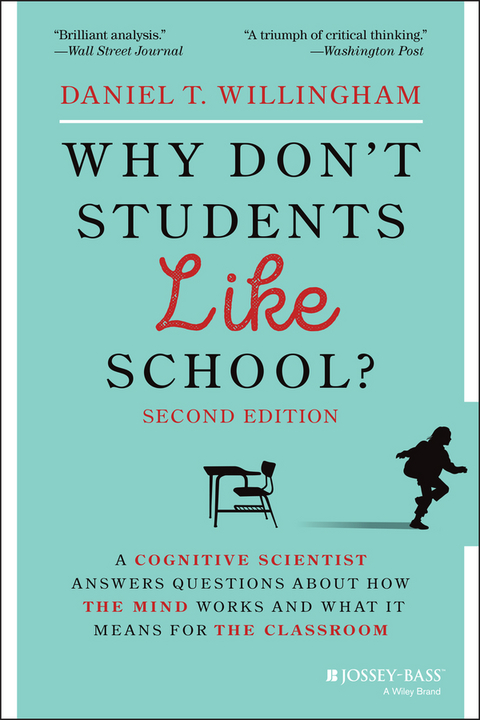
Why Don't Students Like School? (eBook)
John Wiley & Sons (Verlag)
978-1-119-71580-1 (ISBN)
Research-based insights and practical advice about effective learning strategies
In this new edition of the highly regarded Why Don't Students Like School? cognitive psychologist Daniel Willingham turns his research on the biological and cognitive basis of learning into workable teaching techniques. This book will help you improve your teaching practice by explaining how you and your students think and learn. It reveals the importance of story, emotion, memory, context, and routine in building knowledge and creating lasting learning experiences.
With a treasure trove of updated material, this edition draws its themes from the most frequently asked questions in Willingham's 'Ask the Cognitive Scientist' column in the American Educator. How can you teach students the skills they need when standardized testing just requires facts? Why do students remember everything on TV, but forget everything you say? How can you adjust your teaching for different learning styles? Read this book for the answers to these questions and for practical advice on helping your learners learn better.
Discover easy-to-understand, evidence-based principles with clear applications for the classroom
- Update yourself on the latest cognitive science research and new, teacher-tested pedagogical tools
- Learn about Willingham's surprising findings, such as that you cannot develop 'thinking skills' without facts
- Understand the brain's workings to help you hone your teaching skills
Why Students Don't Like School is a valuable resource for both veteran and novice teachers, teachers-in-training, and for the principals, administrators, and staff development professionals who work with them.
Research-based insights and practical advice about effective learning strategies In this new edition of the highly regarded Why Don't Students Like School? cognitive psychologist Daniel Willingham turns his research on the biological and cognitive basis of learning into workable teaching techniques. This book will help you improve your teaching practice by explaining how you and your students think and learn. It reveals the importance of story, emotion, memory, context, and routine in building knowledge and creating lasting learning experiences. With a treasure trove of updated material, this edition draws its themes from the most frequently asked questions in Willingham s Ask the Cognitive Scientist column in the American Educator. How can you teach students the skills they need when standardized testing just requires facts? Why do students remember everything on TV, but forget everything you say? How can you adjust your teaching for different learning styles? Read this book for the answers to these questions and for practical advice on helping your learners learn better. Discover easy-to-understand, evidence-based principles with clear applications for the classroom Update yourself on the latest cognitive science research and new, teacher-tested pedagogical tools Learn about Willingham s surprising findings, such as that you cannot develop thinking skills without facts Understand the brain s workings to help you hone your teaching skills Why Students Don t Like School is a valuable resource for both veteran and novice teachers, teachers-in-training, and for the principals, administrators, and staff development professionals who work with them.
DANIEL T. WILLINGHAM is Professor of Psychology at the University of Virginia. He is the author of several educational books, the columnist for "Ask the Cognitive Scientist" for American Educator, and a fellow of the American Psychological Association. He was appointed in 2017 by President Obama to serve as a Member of the National Board for Education Sciences.
Acknowledgments to the First Edition xi
Acknowledgments to the Second Edition xiii
The Author xv
Introduction xvii
Chapter 1 Why Don't Students Like School? 1
Chapter 2 How Can I Teach Students the Skills They Need When Standardized Tests Require Only Facts? 25
Chapter 3 Why Do Students Remember Everything That's on Television and Forget Everything I Say? 57
Chapter 4 Why Is It So Hard for Students to Understand Abstract Ideas? 95
Chapter 5 Is Drilling Worth It? 119
Chapter 6 What's the Secret to Getting Students to Think Like Real Scientists, Mathematicians, and Historians? 143
Chapter 7 How Should I Adjust My Teaching for Different Types of Learners? 167
Chapter 8 How Can I Help Slow Learners? 191
Chapter 9 How Can I Know Whether New Technology Will Improve Student Learning? 217
Chapter 10 What About My Mind? 251
Conclusion 273
Glossary 281
Notes 285
Index 291
1
Why Don't Students Like School?
Question: Most of the teachers I know entered the profession because they loved school as children. They want to help their students feel the same excitement and passion for learning that they felt.
They are understandably dejected when they find that some of their pupils don't like school much, and that they, the teachers, have trouble inspiring them. Why is it difficult to make school enjoyable for students?
Answer: Contrary to popular belief, the brain is not designed for thinking. It's designed to save you from having to think, because the brain is actually not very good at thinking. Thinking is slow and unreliable. Nevertheless, people enjoy mental work if it is successful. People like to solve problems but not to work on unsolvable problems. If schoolwork is always just a bit too difficult (or too easy) for a student, it should be no surprise that she doesn't like school much. The cognitive principle that guides this chapter is:
People are naturally curious, but we are not naturally good thinkers; unless the cognitive conditions are right, we will avoid thinking.
The implication of this principle is that teachers should reconsider how they encourage their students to think, in order to maximize the likelihood that students will get the pleasurable rush that comes from successful thought.
The Mind Is Not Designed for Thinking
What is the essence of being human? What sets us apart from other species? Many people would answer that it is our ability to reason – birds fly, fish swim, and humans think. (By thinking I mean solving problems, reasoning, reading something complex, or doing any mental work that requires some effort.) Shakespeare extolled our cognitive ability in Hamlet: “What a piece of work is man! How noble in reason!” Some three hundred years later Henry Ford more cynically observed, “Thinking is the hardest work there is, which is the probable reason why so few people engage in it”* (Figure 1.1).
FIGURE 1.1: Kanye West is one the most successful and respected songwriters and performers, as well as a highly successful businessman. But he has said, “I actually don't like thinking. I think people think I like to think a lot. And I don't. I do not like to think at all.”1
Source: © Getty Images/Brad Barket.
Both Shakespeare and Ford had a point. Humans are good at certain types of reasoning, particularly in comparison to other animals, but we exercise those abilities infrequently. A cognitive scientist would add another observation: Humans don't think very often because our brains are designed not for thought but for the avoidance of thought.
Your brain has many capabilities, and thinking is not the one it does best. Your brain also supports the ability to see and to move, for example, and these functions operate much more efficiently and reliably than your ability to think. It's no accident that most of your brain's real estate is devoted to these activities. The extra brain power is needed because seeing is actually more difficult than playing chess or solving calculus problems.
You can appreciate the power of your visual system by comparing human abilities to those of computers. When it comes to math, science, and other traditional “thinking” tasks, machines beat people, no contest. Calculators that can perform simple calculations faster and more accurately than any human have been cheaply available for 40 years. With $50 you can buy chess software that can defeat more than 99% of the world's population. But we're still struggling to get a computer to drive a truck as well as a human. That's because computers can't see, especially not in complex, ever-changing environments like the one you face every time you drive. And in fact, the self-driving vehicles in development typically use radar, lasers, and other sensors to supplement information from visible light.
Robots are similarly limited in how they move. Humans are excellent at configuring our bodies for tasks, even if the configuration is unusual, such as when you twist your torso and contort your arm in an effort to dust behind books on a shelf. Robots are not very good at figuring out novel ways to move and are most useful in repetitive work such as spray painting automotive parts or moving pallets or boxes at an Amazon fulfillment center – jobs in which the objects to be grasped and the locations to move them are predictable. Tasks that you take for granted – for example, walking on a rocky shore where the footing is uncertain – are much more difficult than playing top-level chess (Figure 1.2).
FIGURE 1.2: Hollywood robots (left), like humans, can move in complex environments, but that's true only in the movies. Most real-life robots (right) move in predictable environments. Our ability to see and move is a remarkable cognitive feat.
Source: Hollywood robots © Getty Images/Koichi Kamoshida; factory robots © Getty Images/Christopher Furlong.
Compared to your ability to see and move, thinking is slow, effortful, and uncertain. To get a feel for why I say this, try solving this problem:
In an empty room are a candle, some matches, and a box of tacks. The goal is to have the lit candle about 5 ft off the ground. You've tried melting some of the wax on the bottom of the candle and sticking it to the wall, but that wasn't effective. How can you get the lit candle 5 ft off the ground without having to hold it there?2
Twenty minutes is the usual maximum time allowed, and few people are able to solve it by then, although once you hear the answer you will realize it's not especially tricky. You dump the tacks out of the box, tack the box to the wall, and use it as a platform for the candle.
This problem illustrates three properties of thinking. First, thinking is slow. Your visual system instantly takes in a complex scene. When you enter a friend's backyard you don't think to yourself, “Hmmm, there's some green stuff. Probably grass, but it could be some other ground cover – and what's that rough brown object sticking up there? A fence, perhaps?” You take in the whole scene – lawn, fence, flowerbeds, gazebo – at a glance. Your thinking system does not instantly calculate the answer to a problem the way your visual system immediately takes in a visual scene. Second, thinking is effortful; you don't have to try to see, but thinking takes concentration. You can perform other tasks while you are seeing, but you can't think about something else while you are working on a problem. Finally, thinking is uncertain. Your visual system seldom makes mistakes, and when it does you usually think you see something similar to what is actually out there – you're close, if not exactly right. Your thinking system might not even get you close. In fact, your thinking system may not produce an answer at all, which is what happens to most people when they try to solve the candle problem.
If we're all so bad at thinking, how does anyone get through the day? How do we find our way to work or spot a bargain at the grocery store? How does a teacher make the hundreds of decisions necessary to get through her day? The answer is that when we can get away with it, we don't think. Instead we rely on memory. Most of the problems we face are ones we've solved before, so we just do what we've done in the past. For example, suppose that next week a friend gives you the candle problem. You would immediately say, “Oh, right. I've heard this one. You tack the box to the wall.” Just as your visual system takes in a scene and, without any effort on your part, tells you what is in the environment, so too your memory system immediately and effortlessly recognizes that you've heard the problem before and provides the answer. You may think you have a terrible memory, and it's true that your memory system is not as reliable as your visual or movement system – sometimes you forget, sometimes you think you remember when you don't – but your memory system is much more reliable than your thinking system, and it provides answers quickly and with little effort.
We normally think of memory as storing personal events (memories of my wedding) and facts (the seat of the Coptic Orthodox Church is in Egypt). Our memory also stores strategies to guide what we should do: where to turn when driving home, how to handle a minor dispute when monitoring recess, what to do when a pot on the stove starts to boil over (Figure 1.3). For the vast majority of decisions we make, we don't stop to consider what we might do, reason about it, anticipate possible consequences, and so on. For example, when I decide to make spaghetti for dinner, I don't scour the Internet for recipes, weighing each for taste, nutritional value, ease of preparation, cost of ingredients, visual appeal, and so on – I just make spaghetti sauce the way I usually do. As two psychologists put it, “Most of the time what we do is what we do most of the time.”3 When you feel as though you are “on autopilot,” even if you're doing something rather complex, such as driving home from school, it's because you are using memory to guide your behavior. Using...
| Erscheint lt. Verlag | 13.4.2021 |
|---|---|
| Sprache | englisch |
| Themenwelt | Geisteswissenschaften ► Psychologie ► Pädagogische Psychologie |
| Sozialwissenschaften ► Pädagogik ► Bildungstheorie | |
| Schlagworte | Bildungswesen • classroom techniques • cognitive science • critical thinking • Education • Evidence-based pedagogy • K-12 • k-12 educators • K-12 / Lehren u. Lernen • Learning theory • pedagogical techniques • Pedagogy • Standardized testing • teacher resource • Teaching & Learning (K-12) • teaching tips • teaching tools • teach problem solving |
| ISBN-10 | 1-119-71580-6 / 1119715806 |
| ISBN-13 | 978-1-119-71580-1 / 9781119715801 |
| Informationen gemäß Produktsicherheitsverordnung (GPSR) | |
| Haben Sie eine Frage zum Produkt? |
 EPUB (Adobe DRM)
Kopierschutz: Adobe-DRM
Adobe-DRM ist ein Kopierschutz, der das eBook vor Mißbrauch schützen soll. Dabei wird das eBook bereits beim Download auf Ihre persönliche Adobe-ID autorisiert. Lesen können Sie das eBook dann nur auf den Geräten, welche ebenfalls auf Ihre Adobe-ID registriert sind.
Details zum Adobe-DRM
Dateiformat: EPUB (Electronic Publication)
EPUB ist ein offener Standard für eBooks und eignet sich besonders zur Darstellung von Belletristik und Sachbüchern. Der Fließtext wird dynamisch an die Display- und Schriftgröße angepasst. Auch für mobile Lesegeräte ist EPUB daher gut geeignet.
Systemvoraussetzungen:
PC/Mac: Mit einem PC oder Mac können Sie dieses eBook lesen. Sie benötigen eine
eReader: Dieses eBook kann mit (fast) allen eBook-Readern gelesen werden. Mit dem amazon-Kindle ist es aber nicht kompatibel.
Smartphone/Tablet: Egal ob Apple oder Android, dieses eBook können Sie lesen. Sie benötigen eine
Geräteliste und zusätzliche Hinweise
Buying eBooks from abroad
For tax law reasons we can sell eBooks just within Germany and Switzerland. Regrettably we cannot fulfill eBook-orders from other countries.
aus dem Bereich