


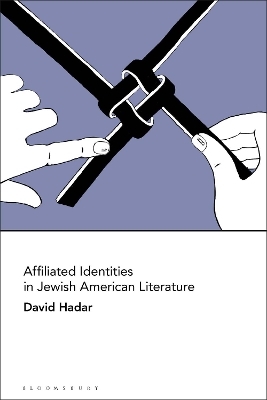
Affiliated Identities in Jewish American Literature
Seiten
2022
Bloomsbury Academic (Verlag)
978-1-5013-7130-1 (ISBN)
Bloomsbury Academic (Verlag)
978-1-5013-7130-1 (ISBN)
Focusing on relationships between Jewish American authors and Jewish authors elsewhere in America, Europe, and Israel, this book explores the phenomenon of authorial affiliation: the ways in which writers intentionally highlight and perform their connections with other writers. Starting with Philip Roth as an entry point and recurring example, David Hadar reveals a larger network of authors involved in formations of Jewish American literary identity, including among others Cynthia Ozick, Saul Bellow, Nicole Krauss, and Nathan Englander. He also shows how Israeli writers such as Sayed Kashua perform their own identities through connections to Jewish Americans.
Whether by incorporating other writers into fictional work as characters, interviewing them, publishing critical essays about them, or invoking them in paratext or publicity, writers use a variety of methods to forge public personas, craft their own identities as artists, and infuse their art with meaningful cultural associations. Hadar's analysis deepens our understanding of Jewish American and Israeli literature, positioning them in decentered relation with one another as well as with European writing. The result is a thought-provoking challenge to the concept of homeland that recasts each of these literary traditions as diasporic and questions the oft-assumed centrality of Hebrew and Yiddish to global Jewish literature. In the process, Hadar offers an approach to studying authorial identity-building relevant beyond the field of Jewish literature.
Whether by incorporating other writers into fictional work as characters, interviewing them, publishing critical essays about them, or invoking them in paratext or publicity, writers use a variety of methods to forge public personas, craft their own identities as artists, and infuse their art with meaningful cultural associations. Hadar's analysis deepens our understanding of Jewish American and Israeli literature, positioning them in decentered relation with one another as well as with European writing. The result is a thought-provoking challenge to the concept of homeland that recasts each of these literary traditions as diasporic and questions the oft-assumed centrality of Hebrew and Yiddish to global Jewish literature. In the process, Hadar offers an approach to studying authorial identity-building relevant beyond the field of Jewish literature.
David Hadar is Associate Lecturer of English Language and Literature at Beit Berl College, Israel.
Acknowledgments
Introduction
1. Filiation and Affiliation
2. Locating Affiliations
3. Jewish American Literary Networks beyond English
4. The Jewish Writer as an Old Man
5. New Networks with Israeli Writers
6. Negotiating Continuity: Writing about Philip Roth in Israel
7. Kashua's Complaint: A Palestinian Writer Meets Roth
Coda
Notes
Appendix: An Abridged Map of Author Connections
Index
| Erscheinungsdatum | 06.03.2022 |
|---|---|
| Zusatzinfo | 4 bw illus |
| Verlagsort | New York |
| Sprache | englisch |
| Maße | 150 x 228 mm |
| Gewicht | 320 g |
| Themenwelt | Geisteswissenschaften ► Sprach- / Literaturwissenschaft ► Anglistik / Amerikanistik |
| Geisteswissenschaften ► Sprach- / Literaturwissenschaft ► Literaturwissenschaft | |
| Sozialwissenschaften ► Soziologie ► Spezielle Soziologien | |
| ISBN-10 | 1-5013-7130-4 / 1501371304 |
| ISBN-13 | 978-1-5013-7130-1 / 9781501371301 |
| Zustand | Neuware |
| Informationen gemäß Produktsicherheitsverordnung (GPSR) | |
| Haben Sie eine Frage zum Produkt? |
Mehr entdecken
aus dem Bereich



aus dem Bereich
Paul Celans Poetik der Mehrsprachigkeit
Buch | Hardcover (2025)
De Gruyter (Verlag)
CHF 153,90


