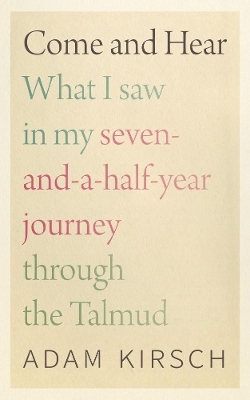
Come and Hear - What I Saw in My Seven-and-a-Half-Year Journey through the Talmud
Brandeis University Press (Verlag)
9781684580675 (ISBN)
Spurred by a curiosity about Daf Yomi—a study program launched in the 1920s in which Jews around the world read one page of the Talmud every day for 2,711 days, or about seven and a half years—Adam Kirsch approached Tablet magazine to write a weekly column about his own Daf Yomi experience. An avowedly secular Jew, Kirsch did not have a religious source for his interest in the Talmud; rather, as a student of Jewish literature and history, he came to realize that he couldn’t fully explore these subjects without some knowledge of the Talmud. This book is perfect for readers who are in a similar position. Most people have little sense of what the Talmud actually is—how the text moves, its preoccupations and insights, and its moments of strangeness and profundity. As a critic and journalist Kirsch has experience in exploring difficult texts, discussing what he finds there, and why it matters. His exploration into the Talmud is best described as a kind of travel writing—a report on what he saw during his seven-and-a-half-year journey through the Talmud. For readers who want to travel that same path, there is no better guide.
Adam Kirsch is a poet and literary critic. A former book critic for the New York Sun and the New Republic, he is currently a contributing editor of Tablet magazine and an editor at the Wall Street Journal's Weekend Review section. He is the author of three collections of poems and five other books of criticism and biography, including, most recently, The People and the Books and The Blessing and the Curse: The Jewish People and Their Books in the Twentieth Century.
Introduction
I. Tractate Berachot and Seder Moed: Prayers, Shabbat and Holidays
1. Berachot: On how to pray, whose prayers are granted, and the perils of snubbing a rabbi's wife.
2. Shabbat: On forbidden labors, set-aside items, and learning the Torah while standing on one leg.
3. Eruvin: On bounaries, interpreting the Torah, and why the Messiah will come on a weekday.
4. Pesachim: On searching for chametz, the Passover sacrifice, and how to calculate the size of hell.
5. Shekalim: On money-changers in the Temple, the appearance of impropriety, and what happened to the Ark of the Covenant.
6. Yoma: On sacred choreography, the meaning of atonement, and the many uses of manna.
7. Sukka: On squaring the circle, using an elephant as a wall, and why the sages juggled torches.
8. Beitza: On newly laid eggs, good table manners, and why the Jewish people need a fiery law.
9. Rosh Hashanah: On the date of Creation, hearing the shofar, and how to trick death.
10. Taanit: On praying for rain, the importance of solidarity, and the inauspicious dates.
11. Megilla: On divine inspiration, rewriting the Bible, and Haman's years as a barber.
12. Moed Katan: On holidays, making graves, and the right to be beautiful.
13. Hagiga: On divine judgment and the danger of praying into God's secrets.
II. Seder Nashim: Marriage and Divorce
14. Yevamot: On levirate marriage, converting to Judaism, and a camel that didn't dance.
15. Ketubot: On marriage contracts, the value of virginity, and how to deal with a disgusting spouse.
16. Nedarim and Nazir: On how to take a vow — and why you shouldn't.
17. Sota: On magic potions, unfaithful wives, and a worm that chews through stone.
18. Gittin: On divorce, the destruction of the Temple, and the real meaning of tikkun olam.
19. Kiddushin: On betrothal, the duties of parents and children, and why women don't have to wear tefillin.
III. Seder Nezikin: Civil and Criminal Law
20. Bava Kamma: On negligence, restitution, and the problem with being robbed by a Jewish bandit.
21. Bava Metzia: On ownership, exploitation, and when to ignore the voice of God.
22. Bava Batra: On real estate, inheritance, and surviving catastrophe.
23. Sanhedrin: On capital punishment, the World to Come, and using magic to make dinner.
24. Makkot: On flogging, perjury, and forbidden tattoos.
25. Shevuot: On taking oaths, the burden of proof, and when to throw a duck at a judge.
26. Avoda Zara: On idol worship, intermarriage, and the rabbi who used an emperor as a footstool.
27. Horayot: On mistaken judgments and why scholars outrank kings.
IV: Seder Kodashim and Tractate Niddah: The Temple, Sacrifices, and Ritual Purity
28. Zevachim and Menachot: On animal sacrifices, meal offerings, and how the Jewish people is like an olive tree.
29. Hullin and Bekhorot: On kosher slaughter, separating meat and dairy, and when a firstborn isn't a firstborn.
30. Arakhin, Temura, and Karetot: On the value of a life, switching sacrifices, and a punishment worse than death.
31. Meila, Tamid, Middot, and Kinnim: On stealing from God, a day in the life of the Temple, and avian brainteasers.
32. Nidda: On menstruation, ejaculation, and why girls are wiser than boys.
Conclusion
Acknowledgments
| Erscheinungsdatum | 11.10.2021 |
|---|---|
| Sprache | englisch |
| Maße | 6 x 9 mm |
| Themenwelt | Geisteswissenschaften ► Religion / Theologie ► Judentum |
| ISBN-13 | 9781684580675 / 9781684580675 |
| Zustand | Neuware |
| Informationen gemäß Produktsicherheitsverordnung (GPSR) | |
| Haben Sie eine Frage zum Produkt? |
aus dem Bereich