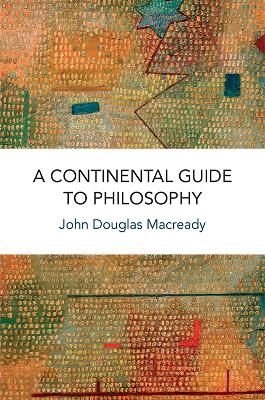
A Continental Guide to Philosophy
Edinburgh University Press (Verlag)
978-1-4744-8678-1 (ISBN)
What is real? How can we know what is real? How might we live authentically? These are the three fundamental questions about metaphysics, epistemology, and ethics. John Macready guides you through these questions by reading three pairs of philosophers and texts. Part I, Metaphysics: Plato's Sophist and Descartes's Meditations on First Philosophy. Part II, Epistemology: Hume's An Enquiry Concerning Human Understanding and Kant's Prolegomena to Any Future Metaphysics. Part III: Ethics: Nietzsche's ‘Schopenhauer as Educator’ and Arendt's ‘Labor, Work, and Action’. Each chapter introduces you to basic philosophical problems, concepts, and methods of philosophical inquiry. You'll learn how to read and understand these key texts so that you can answer these three questions for yourself.
John Douglas Macready is Professor of Philosophy at Collin College in Plano, Texas. His work focuses on critical issues in ethics and social and political philosophy. He is the author of Hannah Arendt and the Fragility of Human Dignity (Lexington Books, 2018).
GlossaryTimeline
Introduction
Three Basic Questions
A Continental Tour of Philosophy
How to Use this Book
How to Read Philosophical Texts
Part I: Metaphysics. What is real? Plato and Descartes
1. Plato: The Hunt for the Real
The Aim of Philosophy
Being and Appearance and the Problem of Difference
The Vermeer Forgeries
The Problem of Identity and Difference
How to Give an Account of the Real
Only Forms are Real
The Hunt for a Slippery Beast
2. Plato: The Net of Language
The Problem of Being
The Problem of Language
Imitation and Knowledge
The Hunt for Being: Four Views
The Five Kinds
3. Descartes: Mind and Reality
The Meditations are Spiritual Exercises
The Substance of Reality
Meditation 1: Doubting Reality
Meditation 2: The Reality of Me
Meditation 3: The Reality of God
4. Descartes: Truth and World
Meditation 4: Judgment and Truth
Meditation 5: God, Things, and Ideas
Meditation 6: The Reality of the World
Part II: Epistemology. How can we know what is real? Hume and Kant
5. Hume: The Mind is an Assemblage of Ideas
A Conceptual Revolution
Hume’s Clash with Rationalism
A New Kind of Philosophy
Hume’s Atomism and Associationism
The Cartesian Ego vs the Assemblage of the Self
Innate Ideas vs Copies of Impressions
Knowledge vs Belief
The Fragile Connection between Cause and Effect
6. Hume: Skepticism and Truth
Probability and Belief
The Illusion of Connection
Are We Free or Determined?
Should We Believe in God or Miracles?
Skepticism as Philosophical Therapy
Hume and the Idea of Race
7. Kant: The Architecture of the Mind
Hume’s Problem and Kant’s Awakening
Critical Philosophy
Knowledge and Judgments
Mathematical Judgments are Synthetic A Priori Judgments
Natural Science Judgments are Synthetic A Priori Judgments
8. Kant: Virtual Reality and the Limits of Reason
The Problem of Reality and Appearances
The Threefold Synthesis
Reason and the Three Dialectical Illusions
Metaphysical Judgments are Synthetic A Priori
Part III: Ethics. How might we live Authentically? Nietzsche and Arendt
9. Nietzsche: Become Who You Are!
How to Know Yourself
Three Exemplary Qualities of an Authentic Life
The Dangers of an Authentic Life
10. Nietzsche: The Creative Life
Modern Culture is Dehumanizing
How to Become a Child
Modern Culture is Egotistic and Tyrannical
Three Images of Creative Spirits
The Meaning of Life is to Contribute to Culture
The Two Sacraments of Culture
Beware of the Four Enemies of Culture
11. Arendt: Think What We Are Doing!
The Prejudice of Philosophy and Worldlessness
The Recovery of the Public World
The Two Ways of Life
The Pre-Philosophic View of the Active Life
The Philosophical View: Political Action as Work
The Modern View: Political Action as Labor
12. Arendt: The Political Life
Labor is Natural and Necessary
Labor is Not Work
Work Makes the World
Action Reveals Who We Are
Behavior vs. Action
Conclusion: Philosophy for Life
Suggestions for Further ReadingBibliographyIndex
| Erscheinungsdatum | 04.01.2022 |
|---|---|
| Zusatzinfo | 54 black and white illustrations |
| Verlagsort | Edinburgh |
| Sprache | englisch |
| Maße | 138 x 216 mm |
| Themenwelt | Geisteswissenschaften ► Philosophie ► Allgemeines / Lexika |
| Geisteswissenschaften ► Philosophie ► Erkenntnistheorie / Wissenschaftstheorie | |
| Geisteswissenschaften ► Philosophie ► Ethik | |
| Geisteswissenschaften ► Philosophie ► Metaphysik / Ontologie | |
| ISBN-10 | 1-4744-8678-9 / 1474486789 |
| ISBN-13 | 978-1-4744-8678-1 / 9781474486781 |
| Zustand | Neuware |
| Informationen gemäß Produktsicherheitsverordnung (GPSR) | |
| Haben Sie eine Frage zum Produkt? |
aus dem Bereich