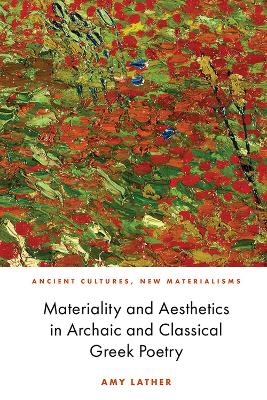
Materiality and Aesthetics in Archaic and Classical Greek Poetry
Edinburgh University Press (Verlag)
978-1-4744-6235-8 (ISBN)
Her readings centre on the concept of poikilia, a richly multivalent term in Greek aesthetics that is used to characterise artefacts as well as mental activity. By delineating patterns of interaction between living and inorganic beings through the lens of this aesthetic concept, Lather maps a body of canonical texts onto the new critical terrains comprised by the new materialisms and cognitive humanities and reveals the points of intersection between cognitive processes and the material entities produced by them.
The result is an innovative contribution to both Classics and New Materialism studies, uncovering the intimate and reciprocal interaction between minds and matter as central to ancient Greek aesthetic experience.
Amy Lather is Assistant Professor of Classics at Wake Forest University in Winston Salem, North Carolina. She is the author of numerous articles on aesthetic experience in ancient Greek poetry and has been the recipient of a Center for Hellenic Studies fellowship as well as a Young Researcher Award from the Fondation Hardt.
Introduction
Chapter One: A Beautiful Mind: Patterns of Thought and the Decoration of TextilesI. Poikilia, Polychromy, and Perception IIa. Sensing Fabric in the Acropolis Korai IIb. Visualizing Fabric and Constructing Images in Vase Painting III. Putting the "Hand" into Handicraft: Poikilia and (feminine) thought patterns
Chapter Two. Brazen Charm: The Vitality of Archaic Armor I. Affective Armor Ia. Bronze as Light Ib. Heavy Metal: The Sound of Battle IIa. Bodies Nonhuman and Superhuman IIb. A Wall of Armor, A Human Boulder, and Brazen Voices IIc. The Armor of Achilles and Blazing WeaponryIII. Life in/of Metal
Chapter Three. Mind Tools: Art, Artifice, and Animation Ia. Paradoxical Poikilia: Labyrinthine Passageways Ib. Poikilia in Miniature Ic. A Wonder to Behold: Pandora in the Theogony IIa. Intelligent Things IIb. Hephaestus’ Tools IIIc. The Ships of the Phaeacians and Other "Smart" Objects III. Conclusion: Poikilia and the Riddle of Speech
Chapter Four. The Protean Shape of Lyric Poikilia I. The Imaginative Matter of Poikilia: Scintillating Objects in Sappho, Alcman, and Anacreon IIa. Pindaric Poikilia and the Victorious Imagination IIb. Pythian 8, Pythian 10, and Olympian 1 IIc. Olympian 6, Nemean 5, and Nemean 4 III. Visible and Audible Movement: Poikilia’s Scintillating Shape
Chapter Five. Mētis and the Mechanics of the Mind I. Crafting Cognition with Prometheus II. Mētis, the Mother of Invention III. Social Media and the Embodiment(s) of Poikilomētis: A Viewing Guide IV. Conclusions
Chapter Six. The Materiality of Feminine Guile I. Hera and the kestos himas IIa. Goddesses in Disguise and Divine Assemblages IIb. Aphrodite’s Seductive Assemblage in the Homeric Hymn to Aphrodite IIc. Pandora as dolos II. Killer Style and Tragic Poikilia: Clytemnestra and Medea III. Conclusions
ConclusionBibliography
| Erscheinungsdatum | 23.09.2021 |
|---|---|
| Reihe/Serie | Ancient Cultures, New Materialisms |
| Zusatzinfo | 12 black and white illustrations |
| Verlagsort | Edinburgh |
| Sprache | englisch |
| Maße | 156 x 234 mm |
| Themenwelt | Geschichte ► Allgemeine Geschichte ► Vor- und Frühgeschichte |
| Geschichte ► Allgemeine Geschichte ► Altertum / Antike | |
| ISBN-10 | 1-4744-6235-9 / 1474462359 |
| ISBN-13 | 978-1-4744-6235-8 / 9781474462358 |
| Zustand | Neuware |
| Informationen gemäß Produktsicherheitsverordnung (GPSR) | |
| Haben Sie eine Frage zum Produkt? |
aus dem Bereich