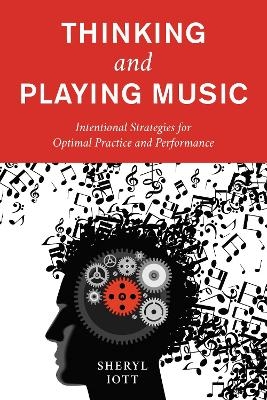
Thinking and Playing Music
Rowman & Littlefield (Verlag)
978-1-5381-5530-1 (ISBN)
Maximizing efficiency and effectiveness while cultivating an observant, experimental approach can help musicians make the most of their time and potential while avoiding tension, injury, and burnout. Aligning efforts with inherent mental processes can make learning faster, deeper, and more secure while freeing up attentional space, allowing for creative, personal expression in performance. The book addresses:
Beginning musicianship, covering relevant cognition topics such as language acquisition, aural processing and development of audiation while cultivating a playful, relaxed approach to the instrumentThe intermediate musician, presenting more advanced cognitive topics such as visual processing, chunking, and early problem solvingThe advanced musician, addressing increased demands on working and long-term memory, how to maximize transfer, a creative approach to problem solving, and strategies to tackle the most difficult repertoireAlso included are sample lesson plans, workshop templates, and sample practice assignments.
Sheryl Iott is an active solo and collaborative performer, speaker, and adjudicator. Iott is on the faculty of Interlochen Arts Camp and has served on the faculties of Grand Rapids Community College, Hope College, Michigan State University, and Calvin College. She is also a member of the College of Examiners for the Royal Conservatory of Music of Toronto. Frequently published in music education and piano pedagogy books and magazines, Iott’s current research is focusing on music cognition and cognition-enhanced practice strategies.
Acknowledgments
List of Figures
Introduction
PART 1
1 The Beginning Musician: Practice Is Play
Music and the Brain
Aural Cognition, Language Acquisition, and Musical Processing
Music Perception and Preparatory Audiation
Optimal Teaching Strategies for the Young Beginner
Whole-Part-Whole
Aptitude
PART 2
2 The Intermediate Musician: Fluent Music Reading and Early Problem Solving
From “Beginner” to “Intermediate”
Visual Processing
Beginning Music Reading: Bringing Meaning to the Score
[Long-Term] Working Memory, Chunking, and Template Theories
Execution, and Benefits, of Mental Practice
“Theory”—When, How, and Why
More Relevant than Learning Styles: Personality, Character, and Motivation
3 Practice Strategies for Musicians of Burgeoning Independence
If You’re Not Thinking, You’re Not Practicing
Don’t Do It Again Until You Know Why
Audiation Pause = Learning Pause
Hands Together!
Patterns and Mental “Chunking”
4 Specific Practice Strategies for the Intermediate Musician
Preparatory Practice Strategies
Chunking Strategies
Tempo and Rhythm
Facility
Think It Then Play It
Structural Lines
Contrapuntal Music
Benefits and Challenges of These Types of Practice Strategies for the Intermediate Musician
PART 3
5 The Advanced Musician: The Cognition of Expertise
Toward “Expertise”
Mindful Practice and Avoidance of Excessive Automatization
Knowledge Representation, Working Memory, and Skilled Visual Processing
Long-Term Memory: Retention and Retrieval
Multiple Intelligences and Rule Learning
(Creative) Problem Solving
Impact of Mood on Problem Solving and Success
Motor Control and Development, and the Risks of Excessive Automaticity
Multimodal Imagery and Musical Memorization
Deliberate, Distributed, Interleaved Practice
Self-Monitoring and Self-Evaluation
6 Conceptual Solutions to Technical Problems (They Are All Technical Problems)
Practice Tools and Strategies for More Challenging Problems
Layers
What to Think About When
Think It Then Play It
Scaffolding and Hypermeter
Mental Practice, Mapping, and Memorization
7 Practice Strategies for Solving Physical Problems
Physical Practice: Chunking, Gestures, The Chart, and Fingerings
Chunking » Gesture
Gesture » Detail
To the Thumbs
The Chart
Hands Alone
Fingerings and How They Help Form Meaningful Units
Above Strategies in Sequence and Combination
PART 4
8 How Intentional Practice Benefits Performance
APPENDICES
Appendix A: Sample Lesson Plan and Practice Sheet: Beginning Musician
Appendix B: Sample Practice Assignments: Intermediate Musician
Appendix C: The Integrated Lesson
Appendix D: Practice Strategies by Category and Figure Numbers
Appendix E: Areas of the Brain Involved in Language and Music Production and Comprehension
Appendix F: Workshop Templates
Bibliography
Index
About the Author
| Erscheinungsdatum | 05.07.2021 |
|---|---|
| Zusatzinfo | 120 b/w illustrations; 22 b/w photos; 6 tables |
| Sprache | englisch |
| Maße | 187 x 266 mm |
| Gewicht | 821 g |
| Themenwelt | Kunst / Musik / Theater ► Musik ► Instrumentenkunde |
| Kunst / Musik / Theater ► Musik ► Musiktheorie / Musiklehre | |
| Geisteswissenschaften ► Psychologie ► Allgemeine Psychologie | |
| Geisteswissenschaften ► Psychologie ► Verhaltenstherapie | |
| ISBN-10 | 1-5381-5530-3 / 1538155303 |
| ISBN-13 | 978-1-5381-5530-1 / 9781538155301 |
| Zustand | Neuware |
| Informationen gemäß Produktsicherheitsverordnung (GPSR) | |
| Haben Sie eine Frage zum Produkt? |
aus dem Bereich