


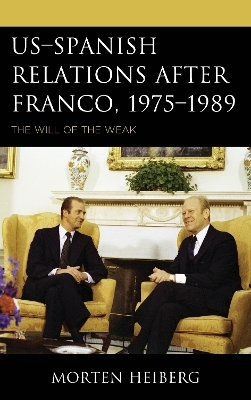
US–Spanish Relations after Franco, 1975–1989
The Will of the Weak
Seiten
2021
Lexington Books (Verlag)
978-1-4985-7502-7 (ISBN)
Lexington Books (Verlag)
978-1-4985-7502-7 (ISBN)
This study examines US relations with Spain during its political transition to democracy after 1975. The author focuses on the US military presence in the country and analyzes how the Spanish democratic government’s perception of the state’s own recent past affected its aims and actions in the post-Franco period.
On September 26, 1953, the Eisenhower administration signed three executive agreements with General Franco’s regime, which allowed the United States to install military bases in Spain in exchange for economic and military aid. The deal clearly favored US Cold War interests, and critics soon denounced that by signing the Pact of Madrid America had betrayed its own democratic credentials. The agreements stabilized the dictatorship and effectively converted it into a US satellite.
During the transition to democracy after 1975, the US military presence in Spain was strongly debated. Many politicians and a large section of the Spanish public demanded a new foreign policy and a much higher degree of autonomy for Spain in the international system. However, as this book unravels, the UCD center governments of the late 1970s and early 1980s essentially gave up on their long-held claim to a new and more balanced relationship with Washington. This fact was carefully concealed from the public. Thus, it was only well into the mid-1980s, when the new socialist government gradually developed a more consistent foreign policy doctrine, that Washington fully realized that the bilateral relations had to be approached in an entirely different manner.
For all these reasons, the present work is also a statement in the ongoing scholarly debate on the Spanish transition to democracy and the importance of foreign influences on this process. Finally, the book sheds new light on the role of King Juan Carlos in foreign affairs, just as it discusses Spain’s alleged role in the Iran-Contra Affair.
On September 26, 1953, the Eisenhower administration signed three executive agreements with General Franco’s regime, which allowed the United States to install military bases in Spain in exchange for economic and military aid. The deal clearly favored US Cold War interests, and critics soon denounced that by signing the Pact of Madrid America had betrayed its own democratic credentials. The agreements stabilized the dictatorship and effectively converted it into a US satellite.
During the transition to democracy after 1975, the US military presence in Spain was strongly debated. Many politicians and a large section of the Spanish public demanded a new foreign policy and a much higher degree of autonomy for Spain in the international system. However, as this book unravels, the UCD center governments of the late 1970s and early 1980s essentially gave up on their long-held claim to a new and more balanced relationship with Washington. This fact was carefully concealed from the public. Thus, it was only well into the mid-1980s, when the new socialist government gradually developed a more consistent foreign policy doctrine, that Washington fully realized that the bilateral relations had to be approached in an entirely different manner.
For all these reasons, the present work is also a statement in the ongoing scholarly debate on the Spanish transition to democracy and the importance of foreign influences on this process. Finally, the book sheds new light on the role of King Juan Carlos in foreign affairs, just as it discusses Spain’s alleged role in the Iran-Contra Affair.
Morten Heiberg is professor of contemporary Spanish studies at the University of Copenhagen.
Part I: Almost Annihilated
Chapter 1: The Empire Ends
Chapter 2: Outcast
Chapter 3: Quid Pro Quo
Part II: Transitions
Chapter 4: The Soft Underbelly
Chapter 5: Upscaling
Chapter 6: Jun Carlos as Puppeteer
Chapter 7: The Meltdown of the Political Center
Chapter 8: Against the Highest Interest of the Nation
Chapter 9: A Spanish Sellout
Chapter 10: The Highest Representative
Chapter 11: Best Efforts
Part III: Reclaiming Sovereignty
Chapter 12: The Decalogue
Chapter 13: In or Out of NATO?
Chapter 14: The Iran-Contra Affair
Chapter 15: Never Averse to Sticking His Neck Out
| Erscheinungsdatum | 17.05.2021 |
|---|---|
| Reihe/Serie | The Harvard Cold War Studies Book Series |
| Sprache | englisch |
| Maße | 153 x 219 mm |
| Gewicht | 358 g |
| Themenwelt | Geisteswissenschaften ► Geschichte ► Regional- / Ländergeschichte |
| Sozialwissenschaften ► Politik / Verwaltung ► Europäische / Internationale Politik | |
| ISBN-10 | 1-4985-7502-1 / 1498575021 |
| ISBN-13 | 978-1-4985-7502-7 / 9781498575027 |
| Zustand | Neuware |
| Informationen gemäß Produktsicherheitsverordnung (GPSR) | |
| Haben Sie eine Frage zum Produkt? |
Mehr entdecken
aus dem Bereich


aus dem Bereich
die Geschichte meiner Urgroßmutter
Buch | Hardcover (2025)
C.H.Beck (Verlag)
CHF 32,15
Träume und Macht : eine Biografie
Buch | Hardcover (2025)
C.H.Beck (Verlag)
CHF 61,60


