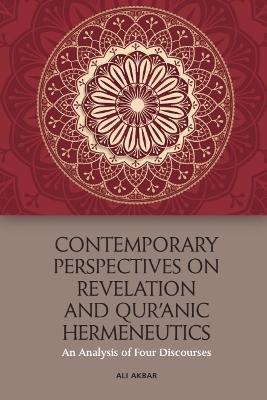
Contemporary Perspectives on Revelation and Qur’ānic Hermeneutics
Edinburgh University Press (Verlag)
978-1-4744-5617-3 (ISBN)
Dr. Ali Akbar is a lecturer and researcher at the University of Melbourne in Australia where he received his PhD in Islamic Studies. He is an expert in the fields of Islamic Studies with a focus on contemporary Islamic thought and Middle Eastern politics as well as Iranian politics with a focus on Iran’s foreign policy in the Middle East and beyond. He is co-author of Iran’s Soft Power in Afghanistan and Pakistan (Edinburgh University Press, 2023) as well as lead author of Contemporary Approaches to the Qur’an and Its Interpretation in Iran (Routledge, 2020) and sole author of Contemporary Perspectives on Revelation and Qur’anic Hermeneutics (Edinburgh University Press, 2020). In addition to these books, Dr. Akbar has published extensively in top-tier journals including Islam and Christian-Muslim Relations, British Journal of Middle East Studies, Iranian Studies, Mediterranean Politics, Third Word Quarterly and Political Theology.
1. Introduction
Some background studies
The study
The content
2. Traditional Understanding of Revelation
Revelation in the Qurʾān
Two terms for revelation in the Qurʾān: wahòy and tanzīl
Revelation in the traditional accounts: Internal and direct, or external and mediated?
Revelation and its link to the personality of the Prophet
The Prophet’s feelings/experiences at the moment of revelation
God’s Words, revelation and the Qurʾān
Challenges to traditional theories of revelation
Conclusion
3. Fazlur Rahman: Revelation Historicized
Rahman’s account of revelation
The sources of Rahman’s theory of revelation
The connection between revelation and Qurʾānic hermeneutics
Rahman’s hermeneutics in practice
Conclusion
4. Abdolkarim Soroush: the Prophet’s Revelatory Experiences
Soroush’s theory of revelation
The sources of Soroush’s ideas about revelation
Soroush’s hermeneutics
The implications of Soroush’s hermeneutics
Conclusion
5. Muhammad Mujtahed Shabestari: How the Prophet saw the world
The need for reconsideration of traditional account of revelation
The sources of Shabestari’s theory of revelation
Shabestari’s hermeneutics
Shabestari’s hermeneutics in practice
Conclusion
6. Nasr Hamid Abu Zayd: Revelation as a Linguistic Manifestation of the Communicative Interaction between God and the Prophet
Abu Zayd’s account of revelation
The sources of Abu Zayd’s ideas about revelation
Abu Zayd’s hermeneutics
The implications of Abu Zayd’s hermeneutics
Conclusion
7. Conclusion
Accounts of revelation
The roots of each scholar’s account of revelation
Hermeneutic approaches: theoretical level
Hermeneutic approaches functioning in practice
Final remarks
| Erscheinungsdatum | 01.09.2021 |
|---|---|
| Verlagsort | Edinburgh |
| Sprache | englisch |
| Maße | 156 x 234 mm |
| Themenwelt | Geisteswissenschaften ► Religion / Theologie ► Islam |
| ISBN-10 | 1-4744-5617-0 / 1474456170 |
| ISBN-13 | 978-1-4744-5617-3 / 9781474456173 |
| Zustand | Neuware |
| Informationen gemäß Produktsicherheitsverordnung (GPSR) | |
| Haben Sie eine Frage zum Produkt? |
aus dem Bereich