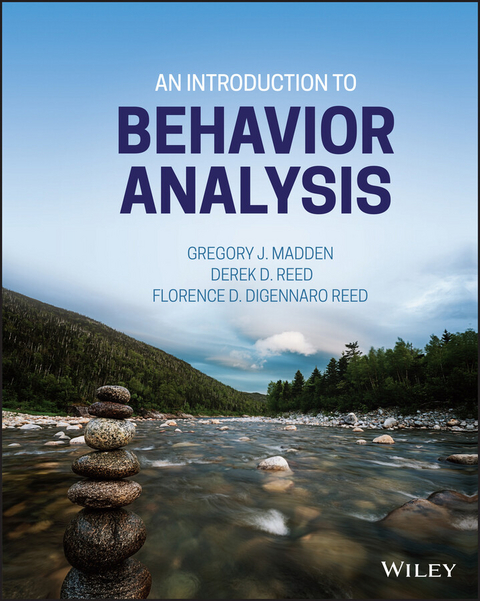
An Introduction to Behavior Analysis (eBook)
John Wiley & Sons (Verlag)
978-1-119-12654-6 (ISBN)
Explore a fascinating introductory treatment of the principles of behavior analysis written by three leading voices in the field
An Introduction to Behavior Analysis delivers an engaging and comprehensive introduction to the concepts and applications of behavior analysis for students of behavior analysis. Written from the ground up to capture and hold student interest, the book keeps its focus on practical issues.
This book offers readers sound analyses of Pavlovian and operant learning, reinforcement and punishment, motivation and stimulus control, language and rule-following, decision-making and clinical behvior analysis. With fully up to date empirical research references and theoretical content, An Introduction to Behavior Analysis thoroughly justifies every principle it describes with empirical support and explicitly points out where more data are required.
The text encourages students to analyze their own experiences and some foundational findings in the field in a way that minimizes jargon and maximizes engagement. Readers will also benefit from the inclusion of:
- A clear articulation and defense of the philosophical assumptions and overarching goals of behavior analysis.
- A thorough description of objective data collection, experimental methods, and data analysis in the context of psychology
- An exploration of the core principles of behavior analysis, presented at a level comprehensible to an introductory audience
- A broad array of principles that cover issues as varied as language, substance-use disorders, and common psychological disorders
Perfect for students taking their first course in behavior analysis or behavior modification, An Introduction to Behavior Analysis will also earn a place in the libraries of students pursuing certification through the Behavior Analysis Certification Board or taking courses in the applied psychological sciences.
Gregory J. Madden, PhD, is Professor of Psychology at Utah State University. His research foci are on impulsivity, drug-taking, pollution control, and health decision-making. He was Editor-in-Chief of the APA Handbook of Behavior Analysis and the Journal of the Experimental Analysis of Behavior. He is a Fellow of the Association for Behavior Analysis International.
Gregory J. Madden, PhD, is a Professor of Psychology at Utah State University. His research foci are on impulsivity, drug-taking, pollution control, and health decision-making. He was Editor-in-Chief of the APA Handbook of Behavior Analysis and the Journal of the Experimental Analysis of Behavior. He is a Fellow of the Association for Behavior Analysis International. Derek D. Reed, PhD, BCBA-D, is a Professor of Applied Behavioral Science at the University of Kansas. His research applies behavioral economic concepts to inform public policy and address issues of societal importance. He has served as Associate Editor for The Psychological Record, Behavior Analysis in Practice, Journal of Applied Behavior Analysis, and Journal of the Experimental Analysis of Behavior. Florence D. DiGennaro Reed, PhD, BCBA-D, is an Associate Professor of Applied Behavioral Science at the University of Kansas. Her research examines effective and efficient staff training and performance improvement practices in human service settings. She also conducts translational research in on-campus laboratory facilities. Dr. DiGennaro Reed has served as Associate Editor for Journal of Applied Behavior Analysis, Journal of Behavioral Education, and Behavior Analysis in Practice.
PREFACE
Why Study Behavior Analysis
The course in which you are currently enrolled will give you substantive training in the behavior-analytic principles that underlie effective behavior-change interventions. For example, the principles covered in this course have proven effective in the treatment of autism spectrum disorders (Bellini & Akullian, 2007; Eldevik et al., 2009), intellectual disabilities (Heyvaert et al., 2012), antisocial behavior (McCart et al., 2006), adult anxiety and depression (Öst, 2008; Powers et al., 2009), and substance-use disorders (Dutra et al., 2008) to name just a few. In this class, you will learn the principles that are foundational to these successes.
Taking a more expansive view, the course will prepare you to pursue further training at one of the more than 250 universities that offer graduate degrees in behavior analysis. Should you choose to pursue this training, you would join more than 51,000 Board Certified Behavior Analysts (BCBA) who are recognized by most US states as the appropriate providers of behavior-analytic services to children and adults with disabilities. These underserved populations depend on students like you to pursue careers in the helping profession of behavior analysis.
For those not drawn to serving those with disabilities, you should know that the principles covered in this book have proven beneficial in the practice of clinical, counseling, and school psychology. For example, in 2012 the Inter-Organizational Task Force on Cognitive and Behavioral Psychology Doctoral Education outlined the most important principles that these practice-oriented psychologists must understand to be effective (Klepac et al., 2012). At least 60% of the competencies listed were behavior analytic, and many of these will be covered in this book (e.g., shaping, extinction/exposure).
Perhaps your interests lie elsewhere still. If so, you may be interested to know that the principles covered in this book have been successfully used in business settings. Indeed, some of the most effective managers are those who know how to (1) identify the behaviors of successful employees, (2) measure the occurrence and non-occurrence of those behaviors in all employees, and (3) develop behavior-management plans that encourage those successful behaviors. Managers who can do this are actually managing behavior, rather than acting like authoritarian dictators. Because behavior analysts rely on positive reinforcement in their management practices, employees tend to be happier while being more productive.
Still not interested? Well, consider that most readers of this book will one day be parents, if they are not already. Because the behavior-analytic principles covered in this book have proven so reliable in positively influencing behavior, they constitute the core of most parent-training programs; for example, the Criando con Amor, Promoviendo Armonía y Superacíon [Raising with Love, Promoting Harmony & Improvement] program (Baumann et al., 2014). So, if you hope to be a loving parent who helps their children to successfully navigate their world, you would do well to learn all you can from this book. Your children will never thank you for it, but you will thank yourself one day, particularly when you see other parents struggling to understand the behavior of their children.
If you are still not interested in the contents of this book, we have only one more plea – consider the words of Socrates who said, “The unexamined life is not worth living.” Socrates was encouraging those of his age to use logic, wisdom, and philosophy in pursuit of self-knowledge, better relationships, and a harmonious existence with the natural world. These goals are timeless and universal. This book can open doors of self-discovery. So, use what you are about to learn to examine your life, your actions, your goals, your values. The examined life is even more worth living.
How to Use the Features of This Book
This book is designed to help students identify the important information they should know after taking this class. When important terms are first presented, they appear in bold. When you identify one of these terms you should take the following steps:
- Write the term on one side of a 3 × 5 inch flashcard. For example, in Chapter 1, the first term defined is “behavior.”
- The definition of the term will always be provided nearby in italics. Once you have found the definition, write it on the back of the flashcard. For example, Chapter 1defines behavior as an individual living organism’s activity, public or private, which may be influenced by external or internal stimulation.
- Sometimes the book will pose a question (e.g., what is behavior analysis?). When you identify one of these, write it on a flashcard and then, as you read on, write the answer to this question on the other side of the card.
- Keep your flashcards with you throughout the day.
Effective Studying
Most college students think reading and rereading the textbook and their lecture notes is a good way to study (Karpicke et al., 2009). It isn’t. This method of studying does little to help you remember the materials when you are taking a test or, more importantly, you are trying to apply the concepts in your everyday life. For example, in a study conducted by Roediger and Karpicke (2006), one group of students was asked to study by reading the materials four times (that’s probably more than you normally study). Although the students thought this would be effective, when they were tested a week later they could recall only about 40% of the materials – that’s a failing grade.
A better way to study is called “repeated retrieval,” but most college students don’t use it (Karpicke et al., 2009). Repeated retrieval involves reading the information that you are studying and then, without peeking, saying everything you can remember (you can say it out loud or to yourself, both work equally well; Smith et al., 2013). Want to try it right now? If so, without looking, say, write, or think the definition of behavior that was given in the previous section.
If you could not recall all of the important components of the definition, that’s not a problem. Compare what you could recall with the definition provided above and then (without peeking) try again. When Karpicke and Roediger (2010) asked students to repeat this read-and-retrieve process three times, the students remembered about 80% of the materials one week later. That’s twice as much as the students who read the book four times.
Repeated Retrieval Made Easy
The following steps outline a practical way to use repeated retrieval to improve the efficiency and efficacy of your studying (Karpicke et al., 2014):
- Make the flashcards discussed previously.
- At least twice a day, go through your flashcards:
- Look at the term and say out loud (or to yourself) as much of what’s on the back of the card as you can.
- Turn the card over and see which parts you missed. If you were not 100% correct, try it one more time before moving on to the next card.
- If you do this a couple times a day, most every day, you will study less and learn more than ever before.
An Added Benefit
Students who use repeated retrieval, by studying their flashcards 3-4 times a day, don’t cram the night before an exam. They sleep anxiety-free. They also have a stack of flashcards to help them study for any comprehensive exams taken later in the semester. So, what are you waiting for? Get some flash cards and start earning better grades. Flash cards too old-school for you? There are several flash card apps you can use on your phone.
The Behavior Analysis Task List
Some readers of this book will be interested in earning the credential of BCBA. This credential is granted by the Behavior Analysis Certification Board (BACB) and it is the gold-standard credential of practicing and applied behavior analysts. The BACB’s Fifth Edition Task List outlines the Foundational principles and concepts that students must master before beginning an internship as a behavior analyst and before earning the BCBA credential. The Appendix of this textbook provides the BACB’s list of Foundations and indicates the chapter in which each topic is discussed.
Animal Research
As your read this textbook, you will find that many of the foundational principles of behavior analysis were discovered in research conducted with nonhuman animals. It is hard to overstate the importance of this research. What we know today about attention, perception, learning, and decision-making were first discovered by studying the behavior of nonhumans. Current research with nonhuman animals continues to expand our understanding of behavior in important ways. For example, these research findings have proven important in understanding similarities and differences in the behavior of different species. Understanding the unique behavioral abilities of each species is important in guiding conservation efforts around the world (Higham, 2016; O’Brien & Robeck, 2010; Swaisgood et al., 2003; Zimbler-DeLorenzo & Stone, 2011).
Importantly, the findings of research conducted with nonhuman animals have improved the efficacy of the work done by psychologists and behavior analysts tasked with improving the lives of individuals with disabilities, addictions, phobias, anxiety, depression, and so on (Carroll & Overmier, 2001; Madden et al., 2016). For...
| Erscheint lt. Verlag | 2.2.2021 |
|---|---|
| Sprache | englisch |
| Themenwelt | Geisteswissenschaften ► Psychologie |
| Schlagworte | Angewandte Psychologie • Applied Psychology • Behavioral analysis • behavior analysis and substance abuse • behavior analysis textbook • Bildungswesen • drug abuse behavior analysis • Education • introductory behavior analysis textbook • Learning Disabilities • Learning Theory & Research • Lernstörungen, Lernschwächen • Lerntheorie u. -forschung • <p>Pavlovian learning • operant learning • Psychologie • Psychology • undergrad behavior analysis textbook</p> • Verhaltensanalyse |
| ISBN-10 | 1-119-12654-1 / 1119126541 |
| ISBN-13 | 978-1-119-12654-6 / 9781119126546 |
| Informationen gemäß Produktsicherheitsverordnung (GPSR) | |
| Haben Sie eine Frage zum Produkt? |
 EPUB (Adobe DRM)
Kopierschutz: Adobe-DRM
Adobe-DRM ist ein Kopierschutz, der das eBook vor Mißbrauch schützen soll. Dabei wird das eBook bereits beim Download auf Ihre persönliche Adobe-ID autorisiert. Lesen können Sie das eBook dann nur auf den Geräten, welche ebenfalls auf Ihre Adobe-ID registriert sind.
Details zum Adobe-DRM
Dateiformat: EPUB (Electronic Publication)
EPUB ist ein offener Standard für eBooks und eignet sich besonders zur Darstellung von Belletristik und Sachbüchern. Der Fließtext wird dynamisch an die Display- und Schriftgröße angepasst. Auch für mobile Lesegeräte ist EPUB daher gut geeignet.
Systemvoraussetzungen:
PC/Mac: Mit einem PC oder Mac können Sie dieses eBook lesen. Sie benötigen eine
eReader: Dieses eBook kann mit (fast) allen eBook-Readern gelesen werden. Mit dem amazon-Kindle ist es aber nicht kompatibel.
Smartphone/Tablet: Egal ob Apple oder Android, dieses eBook können Sie lesen. Sie benötigen eine
Geräteliste und zusätzliche Hinweise
Buying eBooks from abroad
For tax law reasons we can sell eBooks just within Germany and Switzerland. Regrettably we cannot fulfill eBook-orders from other countries.
aus dem Bereich