Public History (eBook)
John Wiley & Sons (Verlag)
978-1-119-14679-7 (ISBN)
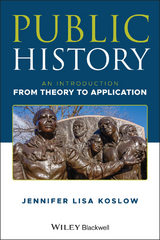
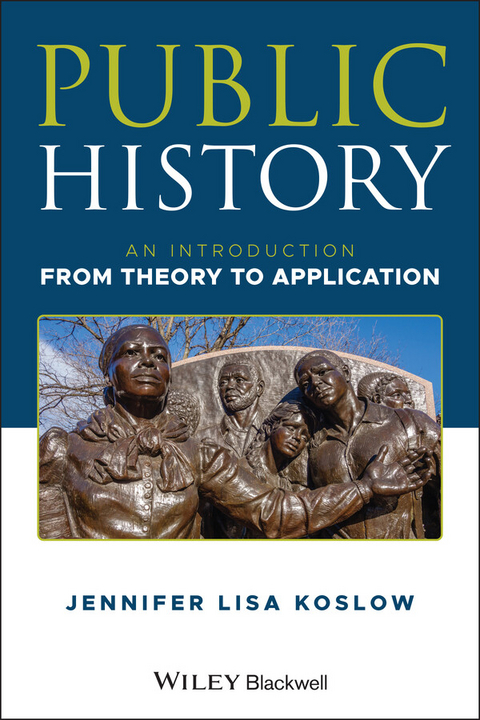
PROVIDES A BACKGROUND IN THE HISTORY, PRINCIPLES, AND PRACTICES OF THE FIELD OF PUBLIC HISTORY
Public History: An Introduction from Theory to Application is the first text of its kind to offer both historical background on the ways in which historians have collected, preserved, and interpreted history with and for public audiences in the United States since the nineteenth century to the present and instruction on current practices of public history. This book helps us recognize and critically evaluate how, why, where, and who produces history in public settings.
This unique textbook provides a foundation for students advancing to a career in the types of spaces-museums, historic sites, heritage tourism, and archives-that require an understanding of public history. It offers a review of the various types of methodologies that are commonly employed including oral history and digital history. The author also explores issues of monuments and memory upon which public historians are increasingly called to comment. Lastly, the textbook includes a section on questions of ethics that public historians must face in their profession. This important book:
Written for students, Public History: An Introduction from Theory to Application offers in one comprehensive volume a guide to an understanding of the fundamentals of public history in the United States.
JENNIFER LISA KOSLOW is Associate Professor of History at Florida State University. Formerly she was Assistant Director, Dr. William M. Scholl Center for Family and Community History, The Newberry Library, Chicago, Illinois.
JENNIFER LISA KOSLOW is Associate Professor of History at Florida State University. Formerly she was Assistant Director, Dr. William M. Scholl Center for Family and Community History, The Newberry Library, Chicago, Illinois.
Preface
Chapter 1: Defining Public History
Chapter 2: Exhibiting History
Chapter 3: Preserving Historic Sites and Spaces
Chapter 4: Managing Archives and Historical Records
Chapter 5: Marking History
Chapter 6: Recording Memory as History
Chapter 7: Digitizing History
Chapter 8: Practicing Ethical History
2
Exhibiting History
In 2007, the International Council of Museums (ICOM) defined a “Museum” as “a non‐profit, permanent institution in the service of society and its development, open to the public, which acquires, conserves, researches, communicates and exhibits the tangible and intangible heritage of humanity and its environment for the purposes of education, study and enjoyment.”1 This modern definition was centuries in the making. However, sometimes the word “museum” is employed in less formal arrangements. Sometimes museums are not permanent. Sometimes they are focused on only providing entertainment. Sometimes they are for‐profit organizations. Sometimes they are not interested in research. Public Historians must acknowledge that not all museums fit the ICOM’s definition. Still, studying those institutions that either fit within the rubric above or aspire to meet it is essential. These are the places with which most Public Historians will either work in or work with to collect, preserve, and interpret history with and for general audiences.
Museums are places of public trust. The evidence that supports this point is more than anecdotal. In the late 1980s and early 1990s, historians Roy Rosenzweig and David Thelen studied the various ways Americans engaged with the past. They knew from social movements of the 1960s and 1970s that people’s engagement with history could be empowering.2 Using social science techniques in 1994, Rosenzweig and Thelen supervised a survey of 808 Americans, of whom they made sure there was diversity represented. Rosenzweig and Thelen learned that except for Native Americans, interviewees identified museums as the most “trustworthy source of information about the past.”3 The reason being is that, for most people, they could see the material artifact for themselves. Also, most people believed that the collaborative nature of museum work made museum workers honest in displaying material culture to the public.4 As a result, the infrastructure of the museum made it trustworthy.
This chapter begins with some significant examples that help historicize the development of institutions known as museums, with a focus on the United States. In particular, the emphasis is on those institutions that presented history (including natural history) as a major aspect of its work and those that grabbed public attention. What might be hidden to you at first but should become clear are the continuities between the motivations of museum visitors and museum makers. “How do I know?” was a fundamental question that audiences sought to answer in museums. Nothing about answering this question necessarily was at odds with the desire to be entertained. Individuals who built museums in the United States did not often see a contradiction between the goals of providing entertainment and education. Also, the term “museum” is a malleable one. At different moments, it has meant different things: a place of objects, a place of research, a place of education, a place of experience, a place of identity formation, and a place of power. How and why people have created museums is at the crux of this story.
In the theory section, we will look at how museum professionals approach their institutions in the twenty‐first century. Museums started as temples and, in many ways, they still are. However, in the late twentieth century ideas about democratic participation transformed expectations. Museums are now expected to be participatory spaces. In the theory section, we will look at the meaning of those changes for Public Historians. In addition, museums are places of interpretation. We will examine what this concept means for storytellers of history.
History
Americans were not the first to create a specific structure devoted to collecting objects believed to have historical significance.5 In the seventeenth century, wealthy Europeans began to collect material objects and put them into “cabinets of curiosities.” A cabinet of curiosity reflected the interests of its collector. In the Age of Enlightenment, these spaces functioned as a place to accumulate and disseminate knowledge. They often consisted of geological substances and zoological specimens. Cultural artifacts from around the globe also often found their way into these accumulations. As Katy Barrett, Curator of Art at the Royal Museums Greenwich, argues, examining the objects evoked a sense of awe‐inspiring educational wonder.6 Through this assemblage, the collector believed that they could obtain universal knowledge. Collectors also designed their cabinets to be shared among their peers.
A significant development in the history of public museums was the establishment of the British Museum in the mid‐eighteenth century. Sir Hans Sloane, a British physician, collected almost 80,000 objects throughout his lifetime.7 He wrote into his will that upon his death the collection should be offered to King George II on behalf of the British nation. If that offer was declined, Sloane stipulated that it should be made available for purchase to the Royal Academies of Science in Paris, St. Petersburg, Berlin, and, last, Madrid. However, the donation came at a cost. Sloane had two daughters, and he stipulated that the proceeds of the purchase, 40,000 pounds, be split between them.8
Parliament held a public lottery to raise funds in 1753 to afford the purchase price of what amounted to approximately seven million US dollars in today’s relative wealth. After securing the funds, Parliament then found a suitable space to house the vast collection: Montagu House. Six years later, in 1759, the British Museum opened its doors and collections to “all studious and curious persons.”9 The mission of the institution was to preserve the collections. Its administration was less concerned with disseminating that knowledge to the public.
“Studious and curious persons” needed to apply for entry. It often took several months for a request to be processed while references were checked. Once issued, tickets were only valid for a specific appointment and, once inside, for a very limited time. A German visitor described his disappointingly rushed experience in 1782:
So rapid a passage through a vast suite of rooms in little more than one hour of time, with opportunity to cast but one poor longing look of astonishment on all the vast treasures of nature, antiquity and literature, in the examination of which one might profitably spend years, confuses, stuns and overpowers the visitor.”10
On Easter Monday 1837, this changed. The British Museum opened its doors to the general public and attracted almost 24,000 visitors that day. Fears that the “public” would destroy the collections, perhaps in a drunken haze, proved unfounded. The museum kept holding open days and slowly increased access. Over the course of the nineteenth century, museums and libraries became understood as places to foster an educated and moral citizenry. The passage of the Museums Act of 1845 and the Public Libraries Act of 1850 led to the widespread establishment of these cultural institutions across the United Kingdom. However, this level of local government support to create similar ventures was not replicated in the United States.
Museums were not always successful ventures. Pierre Eugène Du Simitière’s American Museum is a case in point. Originally from Geneva, Du Simitière spent his young adulthood traveling in the West Indies. In his travels, Du Simitière collected varieties of specimens of the natural world. He also drew images of the flora and fauna he encountered. He came to colonial America in the mid‐1760s, settling in Philadelphia in 1769 at the age of 33. There he became a member of the American Philosophical Society (APS), which had been founded by Benjamin Franklin in 1743 to promote “useful knowledge.” Du Simitière turned to painting to support himself. His portraits of revolutionary leaders led to some fame. He also designed images that appeared on official coins, seals, and medals. However, neither activity amounted to financial success.
Among intellectual circles of Du Simitière’s time, he was known for his collecting acumen. Historian of science Martin Levey argues that Du Simitière always intended to create a museum.11 Posting advertisements in Philadelphia’s papers, Du Simitière opened up his house to “Gentlemen and Ladies” who wished to view “the curiosities it contains” in the summer of 1782. However, he charged 50 cents for admission, and only opened it three days a week. In addition, just eight people could view the material at one time, and they had to stay with the tour. As a result, opening the museum did not resolve Du Simitière's financial problems and he died a pauper just two years later. His collection was sold at public auction. To contrast Du Simitière’s failure we will turn our attention to an example of success.
Charles Willson Peale created the most influential American museum in the history of the Early Republic. His motivation did not come from precedent. First, while Peale and Du Simitière lived within a few blocks of each other in Philadelphia, there is no archival evidence that Peale drew direct inspiration from Du Simitière's experience.12 Second, although it is possible that Peale was familiar with the Charleston Library Society’s attempt to create a museum in the 1770s,...
| Erscheint lt. Verlag | 2.2.2021 |
|---|---|
| Sprache | englisch |
| Themenwelt | Geisteswissenschaften ► Geschichte ► Allgemeines / Lexika |
| Geisteswissenschaften ► Geschichte ► Allgemeine Geschichte | |
| Schlagworte | Art & Applied Arts • Geschichte • Geschichte der USA • History • Kunst u. Angewandte Kunst • Museen u. Kulturerbe • Museum & Heritage Studies • Public History • us history |
| ISBN-10 | 1-119-14679-8 / 1119146798 |
| ISBN-13 | 978-1-119-14679-7 / 9781119146797 |
| Informationen gemäß Produktsicherheitsverordnung (GPSR) | |
| Haben Sie eine Frage zum Produkt? |
 EPUB (Adobe DRM)
Kopierschutz: Adobe-DRM
Adobe-DRM ist ein Kopierschutz, der das eBook vor Mißbrauch schützen soll. Dabei wird das eBook bereits beim Download auf Ihre persönliche Adobe-ID autorisiert. Lesen können Sie das eBook dann nur auf den Geräten, welche ebenfalls auf Ihre Adobe-ID registriert sind.
Details zum Adobe-DRM
Dateiformat: EPUB (Electronic Publication)
EPUB ist ein offener Standard für eBooks und eignet sich besonders zur Darstellung von Belletristik und Sachbüchern. Der Fließtext wird dynamisch an die Display- und Schriftgröße angepasst. Auch für mobile Lesegeräte ist EPUB daher gut geeignet.
Systemvoraussetzungen:
PC/Mac: Mit einem PC oder Mac können Sie dieses eBook lesen. Sie benötigen eine
eReader: Dieses eBook kann mit (fast) allen eBook-Readern gelesen werden. Mit dem amazon-Kindle ist es aber nicht kompatibel.
Smartphone/Tablet: Egal ob Apple oder Android, dieses eBook können Sie lesen. Sie benötigen eine
Geräteliste und zusätzliche Hinweise
Buying eBooks from abroad
For tax law reasons we can sell eBooks just within Germany and Switzerland. Regrettably we cannot fulfill eBook-orders from other countries.
aus dem Bereich