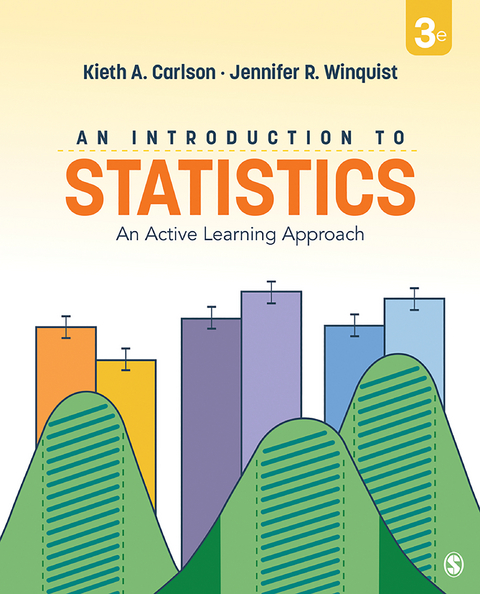
An Introduction to Statistics (eBook)
Sage Publications, Inc (Verlag)
978-1-5443-7510-6 (ISBN)
Preface
Acknowledgments
About the Authors
Part 1: Descriptive Statistics and Sampling Error
Chapter 1: Introduction to Statistics and Frequency Distributions
How to Be Successful in This Course
Math Skills Required in This Course
Statistical Software Options
Why Do You Have to Take Statistics?
The Four Pillars of Scientific Reasoning
Populations and Samples
Independent and Dependent Variables
Identify How a Variable Is Measured
Graphing Data
Shapes of Distributions
Frequency Distribution Tables
Chapter 2: Central Tendency and Variability
Frequency Distribution Graphs and Tables
Central Tendency: Choosing Mean, Median, or Mode
Computing Measures of Central Tendency
Variability: Range or Standard Deviation
Steps in Computing a Population’s Standard Deviation
Steps in Computing a Sample’s Standard Deviation
Constructing a Scientific Conclusion
Chapter 3: z scores
Computing and Interpreting z for a Raw Score
Finding Raw Score “Cut Lines”
Finding the Probability of z Scores Using the Standard Normal Curve
Positive z Score Example
Negative z Score Example
Proportion Between Two z Scores Example
Chapter 4: Sampling Error and Confidence Intervals with z and t Distributions
Sampling and Sampling Error
The Central Limit Theorem and the Standard Error of the Mean (SEM)
Applying the SEM to Find Statistical Evidence
Part 2: Applying the Four Pillars of Scientific Reasoning to Mean Differences
Chapter 5: Single sample t, effect sizes, and confidence intervals
Four Pillars of Scientific Reasoning
Apply the Four Pillars of Scientific Reasoning
Construct a Well-Supported Scientific Conclusion
Chapter 6: Related samples t, effect sizes, and confidence intervals
Related Samples t Test
Logic of the Single Sample and Related Samples t Tests
Apply the Four Pillars of Scientific Reasoning
Construct a Well-Supported Scientific Conclusion
Chapter 7: Independent samples t, effect sizes, and confidence intervals
When to Use the Three t Tests
The t Test Logic and the Independent Samples t Formula
Apply the Four Pillars of Scientific Reasoning
Construct a Well-Supported Scientific Conclusion
How to Interpret High p Values
Chapter 8: One-way ANOVA, effect sizes, and confidence intervals
Independent Samples One-Way ANOVA
Logic of the ANOVA
Apply Four Pillars of Scientific Reasoning
Chapter 9: Two-way ANOVA, effect sizes, and confidence intervals
Purpose of Two-Way ANOVA
Logic of Two-Way ANOVA
Apply Four Pillars of Scientific Reasoning
Part 3: Applying the Four Pillars of Scientific Reasoning to Associations
Chapter 10: Correlations, effect sizes, and confidence intervals
When to Use Correlations
The Logic of Correlation
Interpreting Correlation Coefficients
Spearman’s (rs) Correlation
Correlation Does Not Equal Causation: True but Misleading
Apply the Four Pillars of Scientific Reasoning
Construct a Well-Supported Scientific Conclusion
Chapter 11: Chi square and effect sizes
When to Use X2 Statistics
Logic of the X2 Test
Apply the Pillars of Scientific Reasoning
Construct a Well-Supported Scientific Conclusion
Apply the Pillars of Scientific Reasoning: X2 for Independence
Appendices
References
Index
| Erscheint lt. Verlag | 19.1.2021 |
|---|---|
| Verlagsort | Thousand Oaks |
| Sprache | englisch |
| Themenwelt | Geisteswissenschaften ► Psychologie |
| Schlagworte | An Introduction to Statistics: An Active Learning Approach, Third Edition • introduction to statistics • Kieth A. Carlson • Statistical Concepts • Statistics |
| ISBN-10 | 1-5443-7510-7 / 1544375107 |
| ISBN-13 | 978-1-5443-7510-6 / 9781544375106 |
| Informationen gemäß Produktsicherheitsverordnung (GPSR) | |
| Haben Sie eine Frage zum Produkt? |
 EPUB (Adobe DRM)
Kopierschutz: Adobe-DRM
Adobe-DRM ist ein Kopierschutz, der das eBook vor Mißbrauch schützen soll. Dabei wird das eBook bereits beim Download auf Ihre persönliche Adobe-ID autorisiert. Lesen können Sie das eBook dann nur auf den Geräten, welche ebenfalls auf Ihre Adobe-ID registriert sind.
Details zum Adobe-DRM
Dateiformat: EPUB (Electronic Publication)
EPUB ist ein offener Standard für eBooks und eignet sich besonders zur Darstellung von Belletristik und Sachbüchern. Der Fließtext wird dynamisch an die Display- und Schriftgröße angepasst. Auch für mobile Lesegeräte ist EPUB daher gut geeignet.
Systemvoraussetzungen:
PC/Mac: Mit einem PC oder Mac können Sie dieses eBook lesen. Sie benötigen eine
eReader: Dieses eBook kann mit (fast) allen eBook-Readern gelesen werden. Mit dem amazon-Kindle ist es aber nicht kompatibel.
Smartphone/Tablet: Egal ob Apple oder Android, dieses eBook können Sie lesen. Sie benötigen eine
Geräteliste und zusätzliche Hinweise
Buying eBooks from abroad
For tax law reasons we can sell eBooks just within Germany and Switzerland. Regrettably we cannot fulfill eBook-orders from other countries.
aus dem Bereich