


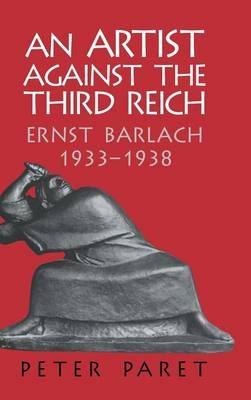
An Artist against the Third Reich
Ernst Barlach, 1933–1938
Seiten
2003
Cambridge University Press (Verlag)
978-0-521-82138-4 (ISBN)
Cambridge University Press (Verlag)
978-0-521-82138-4 (ISBN)
The conflict between National Socialism and Ernst Barlach is an unusual episode in the history of Hitler's efforts to rid Germany of 'international modernism'. Peter Paret's fine study of an artist in a time of crisis seamlessly combines the history of modern Germany and of modern art.
The conflict between National Socialism and Ernst Barlach, one of the most important sculptors of the twentieth century, is an unusual episode in the history of Hitler's efforts to rid Germany of 'international modernism'. Barlach did not passively accept the confiscation and destruction of his sculptures. He protested the injustice, and continued his work. Hitler's rejection of modernism, often dismissed as absurd ranting, is instead interpreted as an internally consistent and politically effective critique of liberal Western culture. That some radical national socialists nevertheless advocated a 'Nordic modernism' and tried to win Barlach over indicates the cultural cross-currents running through the early years of the Third Reich. Peter Paret's closely focused study of an artist in a time of crisis seamlessly combines the history of modern Germany and the history of modern art.
The conflict between National Socialism and Ernst Barlach, one of the most important sculptors of the twentieth century, is an unusual episode in the history of Hitler's efforts to rid Germany of 'international modernism'. Barlach did not passively accept the confiscation and destruction of his sculptures. He protested the injustice, and continued his work. Hitler's rejection of modernism, often dismissed as absurd ranting, is instead interpreted as an internally consistent and politically effective critique of liberal Western culture. That some radical national socialists nevertheless advocated a 'Nordic modernism' and tried to win Barlach over indicates the cultural cross-currents running through the early years of the Third Reich. Peter Paret's closely focused study of an artist in a time of crisis seamlessly combines the history of modern Germany and the history of modern art.
List of illustrations; Acknowledgements; Introduction; 1. Hitler; 2. Barlach; 3. Nordic modernism; 4. The hounding of Barlach; 5. German and un-German art; 6. After the fact; A note on the literature; Notes; Documents and works cited; Index.
| Erscheint lt. Verlag | 24.3.2003 |
|---|---|
| Zusatzinfo | 38 Halftones, unspecified |
| Verlagsort | Cambridge |
| Sprache | englisch |
| Maße | 158 x 237 mm |
| Gewicht | 464 g |
| Themenwelt | Kunst / Musik / Theater ► Kunstgeschichte / Kunststile |
| Kunst / Musik / Theater ► Malerei / Plastik | |
| Geschichte ► Allgemeine Geschichte ► 1918 bis 1945 | |
| Geisteswissenschaften ► Geschichte ► Regional- / Ländergeschichte | |
| ISBN-10 | 0-521-82138-X / 052182138X |
| ISBN-13 | 978-0-521-82138-4 / 9780521821384 |
| Zustand | Neuware |
| Informationen gemäß Produktsicherheitsverordnung (GPSR) | |
| Haben Sie eine Frage zum Produkt? |
Mehr entdecken
aus dem Bereich

aus dem Bereich
Deutschland 1933 bis 1945
Buch | Hardcover (2025)
S. Fischer (Verlag)
CHF 47,60
ein Psychologe erlebt das Konzentrationslager
Buch | Hardcover (2024)
Kösel (Verlag)
CHF 30,80


