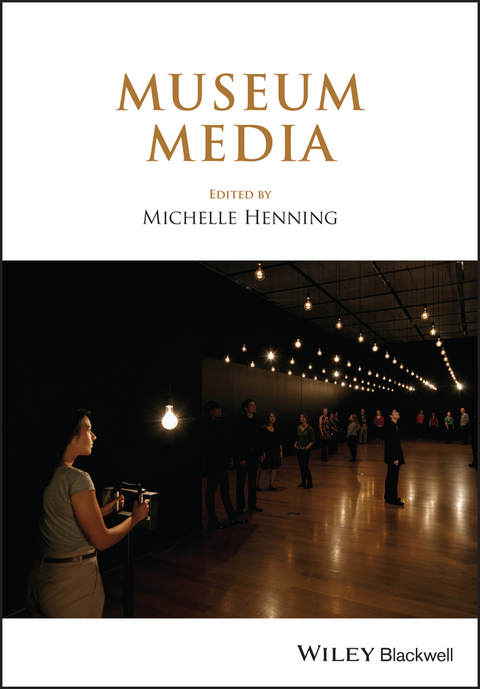
MUSEUM MEDIA Edited by Michelle Henning
Museum Media explores the contemporary uses of diverse media in museum contexts and discusses how technology is reinventing the museum. It considers how technological changes-from photography and television through to digital mobile media-have given rise to new habits, forms of attention and behaviors. It explores how research methods can be used to understand people's relationships with media technologies and display techniques in museum contexts, as well as the new opportunities media offer for museums to engage with their visitors.
Entries written by leading experts examine the transformation of history and memory by new media, the ways in which exhibitions mediate visitor experience, how designers and curators can establish new kinds of relationships with visitors, the expansion of the museum beyond its walls and its insertion into a wider commercial and corporate landscape. Focusing on formal, theoretical and technical aspects of exhibition practice, this in-depth volume explores questions of temporality, attachment to objects, atmospheric and immersive exhibition design, the reinvention of the exhibition medium, and much more.
MICHELLE HENNING is Professor in Photography and Media at the University of Liverpool, UK. She is a practicing photographer and designer, and has written widely on museums, media, and photography in her books Museums, Media and Cultural Theory and Photography: The Unfettered Image.
MICHELLE HENNING is Professor in Photography and Media at the University of Liverpool, UK. She is a practicing photographer and designer, and has written widely on museums, media, and photography in her books Museums, Media and Cultural Theory and Photography: The Unfettered Image.
List of Illustrations ix
Editor xiii
General Editors xiv
Contributors xv
Acknowledgments xvii
General Editors' Preface to Museum Studies and the International Handbooks of Museum Studies xix
Museum Media: An Introduction xxvii
Michelle Henning
Part I The Museum as Medium 1
1 Museums and Media Archaeology: An Interview with Wolfgang Ernst 3
Michelle Henning
2 Media Archaeology of/in the Museum 23
Andrew Hoskins and Amy Holdsworth
3 Museums and the Challenge of Transmediation: The Case of Bristol's Wildwalk 43
Nils Lindahl Elliot
4 Mediatized Memory: Video Testimonies in Museums 69
Steffi de Jong
5 Visible and Invisible Institutions: Cinema in the French Art Museum 95
Jenny Chamarette
6 The Museum as TV Producer: Televisual Form in Curating, Commissioning, and Public Programming 121
Maeve Connolly
7 SimKnowledge: What Museums Can Learn from Video Games 145
Seth Giddings
Part II Mediation and Immersion 165
8 The Life of Things 167
Ivan Gaskell
9 Lighting Practices in Art Galleries and Exhibition Spaces, 1750-1850 191
Alice Barnaby
10 There's Something in the Air: Sound in the Museum 215
Rupert Cox
11 Aesthetics and Atmosphere in Museums: A Critical Marketing Perspective 235
Brigitte Biehl-Missal and Dirk vom Lehn
12 Museums, Interactivity, and the Tasks of "Exhibition Anthropology" 259
Erkki Huhtamo
13 Keeping Objects Live 279
Fiona Candlin
Part III Design and Curating in the Media Age 303
14 Total Media 305
Peter Higgins
15 From Object to Environment: The Recent History of Exhibitions in Germany and Austria 327
Bettina Habsburg-Lothringen [Translated by Mark Miscovich]
16 Museums as Spaces of the Present: The Case for Social Scenography 349
Beat Hachler [Translated by Niall Hoskin]
17 (Dis)playing the Museum: Artifacts, Visitors, Embodiment, and Mediality 371
Karin Harrasser
18 Transforming the Natural History Museum in London: Isotype and the New Exhibition Scheme 389
Sue Perks
19 Embodiment and Place Experience in Heritage Technology Design 419
Luigina Ciolfi
Part IV Extending the Museum 447
20 Open and Closed Systems: New Media Art in Museums and Galleries 449
Beryl Graham
21 Diffused Museums: Networked, Augmented, and Self-Organized Collections 473
John Bell and Jon Ippolito
22 Mobile in Museums: From Interpretation to Conversation 499
Nancy Proctor
23 Moving Out: Museums, Mobility, and Urban Spaces 527
Mark W. Rectanus
24 Beyond the Glass Case: Museums as Playgrounds for Replication 553
Petra Tjitske Kalshoven
25 With and Without Walls: Photographic Reproduction and the Art Museum 577
Michelle Henning
26 The Elastic Museum: Cinema Within and Beyond 603
Haidee Wasson
Index 629
GENERAL EDITORS’ PREFACE TO MUSEUM STUDIES AND THE INTERNATIONAL HANDBOOKS OF MUSEUM STUDIES
Museum Media
As general editors of The International Handbooks in Museum Studies, we – Sharon Macdonald and Helen Rees Leahy – are delighted that Museum Media is now appearing in paperback, as a self-standing volume. So too are the other volumes, which is testament to the strength of these volumes individually, as well as collectively, and to the importance of the issues that they each address. Museum Media clearly concerns a fundamental area of museum studies – museums can be said to in a sense be media, as well as to deploy a wide range of different forms of media. Despite the fact that media are fundamental to museums – and thus to museum studies – there is not, however, an established consensus on precisely what might be covered under the label “museum media”. One reason for this is the relative recency of museum studies as a field. A second reason is that museum studies draws on a wide range of disciplines, each themselves renewing their toolkits in various ways, resulting in new impulses for thinking about the media in museums. In addition, and perhaps of most significance, is the fact of change in the media available for use in museums. This results in fresh thinking about the possibilities for deploying such media, as well as for consideration of its potential consequences not only for engaging new audiences but also for rethinking what the museum already does, as well as what it might do in new ways.
Confronted by the fast-changing world of new media, as well as fascinating redeployments of older media, the editor of Museum Media, Michelle Henning, in consultation with us as general editors, faced a task of how to achieve a volume that would cover approaches that have become central to consideration of museum media, while also being sure to include as much as possible of the new directions and ideas that have been emerging in recent years. That this was achieved so well is evident from the resulting volume. The range of topics included and the ways in which they are tackled, provide a sound and also cutting-edge coverage of museum media.
The International Handbooks in Museum Studies
Collectively, The International Handbooks in Museum Studies include over a hundred original, state-of-the-art chapters on museums and museum studies. As such, they are the most comprehensive review to date of the lively and expanding field of museum studies. Written by a wide range of scholars and practitioners – newer voices as well as those already widely esteemed – The International Handbooks provide not only extensive coverage of key topics and debates in the museum field, but also make a productive contribution to emerging debates and areas, as well as to suggest how museum studies – and museums – might develop in the future.
The number of excellent contributors able and willing to write on museum topics is itself testimony to the state of the field, as was recognition by the publishers that the field warranted such a substantial work. Bringing together such a range and quantity of new writing about museums was accomplished through the deep knowledge, extensive networks, and sheer labour of the volume editors – Andrea Witcomb and Kylie Message, Museum Theory; Conal McCarthy, Museum Practice; Michelle Henning, Museum Media; and Annie E. Coombes and Ruth B. Phillips, Museum Transformations. All enthusiastically took up the mandate to go out and recruit those they thought would be best able to write useful and timely essays on what they defined as the most important topics within their area of remit. Their brief was to look widely for potential contributors, including unfamiliar, as well as familiar, names. We – and they – were especially interested in perspectives from people whose voices have not always been heard within the international museum studies conversation thus far. This breadth is also a feature of the expanded and expanding field itself, as we explain further below.
Diversification and democratization
The editors of the four volumes that constitute The International Handbooks are based in four different countries – Australia, New Zealand, the United Kingdom, and Canada; and contributors have their institutional homes in over a dozen more. Yet these numbers alone do not fully convey the trend to diversification that we see in these volumes, and in museum studies more widely. “Internationalization” is a term that might be used but does not, we think, adequately characterize what is involved. Certainly, there is more traffic between nations of ideas about museums and about how to study them. Debates travel from one part of the globe to another, with museums and exhibitions in one location being used as models for emulation or avoidance in another. The massive expansion of professional training in museum studies that has taken place over the past three decades helps establish a shared discourse, not least as many students study away from their home countries or those in which they will later work. So too do texts in and about the field, certain key ones often being found on reading lists in numerous countries and also republished in successive readers. Such developments establish the basis for a conversation capable of transcending borders.
It is evident from the contents of The International Handbooks of Museum Studies, however, that the democratization runs deeper than the traffic of discourse and practice across national borders, and, in particular, that the traffic is more multidirectional than it was previously. Not only do contributors have their primary work bases in a range of different countries, and not only do many have experience of training or working in others, they also often give attention – sometimes through the direct engagement of collaborative work or study – to a wide range of groups and populations in a variety of countries, including their own. In doing so, they strive not merely to incorporate but also to learn from and be challenged by people and perspectives that have not been part of mainstream museological debate. The attention to the (not unproblematic) category of the indigenous is especially marked in these International Handbooks, most notably in the Transformations volume, although it also finds its way into the others. Like attention to other forms of absence from the existing mainstream museum conversation, this is symptomatic of a broader move toward finding alternative ways of seeing and doing, ways that both add to the range of existing possibilities and also, sometimes, unsettle these by showing how, say, particular theorizing or practice relies on unspoken or previously unrecognized assumptions.
Diversification takes other forms too. These volumes are not organized by type of museum – a format that we think restrictive in its lack of recognition of so many shared features and concerns of museums – and do not use this as a classification of content. Nevertheless, it is easy to see that the volumes include a great range of museum kinds, and even of forms that might not always be considered museums, or that challenge the idea of the museum as a physical space. Museums of art, history, and ethnography – and also those more general and eclectic museums that have sometimes been described as encyclopedic – have powered a good deal of museum theorizing and debate, and they are amply represented here. But they are accompanied also by examples from museums of natural history, science, technology, and medicine, as well as heritage sites and out-of-gallery installations. Alongside national museums, which were the backbone of much important theorizing of the role of museums in the making of national identity and citizenship, are numerous examples of smaller museums, some of which are devoted to a specific topic and others of which have a regional or local foundation and focus. These museums may be less well endowed with staff, buildings, or funds, but are nevertheless doing important, even pioneering, work that deserves attention from museum studies. That attention contributes not only to extending the range of types and cases but also helps to illuminate the variety of specific features of museums that need to be taken into account in formulating more comprehensive approaches. As many chapters across the volumes show, one size does not fit all – or, to put it better perhaps, one theoretical perspective or set of guidelines for practice, one apt choice of media or transformative activity, does not fit all types and sizes of museums. Adding more to the mix does not just provide greater coverage or choice but also helps to identify better what is at stake and what might be possible in different kinds of situations, constellations, or conjunctures (to use a word favored in Museum Theory). As such, it helps those of us engaged in and with museums to get a better grasp on what is and what might be shared, as well as on what is distinctive and needs to be understood in more fine-grained ways.
Another feature of diversification that deserves comment here is the temporal. There has been a considerable amount of outstanding historical research undertaken in museum studies and the International Handbooks both review some of this and contribute further to it. Such work is important in its own terms, helping us to understand better the contexts in which museums emerged and have operated, and the concerns, constraints, personalities, and opportunities in...
| Erscheint lt. Verlag | 17.11.2020 |
|---|---|
| Sprache | englisch |
| Themenwelt | Kunst / Musik / Theater |
| Geisteswissenschaften ► Geschichte ► Hilfswissenschaften | |
| Sozialwissenschaften ► Kommunikation / Medien ► Buchhandel / Bibliothekswesen | |
| Wirtschaft | |
| Schlagworte | Art & Applied Arts • Kunst u. Angewandte Kunst • Museen u. Kulturerbe • Museum • Museum & Heritage Studies |
| ISBN-10 | 1-119-79664-4 / 1119796644 |
| ISBN-13 | 978-1-119-79664-0 / 9781119796640 |
| Informationen gemäß Produktsicherheitsverordnung (GPSR) | |
| Haben Sie eine Frage zum Produkt? |
 EPUB (Adobe DRM)
Kopierschutz: Adobe-DRM
Adobe-DRM ist ein Kopierschutz, der das eBook vor Mißbrauch schützen soll. Dabei wird das eBook bereits beim Download auf Ihre persönliche Adobe-ID autorisiert. Lesen können Sie das eBook dann nur auf den Geräten, welche ebenfalls auf Ihre Adobe-ID registriert sind.
Details zum Adobe-DRM
Dateiformat: EPUB (Electronic Publication)
EPUB ist ein offener Standard für eBooks und eignet sich besonders zur Darstellung von Belletristik und Sachbüchern. Der Fließtext wird dynamisch an die Display- und Schriftgröße angepasst. Auch für mobile Lesegeräte ist EPUB daher gut geeignet.
Systemvoraussetzungen:
PC/Mac: Mit einem PC oder Mac können Sie dieses eBook lesen. Sie benötigen eine
eReader: Dieses eBook kann mit (fast) allen eBook-Readern gelesen werden. Mit dem amazon-Kindle ist es aber nicht kompatibel.
Smartphone/Tablet: Egal ob Apple oder Android, dieses eBook können Sie lesen. Sie benötigen eine
Geräteliste und zusätzliche Hinweise
Buying eBooks from abroad
For tax law reasons we can sell eBooks just within Germany and Switzerland. Regrettably we cannot fulfill eBook-orders from other countries.
aus dem Bereich