


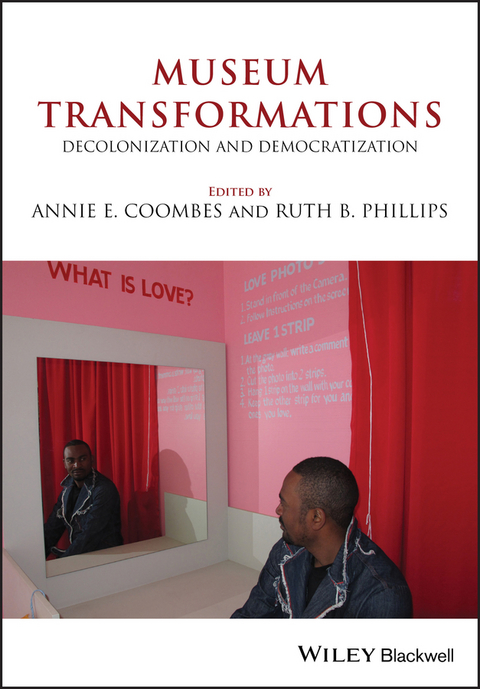
Museum Transformations (eBook)
John Wiley & Sons (Verlag)
978-1-119-79659-6 (ISBN)
MUSEUM TRANSFORMATIONS DECOLONIZATION AND DEMOCRATIZATION
Edited By ANNIE E. COOMBES AND RUTH B. PHILLIPS
Museum Transformations: Decolonization and Democratization addresses contemporary approaches to decolonization, greater democratization, and revisionist narratives in museum exhibition and program development around the world. The text explores how museums of art, history, and ethnography responded to deconstructive critiques from activists and poststructuralist and postcolonial theorists, and provided models for change to other types of museums and heritage sites.
The volume's first set of essays discuss the role of the museum in the narration of difficult histories, and how altering the social attitudes and political structures that enable oppression requires the recognition of past histories of political and racial oppression and colonization in museums. Subsequent essays consider the museum's new roles in social action and discuss experimental projects that work to change power dynamics within institutions and leverage digital technology and new media.
ANNIE E. COOMBES is Professor of Material and Visual Culture at Birkbeck, University of London, UK, where she teaches museum studies and art and cultural history. She is Director of the Peltz Gallery and author of award-winning books on museums, memorialization, and the legacy of colonialism.
RUTH B. PHILLIPS is Canada Research Professor of Art History at Carleton University, Ottawa, Canada. She has served as director of the University of British Columbia Museum of Anthropology and teaches and publishes on Indigenous North American art and critical museology.
ANNIE E. COOMBES is Professor of Material and Visual Culture at Birkbeck, University of London, UK, where she teaches museum studies and art and cultural history. She is Director of the Peltz Gallery and author of award-winning books on museums, memorialization, and the legacy of colonialism. RUTH B. PHILLIPS is Canada Research Professor of Art History at Carleton University, Ottawa, Canada. She has served as director of the University of British Columbia Museum of Anthropology and teaches and publishes on Indigenous North American art and critical museology.
List of Illustrations ix
Editors xiii
General Editors xiv
Contributors xv
Editors' Preface to Museum Transformations and The International Handbooks of Museum Studies xvii
Introduction: Museums in Transformation: Dynamics of Democratization and Decolonization xxv
Annie E. Coombes and Ruth B. Phillips
Part I Difficult Histories 1
1. The Holocaust Memorial in Berlin and Its Information Center: Concepts, Controversies, Reactions 3
Sibylle Quack
2. Ghosts of Future Nations, or The Uses of the Holocaust Museum Paradigm in India 29
Kavita Singh
3. The International Difficult Histories Boom, the Democratization of History, and the National Museum of Australia 61
Bain Attwood
4. Where are the Children? and "We Were So Far Away ...": Exhibiting the Legacies of Residential Schools, Healing, and Reconciliation 85
Jonathan Dewar
5. Recirculating Images of the "Terrorist" in Postcolonial Museums: The Case of the National Museum of Struggle in Nicosia, Cyprus 113
Gabriel Koureas
6. Reactivating the Colonial Collection: Exhibition-Making as Creative Process at the Tropenmuseum, Amsterdam 133
Mary Bouquet
7. "Congo As It is?": Curatorial Reflections on Using Spatial Urban History in the Memory of Congo: The Colonial Era Exhibition 157
Johan Lagae
8. Between the Archive and the Monument: Memory Museums in Postdictatorship Argentina and Chile 181
Jens Andermann
9. The Gender of Memory in Postapartheid South Africa: The Women's Jail as Heritage Site 207
Annie E. Coombes
Part II Social Agency and the Museum 227
10. An Ethnography of Repatriation: Engagements with Erromango, Vanuatu 229
Lissant Bolton
11. Of Heritage and Hesitation: Reflections on the Melanesian Art Project at the British Museum 249
Nicholas Thomas
12. The Blackfoot Shirts Project: "Our Ancestors Have Come to Visit" 263
Alison K. Brown and Laura Peers
13. "Get to Know Your World": An Interview with Jim Enote, Director of the A:shiwi A:wan Museum and Heritage Center in Zuni, New Mexico 289
Gwyneira Isaac
14. The Paro Manene Project: Exhibiting and Researching Photographic Histories in Western Kenya 311
Christopher Morton and Gilbert Oteyo
15. Reanimating Cultural Heritage: Digital Curatorship, Knowledge Networks, and Social Transformation in Sierra Leone 337
Paul Basu
16. On Not Looking: Economies of Visuality in Digital Museums 365
Kimberly Christen
17. Preserving the Physical Object in Changing Cultural Contexts 387
Miriam Clavir
Part III Museum Experiments 413
18. The Last Frontier: Migratory Culture, Video, and Exhibiting without Voyeurism 415
Mieke Bal
19. Public Art/Private Lives: The Making of Hotel Yeoville 439
Tegan Bristow, Terry Kurgan and Alexander Opper
20. Museums, Women, and the Web 471
Reesa Greenberg
21. Möbius Museology: Curating and Critiquing the Multiversity Galleries at the Museum of Anthropology at the University of British Columbia 489
Jennifer Kramer
22. When You Were Mine: (Re)Telling History at the National Museum of the American Indian 511
Paul Chaat Smith
23. Against the Edifice Complex: Vivan Sundaram's History Project and the Colonial Museum in India 527
Saloni Mathur
24. Can National Museums be Postcolonial?: The Canadian Museum for Human Rights and the Obligation of Redress to First Nations 545
Ruth B. Phillips
Index 575
LIST OF ILLUSTRATIONS
Color plate section
1.2 Room of Dimensions, Foundation Memorial to the Murdered Jews of Europe, 2008
3.3 Theresa Napurrula Ross, National Museum of Australia
7.4 “Society” menu of the interactive display on the city of Boma
8.1 The Museum of Memory and Human Rights, Santiago de Chile
9.2 Ground plan of a cell at the Women’s Jail, Johannesburg, 2005
9.4 Nikiwe Deborah Matshoba’s wedding dress at the Women’s Jail, Johannesburg, 2005
10.2 Women in south Erromango studying photographs of barkcloth held by the British Museum, 2007
11.3 Ralph Regenvanu, The Melanesia Project, 2006, British Museum
12.3 Students from Red Crow Community College, Kainai Nation, during a visit to the Glenbow Museum
13.1 Yucca workshop, A:shiwi A:wan Museum and Heritage Center
19.3 A Hotel Yeoville participant adds his story to the Google Maps API in the Journey Booth
19.6 Installation view of the Hotel Yeoville main thoroughfare
20.2 elles@centrepompidou homepage, 2009
21.1 Kwakwaka’wakw area, UBC Museum of Anthropology Multiversity Galleries
23.2 Exhibition view: Vivan Sundaram, The History Project, 1998
Chapter illustrations
0.1 Masks made by Kalabari peoples from the Niger Delta, Sainsbury Africa Gallery, British Museum
0.2 Tree of Life, 2004, Sainsbury Africa Gallery
0.4 Visual Sovereignty Dance at Masq’alors! International Mask Festival, St. Camille
1.1 Memorial to the Murdered Jews of Europe, Berlin
1.2 Room of Dimensions, Memorial to the Murdered Jews of Europe
1.3 Room of Names, Memorial to the Murdered Jews of Europe
1.4 Room of Families, Memorial to the Murdered Jews of Europe
2.1 Khalsa Heritage Complex, Anandpur Sahib
2.2 Galleries dedicated to Guru Nanak, Khalsa Heritage Complex
2.3 Paintings of eighteenth‐century martyrs, Central Sikh Museum
2.4 Gallery view, Tibet Museum, McLeodganj
2.5 Bloodstained shirt of escapee from China, Tibet Museum
2.6 Street leading to Demton Khang and Tsuglugkhang Complex, McLeodganj
3.1 “Contested Frontiers” exhibit, National Museum of Australia
3.2 1823–1825 Wiradjuri War display, National Museum of Australia
3.3 Theresa Napurrula Ross tells of the Coniston Massacre, National Museum of Australia
4.1 Where Are the Children? at the Tom Thomson Gallery, 2009
4.2 Entrance to Where Are the Children?, Glooscap Heritage Centre, Millbrook, Nova Scotia, 2011
4.3 Entrance to Where Are the Children?, Tom Thomson Gallery, 2009
4.4 “We Were So Far Away …,” Ottawa Catholic School Board, 2010
4.5 An Elder in Arviat, Nunavut, encounters “We Were So Far Away …” at the Mikilaaq Centre, 2009
5.1 National Museum of Struggle and Archbishop’s Palace, Nicosia
5.2 Photographs of dead fighters, National Museum of Struggle
5.3 Photographs of British interrogators/torturers and of their victims, National Museum of Struggle
6.2 Introductory panel to “Oceania” section of “Eastward Bound!” at the Tropenmuseum
6.3 Colonial Theater, Tropenmuseum
6.4 Yinka Shonibare, Planets in My Head, Literature, 2011
7.1 The color bar as reflected in urban form and architecture, Royal Museum for Central Africa
7.2 Main interface of interactive display on the city of Boma, Royal Museum for Central Africa
7.3 Title page of interactive display on Boma
7.4 “Society” menu of the interactive display on Boma
7.5 “Violence” menu of the interactive display on Boma
8.1 Museum of Memory and Human Rights, Santiago de Chile
8.2 Jorge Tacla, Al mismo tiempo, en el mismo lugar, Museum of Memory and Human Rights
8.4 Former concentration camp at Police Headquarters, Plaza Cívica, Rosario
9.1 Monument to the Women of South Africa, by Wilma Cruise and Marcus Holme, 2000
9.2 Ground plan of a cell, Women’s Jail, Johannesburg
9.3 Installations across the atrium, Women’s Jail
9.4 Nikiwe Deborah Matshoba’s wedding dress, Women’s Jail
10.1 Erromangan women ready to perform at Vanuatu’s Third National Arts Festival, Port Vila
10.2 Women in south Erromango studying photographs of barkcloth held by the British Museum
11.1 Shield, Trobriand Islands, British Museum
11.2 Workroom at British Museum ethnograph store
11.3 Ralph Regenvanu, The Melanesia Project, 2006
12.1 Blackfoot shirts on display at the Glenbow Museum
12.2 Discussing leggings and shirts at the Pitt Rivers Museum
12.3 Students from Red Crow Community College, Kainai Nation, during a visit to the Glenbow Museum
12.4 Teacher training session at the Glenbow Museum
13.1 Yucca workshop, A:shiwi A:wan Museum and Heritage Center
14.2 Pupils at Rakombe Primary School view the Paro Manene exhibition
14.4 Framed portraits in the home of a surviving wife of Chief Owuor
15.1 The sierraleoneheritage.org digital resource
15.2 Frames from the sowei video documentation
15.3 Mural promoting sierraleoneheritage.org on a wall of the Sierra Leone National Museum
15.4 Visual repatriation of history at Rotata
15.5 The Reanimating Cultural Heritage project
16.1 Warumungu women watching and editing videos for the DDAC website
16.2 Home page of the DDAC website
16.4 Inuvialuit Living History Project team examine engraved wooden plaques
16.5 Inuvialuit Pitqusit Inuuniarutait/Inuvialuit Living History homepage
18.1 Watching films on the lecterns/little houses in Towards the Other
18.2 Watching Nothing Is Missing in Towards the Other
19.1 Hotel Yeoville visitor in the Photo Booth
19.2 Comments left in the Photo Booth by Hotel Yeoville visitors
19.3 Hotel Yeoville participant adds his story to the Journey Booth
19.4 Hotel Yeoville visitor making a YouTube video in the Video Booth
19.5 Hotel Yeoville exhibition layout
19.6 Installation view of Hotel Yeoville main thoroughfare
20.1 WACK! Art and the Feminist Revolution homepage
20.2 elles@centrepompidou homepage
20.3 Shifting the Gaze: Painting and Feminism homepage
21.1 Kwakwaka’wakw area, Multiversity Galleries, UBC Museum of Anthropology
21.2 Nuxalk raven rattles, UBC Museum of Anthropology
22.1 National Museum of the American Indian, Washington, DC
22.3 Installation of guns and Bibles, National Museum of the American Indian
| Erscheint lt. Verlag | 17.11.2020 |
|---|---|
| Sprache | englisch |
| Themenwelt | Kunst / Musik / Theater |
| Geisteswissenschaften ► Geschichte ► Hilfswissenschaften | |
| Sozialwissenschaften ► Kommunikation / Medien ► Buchhandel / Bibliothekswesen | |
| Wirtschaft ► Betriebswirtschaft / Management | |
| Schlagworte | Art & Applied Arts • Kunst u. Angewandte Kunst • Museen u. Kulturerbe • Museum • Museum & Heritage Studies |
| ISBN-10 | 1-119-79659-8 / 1119796598 |
| ISBN-13 | 978-1-119-79659-6 / 9781119796596 |
| Informationen gemäß Produktsicherheitsverordnung (GPSR) | |
| Haben Sie eine Frage zum Produkt? |
 EPUB (Adobe DRM)
Kopierschutz: Adobe-DRM
Adobe-DRM ist ein Kopierschutz, der das eBook vor Mißbrauch schützen soll. Dabei wird das eBook bereits beim Download auf Ihre persönliche Adobe-ID autorisiert. Lesen können Sie das eBook dann nur auf den Geräten, welche ebenfalls auf Ihre Adobe-ID registriert sind.
Details zum Adobe-DRM
Dateiformat: EPUB (Electronic Publication)
EPUB ist ein offener Standard für eBooks und eignet sich besonders zur Darstellung von Belletristik und Sachbüchern. Der Fließtext wird dynamisch an die Display- und Schriftgröße angepasst. Auch für mobile Lesegeräte ist EPUB daher gut geeignet.
Systemvoraussetzungen:
PC/Mac: Mit einem PC oder Mac können Sie dieses eBook lesen. Sie benötigen eine
eReader: Dieses eBook kann mit (fast) allen eBook-Readern gelesen werden. Mit dem amazon-Kindle ist es aber nicht kompatibel.
Smartphone/Tablet: Egal ob Apple oder Android, dieses eBook können Sie lesen. Sie benötigen eine
Geräteliste und zusätzliche Hinweise
Buying eBooks from abroad
For tax law reasons we can sell eBooks just within Germany and Switzerland. Regrettably we cannot fulfill eBook-orders from other countries.


