


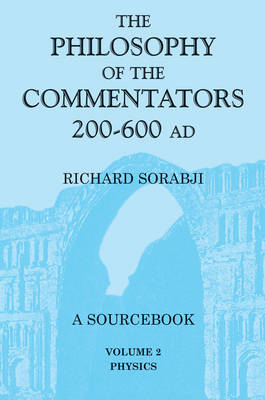
The Philosophy of the Commentators, 200-600 AD
Seiten
2004
Bristol Classical Press (Verlag)
978-0-7156-3246-8 (ISBN)
Bristol Classical Press (Verlag)
978-0-7156-3246-8 (ISBN)
The physics of the commentators was innovatory. The Neoplatonists thought the world of space and time was ordered by a non-spatial, non-temporal world. Simplicius considered his teacher's ideas on space and time to be unprecedented, and Philoponus revised Aristotelianism around Christian thought.
This is a sourcebook that draws upon the 400 years of transition from ancient Greek philosophy to the medieval philosophy of Islam and the West. Philosophy was then often written in the form of commentaries on the works of Plato and Aristotle. Many ideas wrongly credited to the Middle Ages derive from this period, e.g. that of impetus in dynamics and intentional objects in philosophy of mind. The later Neoplatonist commentators fought a losing battle with Christianity, but inadvertently made Aristotle acceptable to Christians by ascribing to him belief in a Creator God and human immortality. They also provided a panorama of up to 1000 years of preceding Greek philosophy, much of it otherwise lost. They serve as the missing link essential for understanding the history of Western philosophy. The physics of the commentators was innovatory. The Neoplatonists among them thought that the world of space and time was causally ordered by a non-spatial, non-temporal world, and this required original thinking.
Of the sixth-century Neoplatonists, Simplicius considered his teacher's ideas on space and time to be unprecedented, and Philoponus revised Aristotelianism, to produce a new physics built around the Christian belief in God's creation of the world. The Middle Ages borrowed from Philoponus and other commentators, the proofs of a finite past, the idea of degrees of latitude in change and mixture, and in dynamics the idea of impetus and the defence of motion in a vacuum. All sources appear in English translation and are carefully linked and cross-referenced by editorial comment and explanation.
This is a sourcebook that draws upon the 400 years of transition from ancient Greek philosophy to the medieval philosophy of Islam and the West. Philosophy was then often written in the form of commentaries on the works of Plato and Aristotle. Many ideas wrongly credited to the Middle Ages derive from this period, e.g. that of impetus in dynamics and intentional objects in philosophy of mind. The later Neoplatonist commentators fought a losing battle with Christianity, but inadvertently made Aristotle acceptable to Christians by ascribing to him belief in a Creator God and human immortality. They also provided a panorama of up to 1000 years of preceding Greek philosophy, much of it otherwise lost. They serve as the missing link essential for understanding the history of Western philosophy. The physics of the commentators was innovatory. The Neoplatonists among them thought that the world of space and time was causally ordered by a non-spatial, non-temporal world, and this required original thinking.
Of the sixth-century Neoplatonists, Simplicius considered his teacher's ideas on space and time to be unprecedented, and Philoponus revised Aristotelianism, to produce a new physics built around the Christian belief in God's creation of the world. The Middle Ages borrowed from Philoponus and other commentators, the proofs of a finite past, the idea of degrees of latitude in change and mixture, and in dynamics the idea of impetus and the defence of motion in a vacuum. All sources appear in English translation and are carefully linked and cross-referenced by editorial comment and explanation.
Richard Sorabji is Research Professor of Philosophy at King's College London and a Fellow of Wolfson College, Oxford. He is the author of many books, including Necessity, Clause and Blame, Matter, Space and Motion, and Time, Creation and the Continuum, all published by Duckworth, and general editor of the Ancient Commentators on Aristotle series, an important continuing series of translations which forms part of the basis for this sourcebook.
| Erscheint lt. Verlag | 26.11.2004 |
|---|---|
| Verlagsort | London |
| Sprache | englisch |
| Maße | 156 x 234 mm |
| Themenwelt | Geisteswissenschaften ► Philosophie ► Philosophie Altertum / Antike |
| ISBN-10 | 0-7156-3246-9 / 0715632469 |
| ISBN-13 | 978-0-7156-3246-8 / 9780715632468 |
| Zustand | Neuware |
| Informationen gemäß Produktsicherheitsverordnung (GPSR) | |
| Haben Sie eine Frage zum Produkt? |
Mehr entdecken
aus dem Bereich

aus dem Bereich
Anleitung zu einer Lektüre Mark Aurels
Buch | Hardcover (2025)
FinanzBuch Verlag
CHF 27,95


