Zum Hauptinhalt springen
Nicht aus der Schweiz? Besuchen Sie lehmanns.de
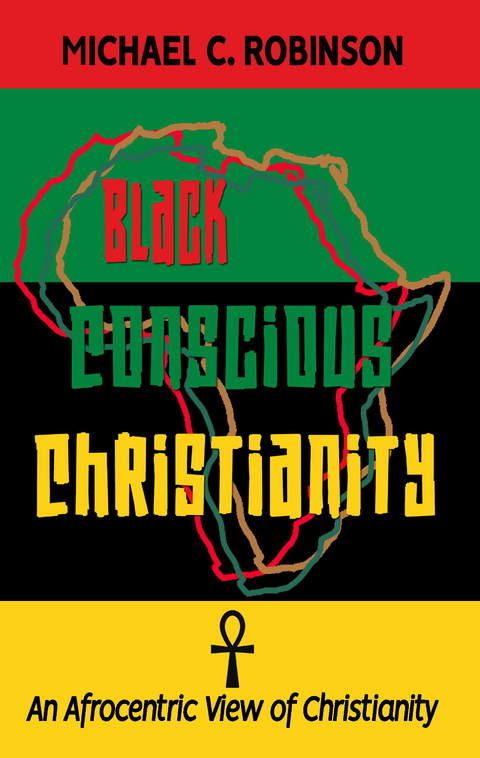
Black Conscious Christianity -  Michael C. Robinson

Black Conscious Christianity (eBook)

An Afrocentric View of Christianity
eBook Download: EPUB
2020 | 1. Auflage
132 Seiten
Bookbaby (Verlag)
978-1-0983-4263-0 (ISBN)
Systemvoraussetzungen
11,89 inkl. MwSt
(CHF 11,60)
Der eBook-Verkauf erfolgt durch die Lehmanns Media GmbH (Berlin) zum Preis in Euro inkl. MwSt.
  • Download sofort lieferbar
  • Zahlungsarten anzeigen
Designed to help pastors, preachers, leaders, and everyday Christians better understand the connection between Afrocentricity and Christianity. Black Conscious Christianity explores the importance of history, theology, and Christian education from an Afrocentric perspective. It is critical that African descendants of slaves as well as all people come to understand the significant role of ancient Africa in the early Christian story.
Designed to help pastors, preachers, leaders, and everyday Christians better understand the connection between Afrocentricity and Christianity. Black Conscious Christianity explores the importance of history, theology, and Christian education from an Afrocentric perspective. It is critical that African descendants of slaves as well as all people come to understand the significant role of ancient Africa in the early Christian story. Black Conscious Christianity addresses the following questions: 1. Is Christianity a white man's religion? 2. Are blacks Christian only because of the slave trade? 3. How can we trust the Bible when it was a key component of our enslavement?4 Major themes of this book1. The importance of a Culturally Relevant Apologetic2. Ancient African Christianity3. Early African Church Fathers4. Ancient African Christian Kingdoms

CHAPTER FOUR: THE FOUR MAJOR THEMES
I heard Trevor Noah say, “Nelson Mandela once said, ‘If you talk to a man in a language he understands, that goes to his head. If you talk to him in his language, that goes to his heart.’ He was so right. When you make an effort to speak someone else’s language, even if it’s just basic phrases here and there, you are saying to them, ‘I understand that you have a culture and identity that exists beyond me. I see you as a human being.”
The nature of this quote is significant to my position. Afrocentricity is merely an attempt to say to African Americans, I know you have a culture and an identity beyond American Eurocentric boundaries, and we see you as a human being. The previous chapter focused on the biblical foundation of the project, which communicates an expectation upon believers to possess the ability to share their faith in a meaningful way to those who have questions, and to do so while showing compassion. The information in this chapter will address the wide scope of Christian history that intersects with Africa and what that means to African Americans. It adds to the conventional teaching concerning Christianity from the framework of Roman and Greek vantage points. Centering Africa in the discussion of Christianity identifies how overlooked the continent is and how vital of a role Africans played in the genesis of Christianity. This Afrocentric positioning of Christian history allows African Americans to see themselves, as Dr. Asante suggests, “as subjects in history and not simply objects.”1 In this chapter, I will emphasize four major themes that together substantiate the purpose of my project, Afrocentricity as a culturally relevant Apologetic, Ancient African Christianity, Early African Church Fathers, and the significant Early Christian African kingdoms.
A CULTURALLY RELEVANT APOLOGETIC
Afrocentricity is a framework of thought and behaviors which centers Africa, Africans, their interest, values, and perspectives as being crucial to the story of world history. At this point in time the story of world history has been shaped by Eurocentricity. Conversely to Afrocentricity, Eurocentricity centers Europeans in the story of world history and in doing so, ignores the significant contributions of African people throughout history. This vantage point marginalizes, and even omits Africans from history, which in turn impacts and has impacted the psychology of an entire culture. Dr. Asante suggests that without an Afrocentric viewpoint, the African is forced to see the world and interpret the lack of his own significant contributions as a negative thing. The internalization of that negativity comes out and is acted upon in ways that reflect that negative self-image. “Unable to call upon the power of the ancestors, because one does not know them: without an ideology of heritage because one does not respect one’s own prophets: the person is only like an ant trying to move a large piece of garbage only to find that it won’t move.”2 Being forced to view the world through white eyes limits our ability to grow and develop from all that history has taught us throughout the years.
The empowerment of an African centered vantage point is seen in the attitudes, actions, and behaviors of people like Marcus Garvey, Du Boise, Fanon, Bethune, Malcolm, and Martin. They all saw beyond the European boundaries of history and embraced all that history has instilled in black people. This then creates a positive self-image, a self-image that encourages thoughts, actions, and attitudes that seek to uplift and build one’s own community. This perspective is in opposition to Eurocentric nationalism and empiricism, therefore making it an intellectual act of freedom or resistance. Although Dr. Asante is not an advocate of Christianity as the religion for Africans and those of African descent, he does speak of the satisfaction of seeing preachers and churches beginning to embrace and teach Christian history in a way that highlights its African roots. Karenga substantiates Afrocentricity by emphasizing the term ethos. Ethos is the collective personality of a people. Asante adds to the thoughts of Karenga, “The Afrocentric response to ethos determines what is in the best interest of African people at a given time, and then creates, nationalizes, and justifies those symbols which validate our interest.”3
Although Christianity was not the focus of Asante’s work, other scholars, biblical scholars such as Cain Hope Felder, have expanded the scope of Afrocentricity and aligned it with Christianity within a black church context. The story of Christianity has been drastically whitewashed. It was not until my black church studies program at Ashland Theological Seminary that I was aware that many of the characters I’ve read and history I had been taught were steeped in African culture. As I will detail later in the chapter, the African church fathers, as well as some of the most powerful and influential African Kingdoms, are all a part of the Christian story that has been altered to fit a Eurocentric narrative.
In Cain Hope Felder’s article, “Afrocentrism: The Bible and the politics of difference”, Cain Hope Felder opens by identifying a cultural shift that has been taking place during the post-cold war era. This change is being driven by the increase of multiculturalism. As the perspectives of the country widen, things that were once considered the norm are being challenged. In the article, Felder uses the celebration of Columbus as a hero as an example. “There was an intentional attempt to evaluate the traditional study of past events from the prominence of white males only to an emerging our-story as a collective narrative about the multifarious contributions of all races to the adventure of human achievement and civilization.”4
Afrocentrism presents a different vantage point from which we observe history. It allows us to see from the perspective of those who are on the margins in this country and give credence to the contribution of those other than European males. “In an uncanny and even paradoxical way, the widening public discourse in America on multiculturalism has been substantially damaged and/or confused by those who have only wanted to exploit the politics of difference in order to maintain their own firm control over wealth, political power, and concomitant institutions such as those of higher education.”4 Essentially, the white supremacist power structure of this country presents huge obstacles when attempting to challenge or question the biased way history has been shaped and presented to the people.
The Bible, Christianity, and biblical interpretation have all been impacted by Eurocentrism. Felder also comments on the alarming Eurocentric translation, reading, and interpretation of the Bible. “By Eurocentric we mean the recasting of the entire biblical tradition into an ancient religious drama of Euro-Asian Hebrews who once sojourned in Egypt, which was somehow removed from black Africa, then evolved into an ancient Canaan that had little or no relation to Africa, and eventually gave rise to the birth of a European Jesus and Christianity as a Hellenistic religion of the Greco-Roman world.”4 Felder uses the idea of Yale University professor Jaroslav who also substantiates my position that Christianity has spread across the world, bearing the face of a white Jesus. Although this image of Jesus has been engrained in the mind of most all who encounter Christianity, the white Jesus that we have all come to tolerate was not created by the biblical authors but was created within a postbiblical western culture and exacerbated by the complicity of its religious institution. Felder has no problem making the assertion that throughout the years, the Bible has been taken hostage by Euro-American thought. But because many scholars recognize the need to rescue biblical interpretation from the captivity of European thought, the idea of Afrocentric biblical interpretation is gaining ground. The Bible itself is full of an array of multicultural paradigms, yet these have been minimized and trivialized to present biblical history in a way that is palatable to a Euro-American audience. Afrocentric biblical interpretation sees Africans and those of African descent as proactive subjects in history and not simply as passive objects of western history.
The Bible itself is full of an array of multicultural paradigms, yet these have been minimized and trivialized to present biblical history in a way that is palatable to a Euro-American audience.
Professor Asante has always intended Afrocentrism to center Africans in the narratives of history without diminishing the accomplishments of others. Although Dr. Asante’s vision was for his Afrocentricity concept to not be seen in a negative light, Felder highlights a few unfounded criticisms that I would like to mention. These criticisms are unfounded because they are based on inaccurate definitions of Afrocentrism. The first criticism is that the concept demonizes all white people. Another is Afrocentrism simply replaces Eurocentrism and shares its hierarchy, patriarchy, and racially exclusive centrism. A final thought is that Afrocentrism marginalizes and vilifies European heritage. There could possibly be an extreme adaptation of Afrocentrism that could fall under those critics, but for the most part, its pro-African element is not...

Erscheint lt. Verlag 11.11.2020
Sprache englisch
Themenwelt Geisteswissenschaften Religion / Theologie Christentum
ISBN-10 1-0983-4263-1 / 1098342631
ISBN-13 978-1-0983-4263-0 / 9781098342630
Informationen gemäß Produktsicherheitsverordnung (GPSR)
Haben Sie eine Frage zum Produkt?
EPUBEPUB (Ohne DRM)
Größe: 390 KB

Digital Rights Management: ohne DRM
Dieses eBook enthält kein DRM oder Kopier­schutz. Eine Weiter­gabe an Dritte ist jedoch rechtlich nicht zulässig, weil Sie beim Kauf nur die Rechte an der persön­lichen Nutzung erwerben.

Dateiformat: EPUB (Electronic Publication)
EPUB ist ein offener Standard für eBooks und eignet sich besonders zur Darstellung von Belle­tristik und Sach­büchern. Der Fließ­text wird dynamisch an die Display- und Schrift­größe ange­passt. Auch für mobile Lese­geräte ist EPUB daher gut geeignet.

Systemvoraussetzungen:
PC/Mac: Mit einem PC oder Mac können Sie dieses eBook lesen. Sie benötigen dafür die kostenlose Software Adobe Digital Editions.
eReader: Dieses eBook kann mit (fast) allen eBook-Readern gelesen werden. Mit dem amazon-Kindle ist es aber nicht kompatibel.
Smartphone/Tablet: Egal ob Apple oder Android, dieses eBook können Sie lesen. Sie benötigen dafür eine kostenlose App.
Geräteliste und zusätzliche Hinweise

Buying eBooks from abroad
For tax law reasons we can sell eBooks just within Germany and Switzerland. Regrettably we cannot fulfill eBook-orders from other countries.

Mehr entdecken
aus dem Bereich