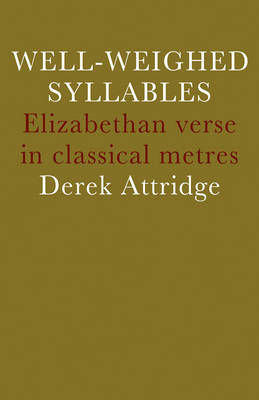
Well-Weighed Syllables
Cambridge University Press (Verlag)
978-0-521-29722-6 (ISBN)
Sidney's statement in his Apology for Poetry that quantitative verse on the Latin model is more suitable than the accentual verse of the English tradition 'lively to express divers passions, by the low and lofty sound of the well-weighed syllable' is only one of numerous assertions of the superiority of classical over native metres made by English scholars and poets during the Renaissance, stretching from Roger Ascham some twenty years earlier to Ben Jonson some fifty years later.
Part I. The Elizabethan understanding of Latin metre: 1. Problems of Latin prosody; 2. The Elizabethan pronunciation of Latin; 3. The Elizabethan reading of Latin verse; 4. Latin prosody in the Elizabethan grammar school; 5. Vowel-length, quantity and accent; 6. Continental discussions of Latin quantity; Part II. English Verse and classical metre: 7. Attitudes towards accentual verse; 8. The quantitative movement - causes; 9. The quantitative movement - magnitude; 10. The quantitative movement - characteristics; Part III. Quantative poets and theorists: 11. Uncompromising imitation - Richard Stanyhurst; 12. Scholarship and sensitivity - Sir Philip Sidney; 13. 'Our new famous enterprise' - Spenser, Harvey and Fraunce; 14. Four approaches to quantitative verse; 15. Theory and compromise - Puttenham and Campion.
| Erscheint lt. Verlag | 6.12.1979 |
|---|---|
| Zusatzinfo | Worked examples or Exercises |
| Verlagsort | Cambridge |
| Sprache | englisch |
| Maße | 139 x 216 mm |
| Gewicht | 351 g |
| Themenwelt | Geisteswissenschaften ► Sprach- / Literaturwissenschaft ► Anglistik / Amerikanistik |
| Geisteswissenschaften ► Sprach- / Literaturwissenschaft ► Literaturwissenschaft | |
| ISBN-10 | 0-521-29722-2 / 0521297222 |
| ISBN-13 | 978-0-521-29722-6 / 9780521297226 |
| Zustand | Neuware |
| Informationen gemäß Produktsicherheitsverordnung (GPSR) | |
| Haben Sie eine Frage zum Produkt? |
aus dem Bereich