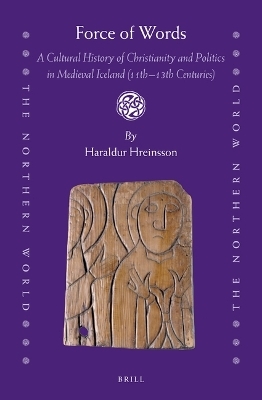
Force of Words: A Cultural History of Christianity and Politics in Medieval Iceland (11th- 13th Centuries)
Brill (Verlag)
978-90-04-44496-6 (ISBN)
Haraldur Hreinsson, Ph.D. (2019, Münster), is a historian of religion, specializing in cultural historical approaches to religion and the history of Christian religion in the Nordic region.
Acknowledgments
Abbreviations
List of Figures
1 Introduction
1.1 Historiographical Context
1.1.1 History of Medieval Christianity in Iceland: A Fragmented Field
1.1.2 Church and Society in Medieval Iceland
1.2 Theoretical Considerations
1.2.1 Ecclesiastical Discourse
1.2.1.1 Discourse
1.2.1.2 Discourse: Religious and Ecclesiastical
1.2.2 Perspective of Empire
1.2.2.1 The Roman Church as an Empire in Medieval Iceland
1.2.2.2 The Perspective of Empire: A Text Oriented Approach
1.3 Source Material
1.3.1 Textual Sources
1.3.2 Material Sources
2 The Roman Church in Free State Iceland
2.1 Christianization of Iceland
2.1.1 The Roman Ecclesiastical Empire
2.1.1.1 The Rise of the Papal Center
2.1.1.2 From Center to the Periphery
2.1.1.3 On the Outskirts
2.1.2 Expanding Boundaries: Christianization of Scandinavia
2.1.3 Christianization of Iceland
2.1.4 Conclusion: Becoming Christian
2.2 Christianization and the Production of Religious Texts
2.2.1 Background: The Roman Church as a Cultural Hegemon
2.2.2 Iceland’s Earliest Religious Manuscripts
2.2.2.1 Collections of Hagiographic Material
2.2.2.2 Collections of Sermonic Material
2.2.2.3 Manuscripts with Mixed Content
2.2.3 Beyond the Manuscripts: The Materiality of Religious Discourse
2.2.4 Conclusion: Texts in Motion
2.3 Icelandic Ecclesiastics and Their Audiences
2.3.1 Representing Rome: Ecclesiastics in Iceland
2.3.1.1 Clerics in the Free State: Socially Diverse or Homogenous?
2.3.1.2 Clerical Education: Practical but International
2.3.1.3 In Whose Authority?
2.2.2 Audiences of All Kinds
2.2.2.1 Audience according to Religious Source Material
2.2.2.2 Audience According to Contemporary Narrative Sources
2.3.3 Pastor and Flock: Points of Encounter
2.3.3.1 Translatio Ecclesiae: A Medieval Icelandic Textual Community
2.3.3.2 Social Significance of the Church: Panopticon or a Heterotopia
2.3.4 Conclusion: Conflicts of Interests
2.4 Ecclesiastical Imagination
2.4.1 Icelanders in the Sixth Age
2.4.2 Typological Thought
2.4.3 Typological Thought in Medieval Icelandic Literature
2.4.4 Conclusion: Beyond the Written Word
3 Force of Words: Constructing a Christian Society
3.1 Authority
3.1.1 Teaching
3.1.1.1 The Original Teaching
3.1.1.2 Teaching in the Icelandic Free State
3.1.2 Apostolic Authority
3.1.2.1 Apostolic Mandate
3.1.2.2 Apostolic Domination
3.1.3 Hierarchy
3.1.3.1 Primatus Petri
3.1.3.2 Church Hierarchy
3.1.4 Conclusion: Powering Over
3.2 The ‘Other’
3.2.1 Enemies of the Church
3.2.1.1 Heretics
3.2.1.2 Heathens
3.2.1.3 Jews
3.2.2 Encountering the ‘Other’
3.2.2.1 Expansion of Error
3.2.2.2 Becoming Other
3.2.3 Conclusion: Making Enemies
3.3 Perish or Prosper
3.3.1 Peace or Unrest?
3.3.1.1 Performing Peace
3.3.1.2 Peace of the Church
3.3.1.3 Fighting for Peace
3.3.1.4 The Danger of Unrest
3.3.2 Heaven or Hell?
3.3.2.1 War
3.3.2.2 Anger of God
3.3.2.3 Justice
3.3.2.4 Punishment
3.3.2.5 Rewards
3.3.3 Conclusion: The Only Way
4 Rome Goes North
4.1 In the Beginning
4.1.1 Chaotic Beginnings
4.1.2 Echoes from Rome
4.1.3 Gizurr’s Age of Peace
4.1.4 Conclusion: The Chieftain Church Rises
4.2 The Reform of Bishop Þorlákr
4.2.1 Libertas Ecclesiae in Iceland
4.2.1.1 Backdrop: Libertas Ecclesiae in Norway
4.2.1.2 The First Clash of Church and Chieftains
4.2.2 The Authority of the Archbishop
4.2.3 Enemies of the Church
4.2.4 Conclusion: On the Other Side
4.3 Reform and Violence: The Rule of Bishop Guðmundr
4.3.1 Guðmundr’s Rise to the Episcopacy
4.3.2 Religious Fervour and Armed Battles
4.3.3 Iceland’s Salvation
4.3.4 Conclusion: Framing Violence
5 Conclusion
Appendix Manuscript Sources
Bibliography
Index
| Erscheinungsdatum | 06.04.2021 |
|---|---|
| Reihe/Serie | The Northern World ; 90 |
| Verlagsort | Leiden |
| Sprache | englisch |
| Maße | 155 x 235 mm |
| Gewicht | 696 g |
| Themenwelt | Geschichte ► Allgemeine Geschichte ► Mittelalter |
| Geschichte ► Teilgebiete der Geschichte ► Kulturgeschichte | |
| Geschichte ► Teilgebiete der Geschichte ► Religionsgeschichte | |
| ISBN-10 | 90-04-44496-3 / 9004444963 |
| ISBN-13 | 978-90-04-44496-6 / 9789004444966 |
| Zustand | Neuware |
| Informationen gemäß Produktsicherheitsverordnung (GPSR) | |
| Haben Sie eine Frage zum Produkt? |
aus dem Bereich