


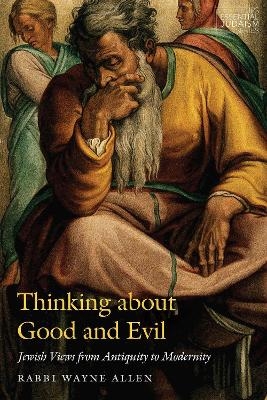
Thinking About Good and Evil
Jewish Views from Antiquity to Modernity
Seiten
2021
Jewish Publication Society (Verlag)
978-0-8276-1471-0 (ISBN)
Jewish Publication Society (Verlag)
978-0-8276-1471-0 (ISBN)
2022 Top Five Reference Book from Academy of Parish Clergy
The most comprehensive book on the topic, Thinking about Good and Evil traces the most salient Jewish ideas about why innocent people seem to suffer, why evil individuals seem to prosper, and God’s role in such matters of (in)justice, from antiquity to the present.
Starting with the Bible and Apocrypha, Rabbi Wayne Allen takes us through the Talmud; medieval Jewish philosophers and Jewish mystical sources; the Ba’al Shem Tov and his disciples; early modern thinkers such as Spinoza, Mendelssohn, and Luzzatto; and, finally, modern thinkers such as Cohen, Buber, Kaplan, and Plaskow. Each chapter analyzes individual thinkers’ arguments and synthesizes their collective ideas on the nature of good and evil and questions of justice. Allen also exposes vastly divergent Jewish thinking about the Holocaust: traditionalist (e.g., Ehrenreich), revisionist (e.g., Rubenstein, Jonas), and deflective (e.g., Soloveitchik, Wiesel).
Rabbi Allen’s engaging, accessible volume illuminates well-known, obscure, and novel Jewish solutions to the problem of good and evil.
The most comprehensive book on the topic, Thinking about Good and Evil traces the most salient Jewish ideas about why innocent people seem to suffer, why evil individuals seem to prosper, and God’s role in such matters of (in)justice, from antiquity to the present.
Starting with the Bible and Apocrypha, Rabbi Wayne Allen takes us through the Talmud; medieval Jewish philosophers and Jewish mystical sources; the Ba’al Shem Tov and his disciples; early modern thinkers such as Spinoza, Mendelssohn, and Luzzatto; and, finally, modern thinkers such as Cohen, Buber, Kaplan, and Plaskow. Each chapter analyzes individual thinkers’ arguments and synthesizes their collective ideas on the nature of good and evil and questions of justice. Allen also exposes vastly divergent Jewish thinking about the Holocaust: traditionalist (e.g., Ehrenreich), revisionist (e.g., Rubenstein, Jonas), and deflective (e.g., Soloveitchik, Wiesel).
Rabbi Allen’s engaging, accessible volume illuminates well-known, obscure, and novel Jewish solutions to the problem of good and evil.
Rabbi Wayne Allen serves as the co-chair of the Rabbinics Department of the Anne and Max Tanenbaum Community Hebrew Academy of Toronto. He is the author of Prescription for an Ailing World and Perspectives on Jewish Law and Contemporary Issues, among other books.
Preface
Acknowledgments
Introduction
1. Good and Evil in the Bible and Apocrypha
2. Rabbinic Approaches to Good and Evil
3. Good and Evil in Medieval Philosophy
4. Kabbalah and the Problem of Evil
5. Hasidic Masters on Evil and Suffering
6. Early Modern Thinkers on Good and Evil
7. Modern Thinkers on Good and Evil
8. The Special Problem of the Shoah
Conclusion
Notes
Bibliography
General Index
Index of Texts
| Erscheinungsdatum | 29.03.2021 |
|---|---|
| Reihe/Serie | JPS Essential Judaism |
| Zusatzinfo | 2 indexes |
| Verlagsort | Philadelphia |
| Sprache | englisch |
| Maße | 152 x 229 mm |
| Themenwelt | Geisteswissenschaften ► Philosophie ► Ethik |
| Geisteswissenschaften ► Religion / Theologie ► Judentum | |
| ISBN-10 | 0-8276-1471-3 / 0827614713 |
| ISBN-13 | 978-0-8276-1471-0 / 9780827614710 |
| Zustand | Neuware |
| Informationen gemäß Produktsicherheitsverordnung (GPSR) | |
| Haben Sie eine Frage zum Produkt? |
Mehr entdecken
aus dem Bereich


aus dem Bereich
Buch | Hardcover (2025)
Suhrkamp (Verlag)
CHF 32,15
ein Versuch über Kardinaltugenden und Laster
Buch | Hardcover (2025)
De Gruyter (Verlag)
CHF 55,90


