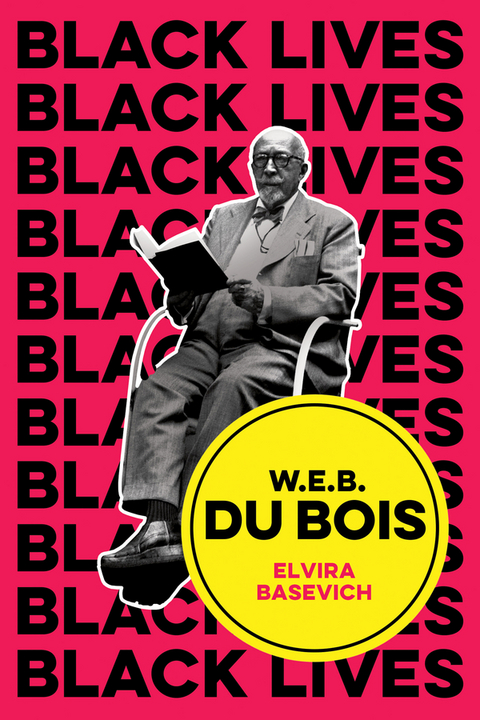
W.E.B. Du Bois (eBook)
John Wiley & Sons (Verlag)
978-1-5095-3575-0 (ISBN)

In this tour-de-force, Elvira Basevich examines this paradox by tracing the development of his life and thought and the relevance of his legacy to our troubled age. She adroitly analyses the main concepts that inform Du Bois's critique of American democracy, such as the color line and double consciousness, before examining how these concepts might inform our understanding of contemporary struggles, from Black Lives Matter to the campaign for reparations for slavery. She stresses the continuity in Du Bois's thought, from his early writings to his later embrace of self-segregation and Pan-Africanism, while not shying away from assessing the challenging implications of his later work.
This wonderful book vindicates the power of Du Bois's thought to help transform a stubbornly unjust world. It is essential reading for racial justice activists as well as students of African American philosophy and political thought.
Elvira Basevich is Assistant Professor of Philosophy at University of Massachusetts, Lowell.
W.E.B. Du Bois spent many decades fighting to ensure that African Americans could claim their place as full citizens and thereby fulfill the deeply compromised ideals of American democracy. Yet he died in Africa, having apparently given up on the United States. In this tour-de-force, Elvira Basevich examines this paradox by tracing the development of his life and thought and the relevance of his legacy to our troubled age. She adroitly analyses the main concepts that inform Du Bois s critique of American democracy, such as the color line and double consciousness, before examining how these concepts might inform our understanding of contemporary struggles, from Black Lives Matter to the campaign for reparations for slavery. She stresses the continuity in Du Bois s thought, from his early writings to his later embrace of self-segregation and Pan-Africanism, while not shying away from assessing the challenging implications of his later work. This wonderful book vindicates the power of Du Bois s thought to help transform a stubbornly unjust world. It is essential reading for racial justice activists as well as students of African American philosophy and political thought.
Elvira Basevich is Assistant Professor of Philosophy at University of Massachusetts, Lowell.
?With the breadth of a biographer, the depth of a philosopher, and the vision of a poet, Elvira Basevich gives us a compelling elucidation of W.E.B. Du Bois? radical liberalism. This is essential reading for understanding why Du Bois still matters!?
Melvin Rogers, Brown University
?In a direct and accessible prose, linking philosophical abstraction with grassroots activism, Elvira Basevich brings us a Du Bois by no means merely a figure of historical importance but very much a thinker relevant for the social justice struggles of today.?
Charles Mills, City University of New York
Introduction
Du Bois Among Us: A Contemporary, A Voice from the Past
In a tape-recorded conversation with Margaret Mead in 1971, James Baldwin described the problem of racism in the United States: “So that’s what makes it all so hysterical, so unwieldy and so completely irretrievable. Reason cannot reach it. It is as though some great, great, great wound is in the whole body, and no one dares to operate: to close it, to examine it, to stitch it.”1 Baldwin discerned racism as an open wound that spans “the whole body” of the republic. Poets, philosophers, and social scientists struggle to explain its stubborn bloodletting rituals; like a chant, it has no clear beginning or end, pervading the legal and social conventions of our past and reaching out to cloud our future. In Between the World and Me, a spellbinding reckoning with white Americans’ complicity in white supremacy, Ta-Nehisi Coates remarks that racism has left him wounded, unable to console his young son in the face of perpetual loss.2 “I can only say what I saw, what I felt,” writes Coates. “There are people whom we do not fully know, and yet they live in a warm place within us, and when they are plundered, when they lose their bodies and the dark energy disperses, that place becomes a wound.”3 If one were to place a stone or a flower at every tree, church basement, stairwell, or dark stretch of road where a person of color has lost their body and left there a wound still painful to touch, a cemetery could overlie the entire geography of North America. Marx had once warned of the specter of communism haunting Europe, whereas actual ghosts haunt the United States.4
In his characterization of American racism, Baldwin invoked two notions that, at first blush, appear to stand in opposition. He observed that reason “cannot reach it” and yet the “wound” remains open because “no one dares to operate: to close it, to examine it, to stitch it.” Reason is both powerless against racism and an indispensable tool to combat it. And so one is left wondering if it is possible to mend the wound using the power of reason in some broad sense, employing persuasion, imagination, and fact-based arguments. The long history of racial violence and terror might suggest that racism is too resilient to crumble under public scrutiny or government intervention, however well intentioned. And yet Baldwin maintained that one must nevertheless “dare” to “close [the wound], examine it, stitch it.” He thus asked his reader to redress the evil of racism. In doing so, we realize that racism, like all evil, as Hannah Arendt had put it, is “banal”; that is, it is a social phenomenon that, like any social phenomenon, originates in the human will and is therefore capable of being rooted from the world, however monstrous its proportions and stranglehold on institutions. What people have willed into existence, including a force as recalcitrant as white supremacy, by the same token can be willed out of existence. Racism is not a random and unstoppable event in the natural world, like an earthquake or the death of a star. To be sure, the fight against it must stretch the boundaries of the moral imagination, drawing on cultural and spiritual resources that are often overlooked as inspirations for democratic agency. The process must also support the transformation of major social and political institutions. But the prospect of a just world, nevertheless, remains viable. The question is only how and when to build it.5
The driving question in W. E. B. Du Bois’s writings as a whole – a question that also inspired Africana philosophers from Frederick Douglass to James Baldwin – was the following: Can reason close the wound of racism that spans the whole body of the republic; and if reason cannot reach it, how else might it be closed? Africana philosophers do not all share the same optimism about finding solutions to anti-black racism.6 But Du Bois had faith in reason – a kind of moral attitude of sustained hope for a better world – that the wound of racism can close and heal, even if it will leave an irremovable scar on the US republic and the world.
Though we cannot imagine that we can go back to a world untouched by racism, we have a moral obligation to figure out how to repair the world we have inherited, to put the ghosts of the dead to rest. The conviction that our profoundly nonideal world is reparable, I believe, is the conviction that inspired W. E. B. Du Bois’s life and work. In his career as an academic, writer, and activist, this conviction motivated him to experiment with a great variety of methods for stitching shut the wound that racism has left on the body of the US republic and on the world. From the scientific method to literature and the arts, Du Bois dedicated his life to theorizing new approaches to anti-racist critique. In my mind, his originality and willingness to adopt new methods sets him apart from most political theorists. His methodological experimentation is perhaps why his thought is both so exciting and so challenging to reconstruct using general philosophical principles.
With the aim of presenting some of the principal methods Du Bois developed to combat anti-black racism and to build a more just world, this book provides an account of the life, activism, and scholarship of W. E. B. Du Bois. In a storied and prolific life, Du Bois’s accomplishments were considerable and wide-ranging. He is recognized in the United States and around the world as an influential civil rights leader of the twentieth century. He co-founded in 1910 the National Association for the Advancement of Colored People (NAACP) and was the editor of The Crisis (1910–34), the official magazine of the NAACP, widely circulated in the segregated black community during the Jim Crow era. What is more, as a social scientist, he pioneered empirical methods to study black neighborhoods, founding modern “scientific” sociology.7 His spellbinding The Souls of Black Folk, published in 1903, is a foundational text of Africana philosophy and African-American arts and letters. During his lifetime, he adopted liberal, Marxian, pan-African, and black nationalist frameworks to fight anti-black racism; and he published poems, short stories, and novels, and was involved in the Harlem Renaissance to use the arts to enhance the moral literacy of the white-controlled republic about racial matters. The characters who people his creative writings move through an uncertain world, burdened with slavery and segregation, wondering if it is still reasonable to hope for a better world in the aftermath of so much suffering.
In this book, I take the view that Du Bois is a modern political philosopher for whom the idea of basic civil and political rights for all, as well as the ideal of racial inclusion in the political, social, and economic spheres, is an indispensable basis for combating anti-black racism and for achieving racial justice. My presentation of Du Bois’s thought, in part, builds on and puts pressure on the noted philosopher Charles W. Mills’s recent argument that Du Bois is a “black radical liberal” who aimed to realize the public values of freedom and equality for all in order to welcome black and brown people, refugees, and immigrants into a reconstituted democratic polity.8 Mills maintains that, for Du Bois, the process of advancing true freedom and equality for all requires a radical reorganization of modern American society from the point of view of historically excluded groups. Mills thus offers a theoretical exposition of Du Bois’s original claim that a color line draws a “veil” over communities of color by withdrawing respect and esteem from black and brown people.9 The readiness or otherwise of the American public to dismantle the color line reflects whether or not the republic is truly “modern” – that is, free and equal for all persons regardless of race. As Du Bois put it, “the advance of all depends increasingly on the advance of each,” such that respecting and esteeming historically excluded groups is instrumental for the development of American modernity.10 I flesh out Mills’s interpretation of Du Bois by looking at the breadth of Du Bois’s writings and activism, and present Du Bois’s changing positions as broadly consistent with a “radical” political liberalism. The challenge, of course, would be to show what Du Bois packed into liberalism to make it “radical” and which liberal ideals are valuable in the first place. Christopher Lebron provides an elegant definition about what it means to be a “radical,” one that complements Mills’s view and on which this book elaborates: “Radicalism is the imagination and will to think and act outside the bounds of the normally acceptable.”11 Rethinking the bounds of the normally acceptable in social, economic, and political life is the heart of Du Bois’s political project for reconstituting the US polity.
In this book, I introduce three themes that inform Du Bois’s critique of American democracy. These themes characterize his political liberalism and map some of its radical potential: (1) inclusion, (2) self-assertion, and (3) despair. In the beginning of his professional life (late 1890s–1934), Du Bois advocated the civic enfranchisement of African Americans as...
| Erscheint lt. Verlag | 22.10.2020 |
|---|---|
| Sprache | englisch |
| Themenwelt | Literatur ► Biografien / Erfahrungsberichte |
| Literatur ► Romane / Erzählungen | |
| Sachbuch/Ratgeber ► Geschichte / Politik | |
| Geschichte ► Teilgebiete der Geschichte ► Kulturgeschichte | |
| Sozialwissenschaften ► Ethnologie ► Völkerkunde (Naturvölker) | |
| Sozialwissenschaften ► Politik / Verwaltung | |
| Sozialwissenschaften ► Soziologie | |
| Schlagworte | Africa • African/African-American Studies • African American Philosophy • African American Political Thought • African-Americans • Afrika-/Afroamerika-Forschung • America • American democracy • American Studies • Amerikanistik • Black lives matter • Black political thought • Booker T. Washington • Color Line • Cultural Studies • Democracy • double consciousness • Du Bois • Du Bois, William E. B. • Ethnicity Studies • Justice • Kulturwissenschaften • pan-Africanism • Political thought • Race • Race & Ethnicity Studies • race studies • Racial Justice • Racism • Rassen- u. Ethnienforschung • reparations • second slavery • Segregation • self-segregation • Slavery • United States • W.E.B. Du Bois |
| ISBN-10 | 1-5095-3575-6 / 1509535756 |
| ISBN-13 | 978-1-5095-3575-0 / 9781509535750 |
| Informationen gemäß Produktsicherheitsverordnung (GPSR) | |
| Haben Sie eine Frage zum Produkt? |
 EPUB (Adobe DRM)
Kopierschutz: Adobe-DRM
Adobe-DRM ist ein Kopierschutz, der das eBook vor Mißbrauch schützen soll. Dabei wird das eBook bereits beim Download auf Ihre persönliche Adobe-ID autorisiert. Lesen können Sie das eBook dann nur auf den Geräten, welche ebenfalls auf Ihre Adobe-ID registriert sind.
Details zum Adobe-DRM
Dateiformat: EPUB (Electronic Publication)
EPUB ist ein offener Standard für eBooks und eignet sich besonders zur Darstellung von Belletristik und Sachbüchern. Der Fließtext wird dynamisch an die Display- und Schriftgröße angepasst. Auch für mobile Lesegeräte ist EPUB daher gut geeignet.
Systemvoraussetzungen:
PC/Mac: Mit einem PC oder Mac können Sie dieses eBook lesen. Sie benötigen eine
eReader: Dieses eBook kann mit (fast) allen eBook-Readern gelesen werden. Mit dem amazon-Kindle ist es aber nicht kompatibel.
Smartphone/Tablet: Egal ob Apple oder Android, dieses eBook können Sie lesen. Sie benötigen eine
Geräteliste und zusätzliche Hinweise
Buying eBooks from abroad
For tax law reasons we can sell eBooks just within Germany and Switzerland. Regrettably we cannot fulfill eBook-orders from other countries.
aus dem Bereich