


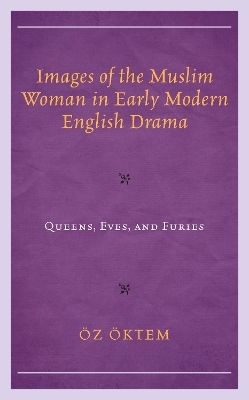
Images of the Muslim Woman in Early Modern English Drama
Queens, Eves, and Furies
Seiten
2021
Lexington Books (Verlag)
978-1-7936-2522-9 (ISBN)
Lexington Books (Verlag)
978-1-7936-2522-9 (ISBN)
This is a multidisciplinary study that reads the early modern literary and historical representations of the Muslim woman against both the European politics towards Islam and the domestic constructions of gender and social hierarchies in England.
Early modern scholarship often reads the dramatic representations of the Muslim woman in the light of postcolonial identity politics, which sees an organic relationship between the West’s historical domination of the East and the Western discourse on the East. This book problematizes the above trajectory by arguing that the assumption of a power relation between a dominating West and a subordinate East cannot be sustained within the context of the political and historical realities of early modern Europe. The Ottoman Empire remained as a dominant superpower throughout the sixteenth and seventeenth centuries and was perceived by Protestant England both as a military and religious threat and as a possible ally against Catholic Spain. Reading a series of early modern plays from Marlowe to Beaumont and Fletcher alongside a number of historical sources and documents, this book re-interprets the image of Islamic femininity in the period’s drama to reflect this overturn in the world’s power balances, as well as the intricate dynamics of England’s intensified contact with Islam in the Mediterranean.
Early modern scholarship often reads the dramatic representations of the Muslim woman in the light of postcolonial identity politics, which sees an organic relationship between the West’s historical domination of the East and the Western discourse on the East. This book problematizes the above trajectory by arguing that the assumption of a power relation between a dominating West and a subordinate East cannot be sustained within the context of the political and historical realities of early modern Europe. The Ottoman Empire remained as a dominant superpower throughout the sixteenth and seventeenth centuries and was perceived by Protestant England both as a military and religious threat and as a possible ally against Catholic Spain. Reading a series of early modern plays from Marlowe to Beaumont and Fletcher alongside a number of historical sources and documents, this book re-interprets the image of Islamic femininity in the period’s drama to reflect this overturn in the world’s power balances, as well as the intricate dynamics of England’s intensified contact with Islam in the Mediterranean.
Öz Öktem is assistant professor in the English Language and Literature Department of Istanbul Aydin University.
Chapter 1: Introduction: Re-Orienting Gender and Islamic Alterity in Early Modern English Drama
Chapter 2: Erasing the Cultural and Religious Difference: Marlowe’s Tamburlaine and Greene’s Alphonsus
Chapter 3: The Muslim Woman and A Christian Turned Turk: Islamic Apostasy and the Gender Paradigm on the Jacobean Stage
Chapter 4: Redeeming the Islamic Eve inside the Ottoman Palace: Massinger’s The Renegado
Chapter 5: “Hell’s Perfect Character:” Dark Female Sexuality and the Fear of Ottoman Colonialism in The Knight of Malta
Chapter 6: The Island Princess: Colonialism, Religion, (Inter)sexuality and Intertextuality
| Erscheinungsdatum | 10.05.2021 |
|---|---|
| Sprache | englisch |
| Maße | 161 x 228 mm |
| Gewicht | 458 g |
| Themenwelt | Geisteswissenschaften ► Sprach- / Literaturwissenschaft ► Anglistik / Amerikanistik |
| Geisteswissenschaften ► Sprach- / Literaturwissenschaft ► Literaturwissenschaft | |
| ISBN-10 | 1-7936-2522-0 / 1793625220 |
| ISBN-13 | 978-1-7936-2522-9 / 9781793625229 |
| Zustand | Neuware |
| Informationen gemäß Produktsicherheitsverordnung (GPSR) | |
| Haben Sie eine Frage zum Produkt? |
Mehr entdecken
aus dem Bereich

aus dem Bereich
Poetik eines sozialen Urteils
Buch | Hardcover (2023)
De Gruyter (Verlag)
CHF 83,90


