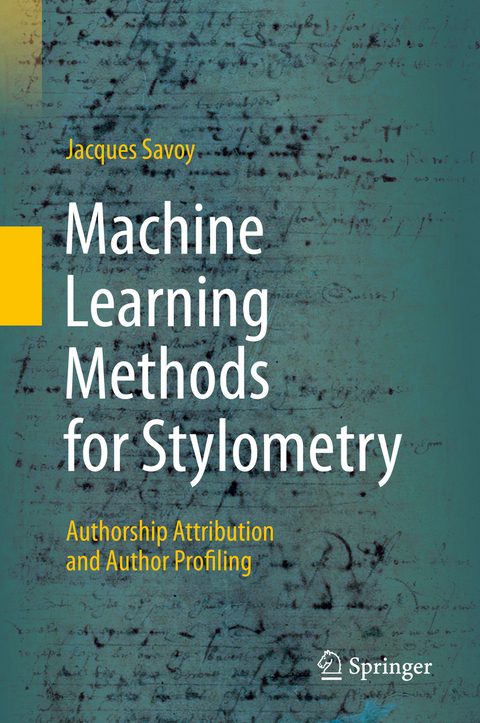
Machine Learning Methods for Stylometry (eBook)
286 Seiten
Springer International Publishing (Verlag)
978-3-030-53360-1 (ISBN)
This book presents methods and approaches used to identify the true author of a doubtful document or text excerpt. It provides a broad introduction to all text categorization problems (like authorship attribution, psychological traits of the author, detecting fake news, etc.) grounded in stylistic features. Specifically, machine learning models as valuable tools for verifying hypotheses or revealing significant patterns hidden in datasets are presented in detail. Stylometry is a multi-disciplinary field combining linguistics with both statistics and computer science.
The content is divided into three parts. The first, which consists of the first three chapters, offers a general introduction to stylometry, its potential applications and limitations. Further, it introduces the ongoing example used to illustrate the concepts discussed throughout the remainder of the book. The four chapters of the second part are more devoted to computer science with a focus on machine learning models. Their main aim is to explain machine learning models for solving stylometric problems. Several general strategies used to identify, extract, select, and represent stylistic markers are explained. As deep learning represents an active field of research, information on neural network models and word embeddings applied to stylometry is provided, as well as a general introduction to the deep learning approach to solving stylometric questions. In turn, the third part illustrates the application of the previously discussed approaches in real cases: an authorship attribution problem, seeking to discover the secret hand behind the nom de plume Elena Ferrante, an Italian writer known worldwide for her My Brilliant Friend's saga; author profiling in order to identify whether a set of tweets were generated by a bot or a human being and in this second case, whether it is a man or a woman; and an exploration of stylistic variations over time using US political speeches covering a period of ca. 230 years.
A solutions-based approach is adopted throughout the book, and explanations are supported by examples written in R. To complement the main content and discussions on stylometric models and techniques, examples and datasets are freely available at the author's Github website.Jacques Savoy is a Full Professor of Computer Science at the University of Neuchatel (Switzerland). His research interests mainly include natural language processing and particularly information retrieval for languages other than English (European, Asian, and Indian) as well as multilingual and cross-lingual information retrieval. For many years he has participated in various evaluations campaigns (TREC, CLEF, NTCIR, FIRE) dealing with these questions. His current research interests focus on the statistical modeling and evaluation of natural language processing such as text clustering and categorization, as well as authorship attribution.
| Erscheint lt. Verlag | 28.9.2020 |
|---|---|
| Zusatzinfo | XIX, 286 p. 111 illus., 101 illus. in color. |
| Sprache | englisch |
| Themenwelt | Geisteswissenschaften ► Sprach- / Literaturwissenschaft |
| Informatik ► Theorie / Studium ► Künstliche Intelligenz / Robotik | |
| Schlagworte | Author profiling • authorship attribution • Information Retrieval • machine learning • Natural Language Processing • Quantitative linguistics • stylometry • text analysis |
| ISBN-10 | 3-030-53360-3 / 3030533603 |
| ISBN-13 | 978-3-030-53360-1 / 9783030533601 |
| Informationen gemäß Produktsicherheitsverordnung (GPSR) | |
| Haben Sie eine Frage zum Produkt? |
 PDF (Wasserzeichen)
DRM: Digitales Wasserzeichen
Dieses eBook enthält ein digitales Wasserzeichen und ist damit für Sie personalisiert. Bei einer missbräuchlichen Weitergabe des eBooks an Dritte ist eine Rückverfolgung an die Quelle möglich.
Dateiformat: PDF (Portable Document Format)
Mit einem festen Seitenlayout eignet sich die PDF besonders für Fachbücher mit Spalten, Tabellen und Abbildungen. Eine PDF kann auf fast allen Geräten angezeigt werden, ist aber für kleine Displays (Smartphone, eReader) nur eingeschränkt geeignet.
Systemvoraussetzungen:
PC/Mac: Mit einem PC oder Mac können Sie dieses eBook lesen. Sie benötigen dafür einen PDF-Viewer - z.B. den Adobe Reader oder Adobe Digital Editions.
eReader: Dieses eBook kann mit (fast) allen eBook-Readern gelesen werden. Mit dem amazon-Kindle ist es aber nicht kompatibel.
Smartphone/Tablet: Egal ob Apple oder Android, dieses eBook können Sie lesen. Sie benötigen dafür einen PDF-Viewer - z.B. die kostenlose Adobe Digital Editions-App.
Buying eBooks from abroad
For tax law reasons we can sell eBooks just within Germany and Switzerland. Regrettably we cannot fulfill eBook-orders from other countries.
aus dem Bereich