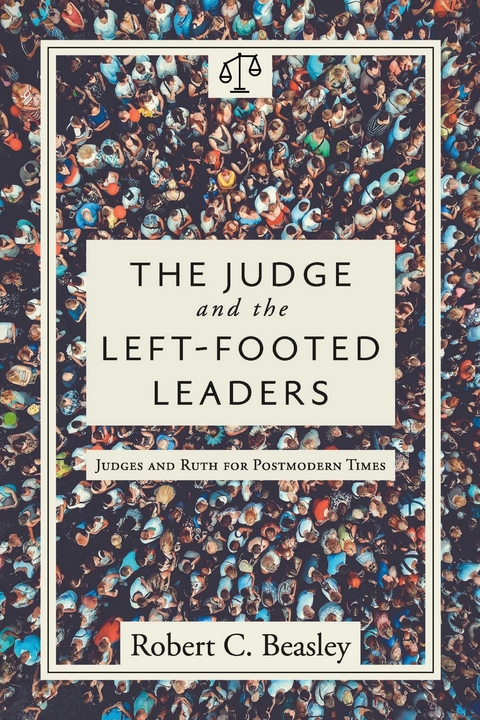
Judge and the Left-Footed Leaders (eBook)
230 Seiten
Bookbaby (Verlag)
978-1-0983-2672-2 (ISBN)
"e;The Judge and the Left-Footed Leaders"e; explores the messages of the Old Testament books of Judges and Ruth. The book of Judges describes a nation strikingly similar to the modern United States. Israel was racked by violence, greed, sexual abuse, political turmoil, and racial tension. On the other hand, the book of Ruth portrays a community bound by kindness and civility. Ruth demonstrates suffering transformed by love and how that quality of living can infiltrate and change a culture. Judges and Ruth were meant to be read together. Judges is a mirror and a warning; Ruth is an inspirational map to recovery. This book examines how they foil one another, and what we can take away from it.
Introduction: WHAT TIME IS IT?
It was a tense and fragile time. The nation faced pressures from without and within. People were so divided that a civil (or uncivil) war was on the brink. Cities were on fire throughout the land. There was racial prejudice, racial tension, and racial riots. There was abuse of women and children to a horrific degree. Power-hungry people dominated the political landscape. Religion was used by some for political and financial gain, but religion was irrelevant and shallow for the masses. The people looked for hope but forgot where to find it. Civil communication had broken down as people pushed their agendas and talked past each other. The culture was obsessed with sex and greed. People made their own rules about what was natural and right. There was moral confusion, social confusion, and family disintegration. The real “gods” were “I” and “me,” and as a result, selfishness and pride were destroying the nation. And there was much weeping. The best description for this time was, “everyone did what was right in their own eyes.”
Sound familiar? What time in history do you think this describes? The United States during the first quarter of the 21st century? That would be a good guess. As of this writing, the United States, along with the world, is facing the global pandemic of COVID-19. While the nation rallied together during the initial stages of the outbreak, that soon degenerated into “Pandemic Politics” and Facebook fights over the lockdown. This unrest was exacerbated by the death of George Floyd at the hands of Minneapolis police, igniting racial tension and sparking riots in major cities. There has never been a time when the U.S. was so divided politically. Each party races to outdo the other with insults and false statements, each grasping for controlling power. The government, in many ways, is a mirror of our society, reflecting the divisions that occur among us. Consider the following phrases and the images they conjure: Black Lives Matter, George Floyd, Breonna Taylor, Michael Brown, Freddie Gray, Walter Scott, and Ahmaud Arbery (to name only a few); #Me Too, Harvey Weinstein, Jeffrey Epstein, and Kevin Spacey (to name only a few); #Never Again, Parkland, Florida, Sante Fe, Texas, El Paso, Las Vegas, and church and synagogue shootings (to name only a few); Russian interference, collusion, immigration debates, Impeachment (to name only a few).
Although life in the United States today bears a remarkable resemblance to the time and nation described above, the current state of our country is not the time and place I intended. The time and the nation described above is ancient. However, the resemblances prove that as much as humans have changed, so much remains the same.
The time in history I am describing was 3,000 years ago, and the nation is a little country in the Middle East, a country that shares the same name as a country that still exists today: the nation of Israel. We learn of this time and nation from two ancient books found in the Bible: the book of Judges and the book of Ruth. Although both books were written to describe the nation of Israel between 1300 and 1050 B.C., the two books couldn’t be more different. The book of Judges is full of violence, greed, sexual abuse, civil war, political turmoil, racial tension, economic collapse, and weeping. It is graphic, offensive, chaotic, ironic, and frustrating. It paints a vivid picture of a culture gone awry, of society with no moral or ethical moorings. Politics, sex, and money had become the nation’s gods. The pursuit of power consumed its leaders and was destroying the masses. The people, while searching for love, transcendence, and pleasure, instead pursued sex with obsession, realizing too late they were searching in the wrong place. Underlying all this was the great god Bread (whose modern cousin is Money); get Bread, and you get power and pleasure too. The catchphrases were “Everyone did what was right in their own eyes,” and “the people had forgotten God.”
The book of Ruth, on the other hand, presents a refreshingly different picture. It is a story about a foreign woman (a non-Israelite from the country of Moab) who quietly, through sacrificial giving and faithfulness, transforms a family and a community. It is a story of suffering transformed by love. Both the foreign woman (whose name is Ruth) and her mother-in-law (whose name is Naomi) have lost their husbands, and Naomi has lost two sons. But Ruth experienced through Naomi the kindness and compassion of Naomi’s God, Yahweh. In turn, Ruth devotes herself to Naomi in their mutual desperation, and this bond of love brings renewal to the people of Israel. Yahweh performs no miracles in this book, and yet his presence is everywhere. It is a story of how that which is most important to Yahweh, loving faithfulness (described by the Hebrew word hesed), can penetrate and transform a society like yeast in bread. The book of Ruth beautifully portrays how peace (in Hebrew, shalom) can become a reality. Ruth demonstrates how the Israelites were supposed to live and how that quality of living can infiltrate and change a culture. Judges and Ruth were meant to be read together. One (Judges) depicts a society where “everyone does what is right in their own eyes.” The other (Ruth) portrays a community where people demonstrate unselfishness, kindness, and civility. Judges is a mirror and a warning; Ruth is a beautiful picture and an inspiration.
The book of Judges describes a nation that began with much promise, the ancient nation of Israel. Ancient Israel is ironically similar in many ways to the United States. Each is a nation of immigrants. Each was born from a revolution, from a desire to be free from despotic bondage. Each was founded upon principles of justice, morality, and equality. Each nation was settled in a rich, fertile land. But each also eventually wasted its vital resources. Each nation eventually forgot what made it unique among the nations of the world. Each became a nation where everyone did what was right in their own eyes.
The Back Story to Judges
Ancient Israel was formed somewhere between 1375 B.C. and 1050 B.C. by a group of former slaves that had escaped the rule of the Egyptian monarchy. The story of their exodus from Egypt continues to be commemorated every year by Jewish people all over the world at Passover. It is a story of how the God of the Hebrews orchestrated their release from slavery through a series of miraculous judgments on the gods of Egypt. This god of the Hebrews had revealed himself to an 80-year-old shepherd (whose name was Moses) in the wilderness of Sinai, speaking to him through a bush that was burning but not burning up. This god told Moses that he had “seen” the misery of the slaves in Egypt; he had “heard” their crying; he was concerned about their suffering; so he “came down” to rescue them from slavery and bring them out of Egypt and into a “good and spacious land, a land flowing with milk and honey” (Exod. 3:7-8). This God told Moses that he had revealed himself in times past as “God Almighty” (El Shaddai), but now he revealed himself by a mysterious, dynamic name: “I AM WHO I AM” or “I WILL BE WHO I WILL BE.” This name in Hebrew consists of the four consonants YHWH (transliterated in English as “Yahweh” and translated by most English Old Testament translations as LORD [all caps]).
The land in which Yahweh would settle these slaves was a stretch of land located in modern-day Israel and Jordan. At the time, it was called Canaan, the home of various people groups ruled by city-states, the home of “the Canaanites, Hittites, Amorites, Perizzites, Hivites, and Jebusites” (Exod. 3:8). These Hebrew slaves, numbering somewhere between 500,000 and 1,000,000, traveled from Egypt across the Sinai peninsula, through the desert of the Negev toward this land. Yahweh, through his angel and by fire and clouds, moved with them, protecting them, providing meat and bread for them, even making sure their shoes didn’t wear out (Deut. 29:5). Yahweh was audaciously bold. He told the Israelites that he had already given them land in Canaan--they just needed to go in and take it (Joshua 1:2,3). Yahweh claimed that all the ground in the world belonged to him, and he had given other land to other nations. Yahweh had already given land east of the Jordan to the Edomites, the Moabites, and the Ammonites, so he told the Israelites not to harass or provoke those nations (Deut. 2). Instead, Yahweh had chosen to give Israel this particular area of land in Canaan, a good land for growing crops. The land of Canaan would be the place where Israel could “grow up,” where Yahweh’s Presence and Word could take root and flourish. Yahweh would reveal himself to these Israelites, and their understanding of him and his Words would begin to accomplish something new and unique in the history of the world. Yahweh had liberated these Hebrews in order to settle them, and he settled them in Canaan for a particular purpose.
The story of Israel’s settlement in Canaan, as described in the books of Joshua and Judges, is not a story of “ethnic cleansing” by the Israelites. On the contrary, as the Israelites moved into the areas of Canaan, they sought terms of peace with the people groups there (Deut. 2:26) and sought to coexist and dwell peacefully with them (Judges 1:27-26). Their settlement also had nothing to do with race or ethnicity-- the multitude coming out of Egypt consisted of both Israelites (descendants of Jacob or...
| Erscheint lt. Verlag | 16.9.2020 |
|---|---|
| Sprache | englisch |
| Themenwelt | Geisteswissenschaften ► Religion / Theologie ► Christentum |
| ISBN-10 | 1-0983-2672-5 / 1098326725 |
| ISBN-13 | 978-1-0983-2672-2 / 9781098326722 |
| Informationen gemäß Produktsicherheitsverordnung (GPSR) | |
| Haben Sie eine Frage zum Produkt? |
 EPUB (Ohne DRM)
Größe: 1,4 MB
Digital Rights Management: ohne DRM
Dieses eBook enthält kein DRM oder Kopierschutz. Eine Weitergabe an Dritte ist jedoch rechtlich nicht zulässig, weil Sie beim Kauf nur die Rechte an der persönlichen Nutzung erwerben.
Dateiformat: EPUB (Electronic Publication)
EPUB ist ein offener Standard für eBooks und eignet sich besonders zur Darstellung von Belletristik und Sachbüchern. Der Fließtext wird dynamisch an die Display- und Schriftgröße angepasst. Auch für mobile Lesegeräte ist EPUB daher gut geeignet.
Systemvoraussetzungen:
PC/Mac: Mit einem PC oder Mac können Sie dieses eBook lesen. Sie benötigen dafür die kostenlose Software Adobe Digital Editions.
eReader: Dieses eBook kann mit (fast) allen eBook-Readern gelesen werden. Mit dem amazon-Kindle ist es aber nicht kompatibel.
Smartphone/Tablet: Egal ob Apple oder Android, dieses eBook können Sie lesen. Sie benötigen dafür eine kostenlose App.
Geräteliste und zusätzliche Hinweise
Buying eBooks from abroad
For tax law reasons we can sell eBooks just within Germany and Switzerland. Regrettably we cannot fulfill eBook-orders from other countries.
aus dem Bereich