


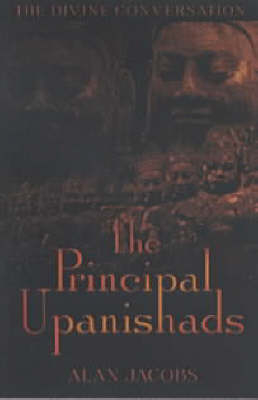
Principal Upanishads
Seiten
2003
O Books (Verlag)
978-1-903816-50-9 (ISBN)
O Books (Verlag)
978-1-903816-50-9 (ISBN)
The "Upanishads" are the sacred writings of Hinduism. Alan Jacobs uses modern free verse to convey the essential meaning and part of the original text. He omits Sanskrit words as far as possible and the commentary provided is contemporary rather than ancient.
The "Upanishads" are the sacred writings of Hinduism. They are perhaps the greatest of all the books in the history of world religions. Their origins predate recorded history, being revealed to the Rishis of the Vedic civilization some 5000 to 10,000 years ago. Many see them as the kernel of the mystical, philosophical truths that are the basis of the Higher World religion of Hinduism, their cradle, of which Buddhism is a successor and Judaism is an offshoot. With Islam and Christianity being offshoots of Judaism, this makes them the foundational documents for understanding and practising religion today. Much of the original text of the "Upanishads" is archaic and occasionally corrupted, but it does convey a moral and ethical thrust that is abundantly clear. Alan Jacobs uses modern free verse to convey the essential meaning and part of the original text. He omits Sanskrit words as far as possible and the commentary provided is contemporary rather than ancient.
The "Upanishads" are the sacred writings of Hinduism. They are perhaps the greatest of all the books in the history of world religions. Their origins predate recorded history, being revealed to the Rishis of the Vedic civilization some 5000 to 10,000 years ago. Many see them as the kernel of the mystical, philosophical truths that are the basis of the Higher World religion of Hinduism, their cradle, of which Buddhism is a successor and Judaism is an offshoot. With Islam and Christianity being offshoots of Judaism, this makes them the foundational documents for understanding and practising religion today. Much of the original text of the "Upanishads" is archaic and occasionally corrupted, but it does convey a moral and ethical thrust that is abundantly clear. Alan Jacobs uses modern free verse to convey the essential meaning and part of the original text. He omits Sanskrit words as far as possible and the commentary provided is contemporary rather than ancient.
Alan Jacobs Chair of the Ramana Maharshi Foundation (UK). He is editor of Poetry of the Spirit, Reflections: An Anthology of Contemporary Mystical Verse, and his poetry is regularly published. He lives in London.
| Erscheint lt. Verlag | 4.12.2003 |
|---|---|
| Sprache | englisch |
| Maße | 150 x 221 mm |
| Gewicht | 558 g |
| Themenwelt | Geisteswissenschaften ► Religion / Theologie ► Hinduismus |
| ISBN-10 | 1-903816-50-5 / 1903816505 |
| ISBN-13 | 978-1-903816-50-9 / 9781903816509 |
| Zustand | Neuware |
| Informationen gemäß Produktsicherheitsverordnung (GPSR) | |
| Haben Sie eine Frage zum Produkt? |
Mehr entdecken
aus dem Bereich


aus dem Bereich
Spiritual Living for Today Based on India's Thousand Names of …
Buch | Softcover (2025)
Nilgiri Press (Verlag)
CHF 35,90
Unearthing and Enacting the Feelings of Nine Himalayan Hindu …
Buch | Hardcover (2025)
De Gruyter (Verlag)
CHF 142,00


