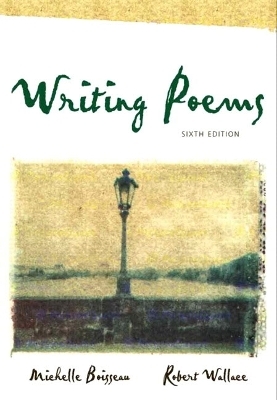
Writing Poems
Pearson (Verlag)
9780321094230 (ISBN)
- Titel erscheint in neuer Auflage
- Artikel merken
Boisseau's best-selling guide offers comprehensive coverage of the creative process and the technical aspects of writing poetry. Filled with practical advice and numerous examples, Writing Poems is appropriate for both the beginning and advanced poet. Its anthology of classic and contemporary poems enlivens its readers' understanding of poetry, illustrates poetic principles, and, above all, inspires writing. With clear explanations, a lively presentation, and in-depth discussions, this book demystifies the process of writing poems and provides the guidance needed to help writers improve their craft.
Note: Poems marked with asterisks are new to this edition.
Preface: To the Teacher.
1. Starting Out.
Word Magic.
Diction.
Syntax.
Pruning and Weeding.
Clarity, Ambiguity, Obscurity.
Questions and Suggestions.
Poems to Consider.
“Famous,” Naomi Shihab Nye.
“Sizing,” Heather McHugh *.
“We Three Kings,” Anonymous.
“Realism,” Czelsaw Milosz.
“Difficult Daughters,” Angela Ball *.
“A Poem of Attrition,” Etheridge Knight.
“No,”Mark Doty.
“David,” Josephine Miles *.
“For Hai Zi Who Call Himself Son of the Sea,” Ye Chun *.
I. FORM: THE NECESSARY NOTHING.
2. Verse.
Line.
Form.
Balance, Imbalance.
Questions and Suggestions.
Poems to Consider.
“Traveling through the Dark,” William Stafford.
“April,” Hettie Jones.
“One Heart,” Li-Young Lee *.
“Mulroney,” Baron Wormser *.
“The Impossible May Be Possible,” Cynthia Macdonald *.
“The Kiss,” Marta Tomes.
“In the Beginning,” Sarah Kennedy.
“Names of Horses,” Donald Hall.
“A Grave,” Marianne Moore.
“Storm Window,” Conrad Hilberry.
3. Making the Line (I).
Syllable-Stress Meter.
Rhythm.
The Length of Metrical Lines.
Substitutions and Variations.
A Little Scanning.
Questions and Suggestions.
Poems to Consider.
“Loveliest of Trees,” A. E. Housman.
“Crows,” Lizette Woodworth Reese.
“Balance,” Marilyn Nelson.
“Sonnet 116,” William Shakespeare.
“Scavenging the Wall,” R. T. Smith.
“Hamlen Brook,” Richard Wilbur.
“Move,” Geoffrey Brock *.
“Brown Recluse,” Erin Belieu.
“Fiduciary,” Randall Mann *.
“Barbed Wire,” Henry Taylor.
“The Payoff,” Allison Joseph *.
“Learning by Doing,” Howard Nemerov.
4. Making the Line (II).
Nonmetrical Verse: Long Lines.
Nonmetrical Verse: Mixed Lines.
Nonmetrical Verse: Short Lines.
Syllabics and Prose Poems.
Questions and Suggestions.
Poems to Consider.
“The Return,” Ezra Pound.
“Amaryllis,” Margaret Gibson.
“A Simple Experiment,” Muriel Rukeyser.
“The Wrong Street,” Cornelius Eady.
“The Long Marriage,” Maxine Kumin.
“Moon,” Carol Frost.
“my sweet old et cetera,” e.e. cummings.
“Meeting the Occasion,” Lucia Cordell Getsi.
“The stillborn calf,” Gary Young *.
5.The Sound and Look of Sense.
Visible Form.
Repetition.
Alliteration and Assonance.
Rhyme.
Onamatopoeia.
Questions and Suggestions.
Poems to Consider.
“Laundromat,” Lorine Niedecker *.
“Perseid Meteor Shower,” Christopher Buckley *.
“Don't Look Back,” Kay Ryan.
“January II,” Charles Wright *.
“Battle Scene,” Kelly Cherry *.
“Famous Last Words,” Michael Heffernan.
“Guilt,” Gerald Barrax.
“Ronda,” Gloria Vando.
“ Po_tolka,” Christian Wiman *.
“Reapers,” Jean Toomer.
“ To Autumn,” John Keats.
II. CONTENT: A LOCAL HABITATION AND A NAME.
6. Subject Matter.
Subjects and Objects.
Memory.
Presenting.
Implication and Focus.
Questions and Suggestions.
Poems to Consider.
“What She Could Do,” Elizabeth Holmes.
“An Introduction,” Judson Mitcham.
“Charles Harper Webb,” Charles Harper Webb *.
“The Tropics in New York,” Claude McCay.
“A Song in the Front Yard,” Thylias Moss *.
“The Fold-Out Atlas of the Human Body: A Three-Dimensional Book for Readers of All Ages,” William Olsen.
“On the Way to Early Morning Mass,” Pattiann Rogers.
“Handwriting,” Maura Stanton.
“My Attempt to Slow Down the World,” Roger Kirschbaum.
“Detroit Moi,” Al Young *.
7. Tale, Teller, Tone.
Narration and Action.
Persona.
Point of View.
Tone.
Questions and Suggestions.
Poems to Consider.
“Personals,” C. D. Wright.
“Witch of Coös,” Robert Frost.
“Antigone Today,” Richard Jackson *.
“A Cigarette's Iris in the Eye of a Candle,” Martín Espada.
“Extra Extra,” Sarah Gorham.
“Aunt Sue's Stories,” Langston Hughes.
“American Classic,” Louis Simpson.
“Sheep,” Linda Newton.
“The Curator,” Miller Williams.
8. Metaphor.
Figuratively Speaking.
A Name for Everything.
Pattern and Motif.
Conceits.
Metaphoric Implication.
Questions and Suggestions.
“Shalimar Gardens,” Carolyn Kizer.
“Rowing,” Jeffrey Harrison.
“X,” Carl Phillips.
“Giving Birth,” Andrea Hollander Budy *.
“Late September,” Charles Simic.
“After Fighting for Hours,” Kate Gleason.
“The Elements,” Trish Reeves.
“Cycladic Island Female Statue, British Museum,” David Citino *.
“Diapers for My Father,” Alice Friman.
9. Beyod the Rational.
The Sense of Nonsense.
The Logic of the Analogic.
Ordinary Strangeness.
Surreality.
Questions and Suggestions.
Poems to Consider.
“Kubla Khan,” Samuel Taylor Coleridge.
“A Hill,” Anthony Hecht *.
“Remember the Trains,” Martha Collins.
“Nihilistic Time,” Rodney Jones *.
“Goat,” Andrew Hudgins
“Conception,” Susan Whitmore.
“Fruit Flies to the Too Ripe Fruit,” Michele Glazer.
“71 Hwy. The Moment of Change,” Robert Stewart.
“The Virgin Appears as an Old Gay Man,” Michael Nelson.
“A Man Who Writes,” Russell Edson.
III. PROCESS: MAKING THE POEM HAPPEN.
10. Finding the Poem.
Imitation and Models.
Sources, Currents.
Emotion and Thought.
Getting into Words.
Keeping a Poem Going.
Questions and Suggestions.
Poems to Consider.
“A Description of the Morning,” Jonathan Swift.
“Kerosene,” Chase Twichell *.
“Bread and Water,” Shirley Kaufman.
“Late Night Drive,” Deborah Kroman.
“At Sixteen,” Edward Hirsch.
“At Seventeen,” Travis Brown.
“Sonnet: To Tell the Truth,” Alicia Ostriker.
“Ballade Beginning with a Line by Robert Bly,” R. S. Gwynn.
“Good Deeds,” Arthur Smith.
“She Says,” Luci Tapahonso.
11. Devising and Revising.
Exploring.
Trying Out.
Focusing.
Shaping.
Drafts.
Questions and Suggestions.
Poems to Consider.
“Love Calls Us to the Things of This World,” Richard Wilbur.
“The Edge of the Hurricane,” Amy Clampitt *.
“And Sweetness Out of the Strong,” Jennifer Atkinson *.
“Trompe L'oeil: Slovenia,” Colleen J. McElroy *.
“ABC,” Robert Pinsky.
“Woman on Twenty-Second Eating Berries,” Stanley Plumly.
“Romance in the Old Folks Home,” Michael Waters.
“Eggs,” Susan Wood *.
“The Man. His Bowl. His Raspberries,” Claudia Rankine.
“Laws,” Stephen Dunn.
12. Becoming a Poet.
The Growth of a Poet.
Going Public.
Writing Communities.
Getting Organized.
Questions and Suggestions.
Poems to Consider.
“Dancing with Poets,” Ellen Bryant Voigt.
“If You Don't Face It,” Michael S. Harper".
“The Purpose of Poetry,” Jared Carter *.
“Rain,” Sidney Wade.
“Buffalo,” Mark Irwin.
“La Muerte, Patron Saint of Writers,” Clarissa Pinkola Estes.
“Riverside Ghazal,” Patricia Clark *.
“Under the Oaks at Holmes Hall, Overtaken by Rain,” Garrett Hongo.
“Improvisation,” Eric Pankey.
“Writer in Exile,” Rafael Campo *.
“The Next Poem,” Dana Gioia.
Appendix I A Brief Glossary.
Appendix II Notes to the Questions and Suggestions.
Appendix III. Further Reading.
Acknowledgments.
Index of Authors and Titles.
Index of Terms.
| Erscheint lt. Verlag | 4.3.2004 |
|---|---|
| Sprache | englisch |
| Maße | 167 x 234 mm |
| Gewicht | 501 g |
| Themenwelt | Geisteswissenschaften ► Sprach- / Literaturwissenschaft ► Literaturwissenschaft |
| Geisteswissenschaften ► Sprach- / Literaturwissenschaft ► Sprachwissenschaft | |
| ISBN-13 | 9780321094230 / 9780321094230 |
| Zustand | Neuware |
| Informationen gemäß Produktsicherheitsverordnung (GPSR) | |
| Haben Sie eine Frage zum Produkt? |
aus dem Bereich