


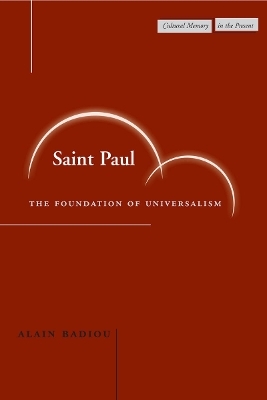
Saint Paul
The Foundation of Universalism
Seiten
2003
|
New edition
Stanford University Press (Verlag)
978-0-8047-4471-3 (ISBN)
Stanford University Press (Verlag)
978-0-8047-4471-3 (ISBN)
This book revisits and revises some of the most basic concepts of time in the Judeo-Christian tradition, drawing on St. Paul's writings to rethink a new kind of radical faith in truth as an event, as the advent of the incalculable, a modality that remakes the pairing religious/secular.
In this bold and provocative work, French philosopher Alain Badiou proposes a startling reinterpretation of St. Paul. For Badiou, Paul is neither the venerable saint embalmed by Christian tradition, nor the venomous priest execrated by philosophers like Nietzsche: he is instead a profoundly original and still revolutionary thinker whose invention of Christianity weaves truth and subjectivity together in a way that continues to be relevant for us today.
In this work, Badiou argues that Paul delineates a new figure of the subject: the bearer of a universal truth that simultaneously shatters the strictures of Judaic Law and the conventions of the Greek Logos. Badiou shows that the Pauline figure of the subject still harbors a genuinely revolutionary potential today: the subject is that which refuses to submit to the order of the world as we know it and struggles for a new one instead.
In this bold and provocative work, French philosopher Alain Badiou proposes a startling reinterpretation of St. Paul. For Badiou, Paul is neither the venerable saint embalmed by Christian tradition, nor the venomous priest execrated by philosophers like Nietzsche: he is instead a profoundly original and still revolutionary thinker whose invention of Christianity weaves truth and subjectivity together in a way that continues to be relevant for us today.
In this work, Badiou argues that Paul delineates a new figure of the subject: the bearer of a universal truth that simultaneously shatters the strictures of Judaic Law and the conventions of the Greek Logos. Badiou shows that the Pauline figure of the subject still harbors a genuinely revolutionary potential today: the subject is that which refuses to submit to the order of the world as we know it and struggles for a new one instead.
Alain Badiou holds the Chair of Philosophy at the Ecole Normale Supérieure in Paris. Several of his books have been translated into English, including Manifesto for Philosophy (1999), Deleuze: The Clamor of Being (2000) and Ethics: an Essay on the Understanding of Evil (2001).
| Erscheint lt. Verlag | 6.5.2003 |
|---|---|
| Reihe/Serie | Cultural Memory in the Present |
| Übersetzer | Ray Brassier |
| Verlagsort | Palo Alto |
| Sprache | englisch |
| Maße | 140 x 216 mm |
| Gewicht | 177 g |
| Themenwelt | Geisteswissenschaften ► Philosophie ► Philosophie Altertum / Antike |
| Geisteswissenschaften ► Philosophie ► Philosophie der Neuzeit | |
| Religion / Theologie ► Christentum ► Kirchengeschichte | |
| ISBN-10 | 0-8047-4471-8 / 0804744718 |
| ISBN-13 | 978-0-8047-4471-3 / 9780804744713 |
| Zustand | Neuware |
| Informationen gemäß Produktsicherheitsverordnung (GPSR) | |
| Haben Sie eine Frage zum Produkt? |
Mehr entdecken
aus dem Bereich

aus dem Bereich
eine andere Geschichte der Papststadt
Buch | Softcover (2024)
C.H.Beck (Verlag)
CHF 25,20
die Macht des Dunklen in unserer Zeit und wie wir ihr entgegentreten
Buch | Hardcover (2025)
Verlag Herder
CHF 27,90


