


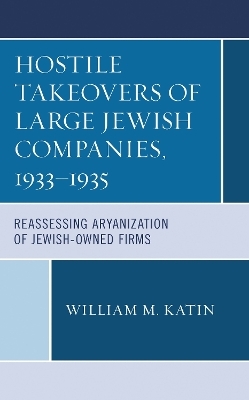
Hostile Takeovers of Large Jewish Companies, 1933–1935
Reassessing Aryanization of Jewish-Owned Firms
Seiten
2020
Lexington Books (Verlag)
9781793606822 (ISBN)
Lexington Books (Verlag)
9781793606822 (ISBN)
This book challenges the view that cheap purchases of Jewish firms were the result of the Nazi Party's activity in 1938 by emphasizing the role of private businessmen being supported by banks and the judiciary in 1933-1935.
Opportunism combined with anti-Semitism led non-Nazi businessmen to acquire the largest German-Jewish companies in the period 1933–1935. These hostile takeovers were made possible by the Deutsche Bank and Dresdner Bank, which recalled loans previously extended to Jewish firms. Thereby Germany's largest banks obtained new loan fees, new supervisory board seats and became the house banks for the new Gentile-owned firms. The German judiciary did not defend Jewish property rights, because judges shared the same conservative mindset. Scholarship has previously not discovered this 1933–1935 paradigm because of a focus on Berlin government or Nazi Party actions, instead of the Jewish companies. In addition, a failure to distinguish between multi-million dollar enterprises and tiny shops caused scholars to emphasize the year 1938, when thousands of mom-and-pop shops became bankrupt.
Opportunism combined with anti-Semitism led non-Nazi businessmen to acquire the largest German-Jewish companies in the period 1933–1935. These hostile takeovers were made possible by the Deutsche Bank and Dresdner Bank, which recalled loans previously extended to Jewish firms. Thereby Germany's largest banks obtained new loan fees, new supervisory board seats and became the house banks for the new Gentile-owned firms. The German judiciary did not defend Jewish property rights, because judges shared the same conservative mindset. Scholarship has previously not discovered this 1933–1935 paradigm because of a focus on Berlin government or Nazi Party actions, instead of the Jewish companies. In addition, a failure to distinguish between multi-million dollar enterprises and tiny shops caused scholars to emphasize the year 1938, when thousands of mom-and-pop shops became bankrupt.
William M. Katin, PhD, is lecturer at the California State University, San Bernardino.
Chapter One: How Cheap Purchases of German-Jewish Firms Occurred
Chapter Two: History of Research on Cheap Purchases of Jewish Firms
Chapter Three: New Approach to Comprehend Aryanizers
Chapter Four: Background to Aryanization of the Hermann Tietz Chain
Chapter Five: Aryanization of Hermann Tietz
Chapter Six: Early Aryanizations Confirming the Hermann Tietz Paradigm
Chapter Seven: Conclusion
| Erscheinungsdatum | 10.05.2021 |
|---|---|
| Reihe/Serie | Bloomsbury Studies in Modern Jewish History, Historiography, and Memory |
| Zusatzinfo | 28 tables; 9 graphs; |
| Sprache | englisch |
| Maße | 161 x 227 mm |
| Gewicht | 585 g |
| Themenwelt | Geschichte ► Allgemeine Geschichte ► 1918 bis 1945 |
| Geisteswissenschaften ► Geschichte ► Regional- / Ländergeschichte | |
| Geschichte ► Teilgebiete der Geschichte ► Religionsgeschichte | |
| Geisteswissenschaften ► Religion / Theologie ► Judentum | |
| ISBN-13 | 9781793606822 / 9781793606822 |
| Zustand | Neuware |
| Informationen gemäß Produktsicherheitsverordnung (GPSR) | |
| Haben Sie eine Frage zum Produkt? |
Mehr entdecken
aus dem Bereich



aus dem Bereich
Deutschland 1933 bis 1945
Buch | Hardcover (2025)
S. Fischer (Verlag)
CHF 47,60
ein Psychologe erlebt das Konzentrationslager
Buch | Hardcover (2024)
Kösel (Verlag)
CHF 30,80


