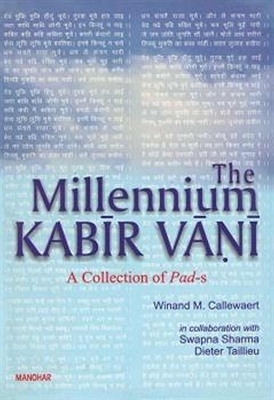
The Millennium Kabir Vani
Manohar Publishers and Distributors (Verlag)
978-81-7304-357-4 (ISBN)
- Titel nicht im Sortiment
- Artikel merken
When around 1500 the Muslim weaver Kab?r sang his songs in Banaras, nobody could imagine that at the end of the twentieth century he would be the most frequently quoted bhakti saint in north India. Five hundred years after Kab?r was born in Banaras and after at least 80 years of scholarship, do we have any certainty that the songs attributed to him and published in critical and uncritical editions and translations, are by Kab?r? Between Kab?r and the computer age lies 150 years of oral transmission (which never stopped) and nearly 400 years of scribal transmission. We have no oral recordings of Kab?r scolding his audiences and I take it for granted that he did not write down his compositions. What we have are manuscripts in which his popular repertoire was written down, first by travelling singers, and later, in a more respectful and professional way, by devoted scribes. But what do we have of Kab?r in those repertoires?
The author argues that with certainty we can only say that the version of Kab?r's songs found in the seventeenth century manuscripts is the version commonly used and sung by singers then. Among the pad-s in the V?]n? of Kab?r we can earmark those that may have been popular in the repertoires around 1550, that is two generations after the death of Kab?r and one generation before the first manuscripts still preserved now were written. The norm is 'occurrence' in Punjab and/or Rajasthan. When everything is said and done, one question remains: How could Kab?r become so charismatic that many devotees, possibly during his lifetime and definitely after his death, were happy to insert his name as bha]nit? in their own compositions and let those songs circulate with his name, not their own? What was his genius that eventually was changed into a social consciousness strongly influencing later generations?
Winand M. Callewaert (1943), is a Emeritus Professor of Sanskrit at the KU Leuven, Belgium. He has been studying and working in India since 1965, holding degrees in Hindi, Sanskrit and Philosophy from Ranchi, Pune, Banaras and Leuven. Besides numerous research articles he has published 17 books in English or Hindi and 12 in Dutch. Swapna Sharma is a Senior Hindi preceptor at Yale University. She was previously a lecturer at University of Leipzig in 2007. She received her PhD from Agra University, with her thesis on 'Gadhadhar Bhatta'. Dieter Taillieu has graduated from Leuven in Indian and Iranian studies and is now doing research about pre-Islamic Iran.
Preface VII
Abbreviations VIII
Manuscripts Editions `Stemma' of the Repertoires X
Introduction 1
1 Editions of Kabir's Songs: Three Traditions 3
2 New Manuscript Material 19
3 First line indexes 25
4 In What repertoies are the pad-s found? 75
5 Pad-s in the Sabha edition 81
6 Pad-s in the Adi-granth, our edition 95
7 Looking at the rag structure 103
8 Comparing the P.N. Tivari 107
9 Most Popular songs of Kabir 109
10 Language and critical editions of Kabir's songs 109
Bibliography 113
Text edition 115
| Erscheint lt. Verlag | 1.7.2024 |
|---|---|
| Verlagsort | New Delhi |
| Sprache | englisch |
| Maße | 160 x 240 mm |
| Gewicht | 1200 g |
| Themenwelt | Geisteswissenschaften ► Religion / Theologie ► Weitere Religionen |
| Geisteswissenschaften ► Sprach- / Literaturwissenschaft ► Anglistik / Amerikanistik | |
| Geisteswissenschaften ► Sprach- / Literaturwissenschaft ► Literaturwissenschaft | |
| ISBN-10 | 81-7304-357-4 / 8173043574 |
| ISBN-13 | 978-81-7304-357-4 / 9788173043574 |
| Zustand | Neuware |
| Informationen gemäß Produktsicherheitsverordnung (GPSR) | |
| Haben Sie eine Frage zum Produkt? |
aus dem Bereich