


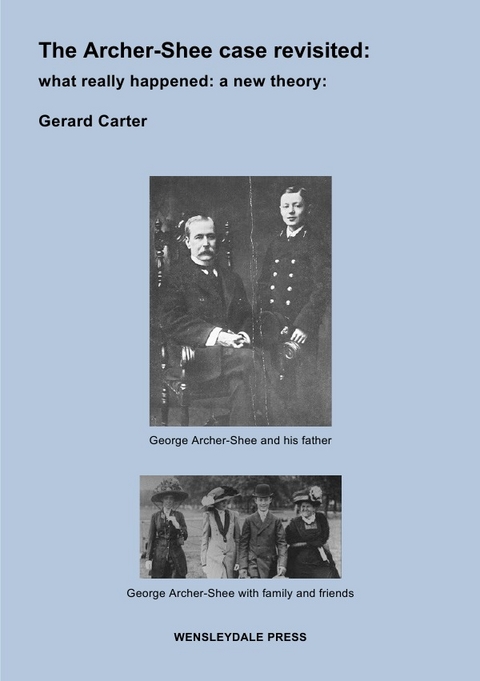
The Archer-Shee case revisited
what really happened: a new theory
Seiten
2020
|
3. Auflage
epubli (Verlag)
978-3-7529-7379-2 (ISBN)
epubli (Verlag)
978-3-7529-7379-2 (ISBN)
- Print on Demand
- Artikel merken
Gerard Carter was admitted as a Solicitor of the Supreme Court of New South Wales in 1971 and practised law in Sydney for many years. He is the author of numerous legal and musical publications.
On 7 October 1908 George Archer-Shee, a naval cadet at the Royal Naval College, Osborne, allegedly stole a 5/- postal order belonging to a fellow cadet. The Navy investigated the allegations, found George guilty and expelled him. This branded George publicly as a thief and destroyed his good name, his planned naval career and his future employability. It also destroyed the good name of his family. The ensuing case by his father against the Admiralty claimed that George was not guilty and that he had been wrongfully expelled. There was widespread public support for the Archer-Shees during the hearing of their case against the Admiralty. Settlement of the case cleared George of any wrongdoing and released the Admiralty from any legal claim for breach of contract or malicious prosecution. George's father then pressed for and obtained an ex gratia payment from the Admiralty. Navy officials always believed George was guilty although commentators have either considered that George was innocent or have left the question open. The present author expresses the view that George was guilty and proposes his own theory.
On 7 October 1908 George Archer-Shee, a naval cadet at the Royal Naval College, Osborne, allegedly stole a 5/- postal order belonging to a fellow cadet. The Navy investigated the allegations, found George guilty and expelled him. This branded George publicly as a thief and destroyed his good name, his planned naval career and his future employability. It also destroyed the good name of his family. The ensuing case by his father against the Admiralty claimed that George was not guilty and that he had been wrongfully expelled. There was widespread public support for the Archer-Shees during the hearing of their case against the Admiralty. Settlement of the case cleared George of any wrongdoing and released the Admiralty from any legal claim for breach of contract or malicious prosecution. George's father then pressed for and obtained an ex gratia payment from the Admiralty. Navy officials always believed George was guilty although commentators have either considered that George was innocent or have left the question open. The present author expresses the view that George was guilty and proposes his own theory.
Gerard Carter was admitted as a Solicitor of the Supreme Court of New South Wales in 1971 and practised law in Sydney for many years. He is a Bachelor of Economics and Bachelor of Laws from the University of Sydney and is the author of numerous books, monographs and articles on legal and musical subjects.
| Erscheinungsdatum | 30.11.2022 |
|---|---|
| Sprache | englisch |
| Maße | 148 x 210 mm |
| Gewicht | 113 g |
| Themenwelt | Geschichte ► Teilgebiete der Geschichte ► Militärgeschichte |
| Recht / Steuern ► Rechtsgeschichte | |
| Schlagworte | Archer • CASE • Historical • legal • Revisited • Shee • theory |
| ISBN-10 | 3-7529-7379-X / 375297379X |
| ISBN-13 | 978-3-7529-7379-2 / 9783752973792 |
| Zustand | Neuware |
| Informationen gemäß Produktsicherheitsverordnung (GPSR) | |
| Haben Sie eine Frage zum Produkt? |
Mehr entdecken
aus dem Bereich



aus dem Bereich
von der Wiederbewaffnung bis zur Zeitenwende
Buch | Softcover (2025)
C.H.Beck (Verlag)
CHF 16,80
Deutschlands großer Volksaufstand
Buch | Softcover (2024)
Propyläen Verlag
CHF 30,80


