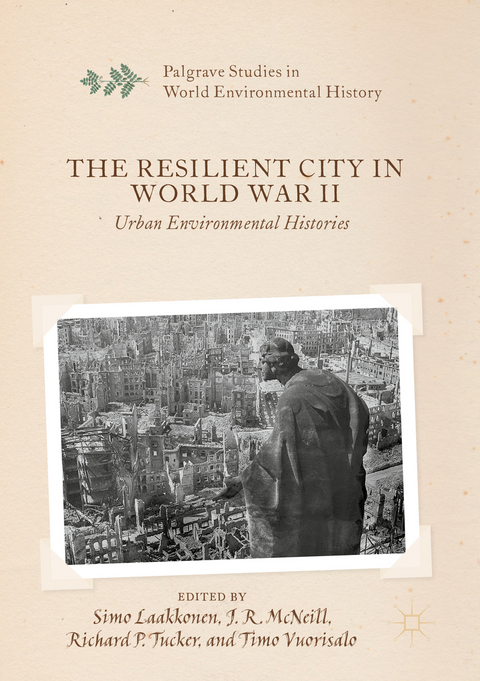
The Resilient City in World War II
Springer International Publishing (Verlag)
978-3-030-17441-5 (ISBN)
lt;b>Simo Laakkonen is Senior Lecturer of Landscape Studies at the University of Turku, Finland.
J. R. McNeill is Professor of History at Georgetown University, USA.
Richard P. Tucker is Adjunct Professor of Environmental History at the University of Michigan, USA.
Timo Vuorisalo is Senior Lecturer of Environmental Science at the University of Turku, Finland.
I. Introduction.- 1. Environmental History, the Second World War, and Urban Resilience.- II. Urban Environment.- 2. Critical Networks.- 3. Fortress City: The Militarized Landscape of Seattle.- 4. War and Urban-Industrial Air Pollution in the UK and US.- 5. Imagined Resilience.- III. Urban Nature.- 6. Guerrilla Gardening? Urban Agriculture and the Environment.- 7. Gaining Strength from Nature.- 8. Resilience behind Bars.- 9. Where Have all the Pigeons Gone.- IV. Urban Society.- 10. Partial Resilience in Nationalist China's Wartime Capital.- 11. Japanese-Occupied Hanoi.- 12. The Esteros and Manila's Postwar Remaking.- 13. Apocalyptic Urban Future.- V. Conclusions.- 14. Epilogue: What Makes a City Resilient?
| Erscheinungsdatum | 07.07.2020 |
|---|---|
| Reihe/Serie | Palgrave Studies in World Environmental History |
| Zusatzinfo | XX, 317 p. 31 illus., 12 illus. in color. |
| Verlagsort | Cham |
| Sprache | englisch |
| Maße | 148 x 210 mm |
| Gewicht | 445 g |
| Themenwelt | Geschichte ► Allgemeine Geschichte ► 1918 bis 1945 |
| Schlagworte | Air Pollution • animals in World War II • atomic bomb in science fiction • climate change • Eco-horror • ecosystem • industrial warfare • Military-Industrial Complex • postwar recovery • Second World War • Shock cities • socio-environmental stress • Spanish Civil War • urban planning • wartime conservation • wartime urban argiculture • water supply |
| ISBN-10 | 3-030-17441-7 / 3030174417 |
| ISBN-13 | 978-3-030-17441-5 / 9783030174415 |
| Zustand | Neuware |
| Informationen gemäß Produktsicherheitsverordnung (GPSR) | |
| Haben Sie eine Frage zum Produkt? |
aus dem Bereich