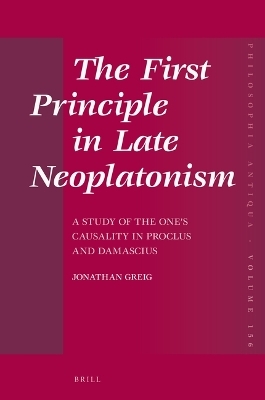
The First Principle in Late Neoplatonism
Brill (Verlag)
978-90-04-43905-4 (ISBN)
In The First Principle, Jonathan Greig examines the philosophical theology of the two Neoplatonists, Proclus and Damascius (5th–6th centuries A.D.), on the One as the first cause. Both philosophers address a tension in the Neoplatonic tradition: namely that the One was seen as absolutely transcendent, yet it was also seen as intimately related to other things as the source of their unity and being. Proclus’ solution is to posit intermediate causes after the One, while Damascius posits a distinct principle, the ‘Ineffable’, above the One. This book provides a new, thorough study of the theories of causation that lead each to their respective position and reveals crucial insights involved in a rigorous negative theology employed in metaphysics.
Jonathan Greig, Ph.D. (LMU Munich, 2018), is a postdoctoral research fellow at the Austrian Academy of Sciences (Institute for Medieval Research). He has published on Neoplatonic metaphysics and its reception in early and late Byzantine philosophy/theology.
Acknowledgements
Preface
Introduction
1 The Background to Proclus and Damascius
1.1 Plotinus
1.1.1 The One as Anticipating Intellect’s Nature
1.2 Porphyry
1.2.1. The Anonymous Parmenides Commentary
1.2.2. Assessing Porphyry and the Anonymous Commentary in Light of Plotinus
1.3 Iamblichus
1.4 Conclusion: Syrianus’ Transformation as the Foundation for Proclus and Damascius
2 Proclus’ Causal Framework
2.1 The Building Blocks of Causality in Proclus
2.1.1 The Cause as Greater Than Its Effect
2.1.2 ἐνέργεια, δύναμις, and Causal Synonymy in Proclus
2.1.3 Productive Causes and Two Kinds of Intermediaries
2.2 Unparticipated and Participated Causes
2.2.1 Participated Causes as Relative to Participants: Proclus’ Shift from Plotinus
2.2.2 Relating Unparticipated Causes with Participants
2.3 The Derivation of Participated Entities and Lower Levels from the Unparticipated
2.4 Conclusion
3 Damascius’ Causal Framework
3.1 Synonymy in Causal Relations
3.2 Causal Synonymy and Similar/Dissimilar Effects
3.3 Unparticipated Causality and Self-Constitution
3.3.1 Self-Constitution and Reversion
3.3.2 Unparticipated/Participated Causality
3.4 Conclusion
4 Proclus on the One’s Causality
4.1 Proclus’ Proofs for the One
4.1.1 ET Prop. 1–4: Unity as an Ontological Component
4.1.2 ET Prop. 5: the One as Unparticipated
4.1.3 ET Prop. 6: the One’s Causality Delegated to the Henads
4.1.4 Putting Proclus’ One in Perspective
4.2 The One within Proclus’ Causal Framework
4.2.1 Proclus’ Causal Model in Response to the Plotinian Model
4.2.2 The One’s Causality Indicated in Negations
4.2.3 The One and Matter
4.3 The Henads as Participated Causes of the One
4.3.1 Distinguishing the Henads
4.3.2 The Henads’ Derivation from the One
4.3.3 Orders of the Henads, and the Limit/Unlimited
4.4 The Limit and Unlimited: a Second Participated Model?
4.4.1 The One and the Limit/Unlimited in PT III.8–9
4.5 Reconciling Causal Models, and a Remaining Impasse
4.6 Conclusion: Assessing Proclus’ Framework for the One
5 Damascius on the One’s Causality and the Ineffable
5.1 Causal Synonymy and the One
5.1.1 The First Aporia in DP I,1–2: the One as Coordinated with τὰ πάντα
5.1.2 The One’s Causal Synonymy with τὰ πάντα
5.1.3 Damascius’ Response to Proclus against the One as τὰ πάντα
5.2 Causal Synonymy, and the One-All, All-One, and the Unified
5.2.1 The Undetermined-Determined Distinction in the One (DP I,94–98)
5.2.2 The One Distinguished as Remaining, Procession, Reversion κατὰ ἀναλογίαν
5.2.3 Damascius’ Assessment of the Iamblichean/Proclean Interpretations of the Limit/Unlimited
5.2.4 The One Differentiated into the One-All, All-One, Unified
5.2.5 Summing up Damascius’ Structural Changes
5.3 The Ineffable: Separating Causal Synonymy and the ἀρχή
5.3.1 Distinguishing the Ineffable in Speech
5.3.2 The Three ‘Ascents’ to the First Principle
5.3.3 The Ineffable as the Grounding Principle of the One
5.3.4 The ‘Superfluous Reading’: Objections to Damascius’ Ineffable, and the Ineffable’s Role
5.4 Conclusion: Assessing Damascius’ Transformation
Conclusion
Bibliography
Index Locorum
Index Rerum
| Erscheinungsdatum | 09.11.2020 |
|---|---|
| Reihe/Serie | Philosophia Antiqua ; 156 |
| Verlagsort | Leiden |
| Sprache | englisch |
| Maße | 155 x 235 mm |
| Gewicht | 725 g |
| Themenwelt | Geisteswissenschaften ► Philosophie ► Philosophie Altertum / Antike |
| ISBN-10 | 90-04-43905-6 / 9004439056 |
| ISBN-13 | 978-90-04-43905-4 / 9789004439054 |
| Zustand | Neuware |
| Informationen gemäß Produktsicherheitsverordnung (GPSR) | |
| Haben Sie eine Frage zum Produkt? |
aus dem Bereich