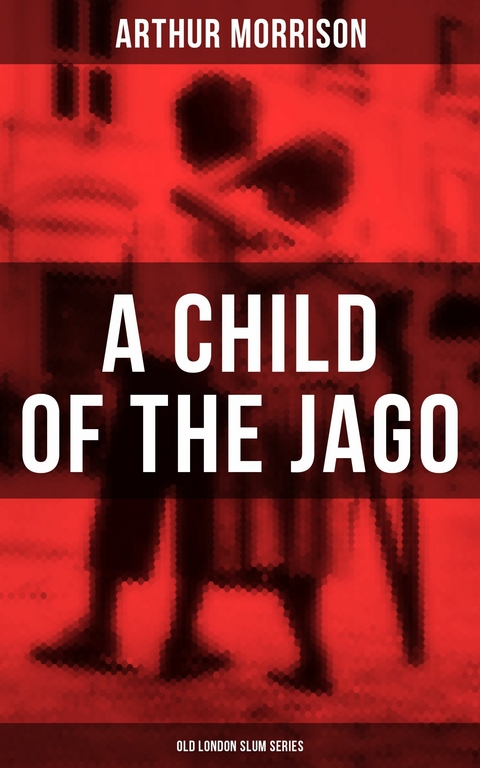
A CHILD OF THE JAGO (Old London Slum Series) (eBook)
191 Seiten
Musaicum Books (Verlag)
978-80-7583-385-3 (ISBN)
CHAPTER I
IT was past the mid of a summer night in the Old Jago. The narrow street was all the blacker for the lurid sky; for there was a fire in a farther part of Shoreditch, and the welkin was an infernal coppery glare. Below, the hot, heavy air lay, a rank oppression, on the contorted forms of those who made for sleep on the pavement: and in it, and through it all, there rose from the foul earth and the grimed walls a close, mingled stink—the odour of the Jago.
From where, off Shoreditch High Street, a narrow passage, set across with posts, gave menacing entrance on one end of Old Jago Street, to where the other end lost itself in the black beyond Jago Row; from where Jago Row began south at Meakin Street, to where it ended north at Honey Lane—there the Jago, for one hundred years the blackest pit in London, lay and festered; and half-way along Old Jago Street a narrow archway gave upon Jago Court, the blackest hole in all that pit.
A square of two hundred and fifty yards or less—that was all there was of the Jago. But in that square the human population swarmed in thousands. Old Jago Street, New Jago Street, Half Jago Street lay parallel, east and west: Jago Row at one end and Edge Lane at the other lay parallel also, stretching north and south: foul ways all. What was too vile for Kate Street, Seven Dials, and Ratcliff Highway in its worst day, what was too useless, incapable and corrupt—all that teemed in the Old Jago.
Old Jago Street lay black and close under the quivering red sky; and slinking forms, as of great rats, followed one another quickly between the posts in the gut by the High Street, and scattered over the Jago. For the crowd about the fire was now small, the police was there in force, and every safe pocket had been tried. Soon the incursion ceased, and the sky, flickering and brightening no longer, settled to a sullen flush. On the pavement some writhed wearily, longing for sleep; others, despairing of it, sat and lolled, and a few talked. They were not there for lack of shelter, but because in this weather repose was less unlikely in the street than within doors: and the lodgings of the few who nevertheless abode at home were marked here and there by the lights visible from the windows. For in this place none ever slept without a light, because of three kinds of vermin that light in some sort keeps at bay: vermin which added to existence here a terror not to be guessed by the unafflicted: who object to being told of it. For on them that lay writhen and gasping on the pavement; on them that sat among them; on them that rolled and blasphemed in the lighted rooms; on every moving creature in this, the Old Jago, day and night, sleeping and walking, the third plague of Egypt, and more, lay unceasing.
The stifling air took a further oppression from the red sky. By the dark entrance to Jago Court a man rose, flinging out an oath, and sat with his head bowed in his hands.
‘Ah—h—h—h,’ he said. ‘I wish I was dead: an’ kep’ a cawfy shop.’ He looked aside from his hands at his neighbours; but Kiddo Cook’s ideal of heaven was no new thing, and the sole answer was a snort from a dozing man a yard away.
Kiddo Cook felt in his pocket and produced a pipe and a screw of paper. ‘This is a bleed’n’ unsocial sort o’ evenin’ party, this is,’ he said, ‘An’ ‘ere’s the on’y real toff in the mob with ardly ‘arf a pipeful left, an’ no lights. D’ y’ ‘ear, me lord’—leaning toward the dozing neighbour—‘got a match?’
‘Go t’ ‘ell!’
‘O wot ‘orrid langwidge! It’s shocking, blimy. Arter that y’ ought to find me a match. Come on.’
‘Go t’ ‘ell!’
A lank, elderly man, who sat with his back to the wall, pushed up a battered tall hat from his eyes, and, producing a box of matches, exclaimed ‘Hell? And how far’s that? You’re in it!’ He flung abroad a bony hand, and glanced upward. Over his forehead a greasy black curl dangled and shook as he shuddered back against the wall. ‘My God, there can be no hell after this!’
‘Ah,’ Kiddo Cook remarked, as he lit his pipe in the hollow of his hands, ‘that’s a comfort, Mr Beveridge, any’ow.’ He returned the matches, and the old man, tilting his hat forward, was silent.
A woman, gripping a shawl about her shoulders, came furtively along from the posts, with a man walking in her tracks—a little unsteadily. He was not of the Jago, but a decent young workman, by his dress. The sight took Kiddo Cook’s idle eye, and when the couple had passed, he said meditatively: ‘There’s Billy Leary in luck ag’in: ‘is missis do pick ‘em up, s’elp me. I’d carry the cosh meself if I’d got a woman like ‘er.’
Cosh-carrying was near to being the major industry of the Jago. The cosh was a foot length of iron rod, with a knob at one end, and a hook (or a ring) at the other. The craftsman, carrying it in his coat sleeve, waited about dark staircase corners till his wife (married or not) brought in a well drunken stranger: when, with a sudden blow behind the head, the stranger was happily coshed, and whatever was found on him as he lay insensible was the profit on the transaction. In the hands of capable practitioners this industry yielded a comfortable subsistence for no great exertion. Most, of course, depended on the woman: whose duty it was to keep the other artist going in subjects. There were legends of surprising ingatherings achieved by wives of especial diligence: one of a woman who had brought to the cosh some six-and-twenty on a night of public rejoicing. This was, however, a story years old, and may have been no more than an exemplary fiction, designed, like a Sunday School book, to convey a counsel of perfection to the dutiful matrons of the Old Jago.
The man and woman vanished in a doorway near the Jago Row end, where, for some reason, dossers were fewer than about the portal of Jago Court. There conversation flagged, and a broken snore was heard. It was a quiet night, as quietness was counted in the Jago; for it was too hot for most to fight in that stifling air—too hot to do more than turn on the stones and swear. Still the last hoarse yelps of a combat of women came intermittently from Half Jago Street in the further confines.
In a little while something large and dark was pushed forth from the door-opening near Jago Row which Billy Leary’s spouse had entered. The thing rolled over, and lay tumbled on the pavement, for a time unnoted. It might have been yet another would-be sleeper, but for its stillness. Just such a thing it seemed, belike, to two that lifted their heads and peered from a few yards off, till they rose on hands and knees and crept to where it lay: Jago rats both. A man it was; with a thick smear across his face, and about his head the source of the dark trickle that sought the gutter deviously over the broken flags. The drab stuff of his pockets peeped out here and there in a crumpled bunch, and his waistcoat gaped where the watch-guard had been. Clearly, here was an uncommonly remunerative cosh—a cosh so good that the boots had been neglected, and remained on the man’s feet. These the kneeling two unlaced deftly, and, rising, prize in hand, vanished in the deeper shadow of Jago Row.
A small boy, whom they met full tilt at the corner, staggered out to the gutter and flung a veteran curse after them. He was a slight child, by whose size you might have judged his age at five. But his face was of serious and troubled age. One who knew the children of the Jago, and could tell, might have held him eight, or from that to nine.
He replaced his hands in his trousers pockets, and trudged up the street. As he brushed by the coshed man he glanced again toward Jago Row, and, jerking his thumb that way, ‘Done ‘im for ‘is boots,’ he piped. But nobody marked him till he reached Jago Court, when old Beveridge, pushing back his hat once more, called sweetly and silkily, ‘Dicky Perrott!’ and beckoned with his finger.
The boy approached, and as he did so the man’s skeleton hand suddenly shot out and gripped him by the collar. ‘It—never—does—to—see—too—much!’ Beveridge said, in a series of shouts, close to the boy’s ear. ‘Now go home,’ he added, in a more ordinary tone, with a push to make his meaning plain: and straightway relapsed against the wall.
The boy scowled and backed off the pavement. His ragged jacket was coarsely made from one much larger, and he hitched the collar over his shoulder as he shrank toward a doorway some few yards on. Front doors were used merely as firewood in the Old Jago, and most had been burnt there many years ago. If perchance one could have been found still on its hinges, it stood ever open and probably would not shut. Thus at night the Jago doorways were a row of black holes, foul and forbidding.
Dicky Perrott entered his hole with caution, for anywhere, in the passage and on the stairs, somebody might be lying drunk, against whom it would be unsafe to stumble. He found nobody, however, and climbed and reckoned his way up the first stair-flight with the necessary regard for the treads that one might step through and the rails that had gone from the side. Then he pushed open the door of the first-floor back and was at home.
A little heap of guttering grease, not long ago a candle end, stood and spread on the mantel-piece, and gave irregular light from its drooping wick. A thin-railed iron bedstead, bent and staggering, stood against a wall, and on its murky coverings a half-dressed woman sat and neglected a baby that lay by her, grieving and wheezing. The woman had a long dolorous face, empty of expression and...
| Erscheint lt. Verlag | 21.6.2017 |
|---|---|
| Verlagsort | Prague |
| Sprache | englisch |
| Themenwelt | Literatur ► Romane / Erzählungen |
| Sachbuch/Ratgeber ► Geschichte / Politik ► Neuzeit bis 1918 | |
| Geisteswissenschaften ► Geschichte | |
| Schlagworte | Angela's Ashes • Arthur Morrison • A Tree Grows in Brooklyn • Charles Dickens • crime and violence • East End • Innocence corrupted • Jack London • Lion • London setting • lower class • Oliver Twist • realistic portrayal • Sarah Wise • Sherlock Holmes • slum environment • The Perks of Being a Wallflower • Tom Sawyer • Victorian London • working-class life |
| ISBN-10 | 80-7583-385-6 / 8075833856 |
| ISBN-13 | 978-80-7583-385-3 / 9788075833853 |
| Informationen gemäß Produktsicherheitsverordnung (GPSR) | |
| Haben Sie eine Frage zum Produkt? |
 EPUB (Wasserzeichen)
DRM: Digitales Wasserzeichen
Dieses eBook enthält ein digitales Wasserzeichen und ist damit für Sie personalisiert. Bei einer missbräuchlichen Weitergabe des eBooks an Dritte ist eine Rückverfolgung an die Quelle möglich.
Dateiformat: EPUB (Electronic Publication)
EPUB ist ein offener Standard für eBooks und eignet sich besonders zur Darstellung von Belletristik und Sachbüchern. Der Fließtext wird dynamisch an die Display- und Schriftgröße angepasst. Auch für mobile Lesegeräte ist EPUB daher gut geeignet.
Systemvoraussetzungen:
PC/Mac: Mit einem PC oder Mac können Sie dieses eBook lesen. Sie benötigen dafür die kostenlose Software Adobe Digital Editions.
eReader: Dieses eBook kann mit (fast) allen eBook-Readern gelesen werden. Mit dem amazon-Kindle ist es aber nicht kompatibel.
Smartphone/Tablet: Egal ob Apple oder Android, dieses eBook können Sie lesen. Sie benötigen dafür eine kostenlose App.
Geräteliste und zusätzliche Hinweise
Buying eBooks from abroad
For tax law reasons we can sell eBooks just within Germany and Switzerland. Regrettably we cannot fulfill eBook-orders from other countries.
aus dem Bereich