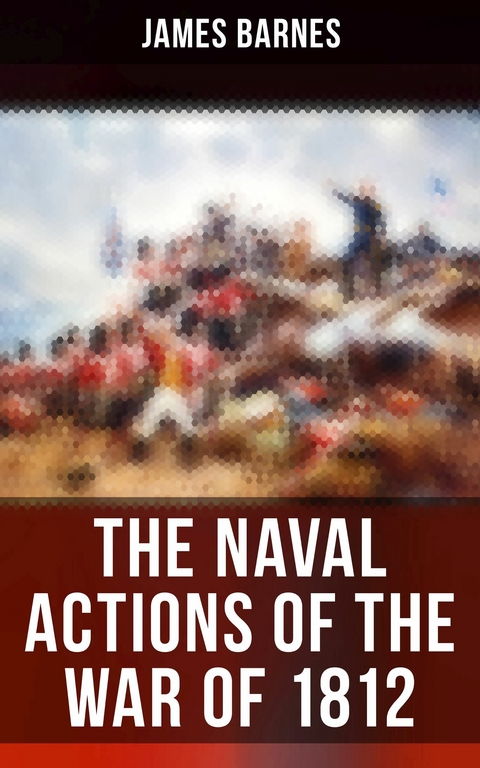
The Naval Actions of the War of 1812 (eBook)
151 Seiten
Musaicum Books (Verlag)
978-80-272-4768-4 (ISBN)
I
THE THREE-DAYS CHASE OF THE “CONSTITUTION”
[July 17th, 18th, 19th, 1812]
MEDAL PRESENTED BY CONGRESS TO CAPTAIN ISAAC HULL
If during the naval war of 1812 any one man won laurels because he understood his ship, and thus triumphed over odds, that man was Captain Hull, and the ship was the old Constitution.
Returning from a mission to Europe during the uncertain, feverish days that preceded the declaration of war between England and America, Hull had drawn into the Chesapeake to outfit for a cruise. He had experienced a number of exciting moments in European waters, for everything was in a turmoil and every sail suspicious — armed vessels approached one another like dogs who show their fangs.
Although we were at peace, on more than one occasion Hull had called his men to quarters, fearing mischief. Once he did so in an English port, for he well remembered the affair of the Leopard and the Chesapeake.
At Annapolis he shipped a new crew, and on July 12th he sailed around the capes and made out to sea. Five days later, when out of sight of land, sailing with a light breeze from the northeast, four sail were discovered to the north, heading to the westward. An hour later a fifth sail was seen to the northward and eastward. Before sunset it could be declared positively that the strangers were vessels of war, and without doubt English. The wind was fair for the nearest one to close, but before she came within three miles the breeze that had brought her up died out, and after a calm that lasted but a few minutes the light wind came from the southward, giving the Constitution the weather-gage.
And now began a test of seamanship and sailing powers, the like of which has no equal in history for prolonged excitement. Captain Hull was almost alone in his opinion that the Constitution was a fast sailer. But it must be remembered, however, that a vessel’s speed depends upon her handling, and with Isaac Hull on deck she had the best of it.
All through the night, which was not dark, signals and lights flashed from the vessels to leeward. The Constitution, it is claimed by the English, was taken for one of their own ships. She herself had shown the private signal of the day, thinking perhaps that the vessel near to hand might be an American.
Before daybreak three rockets arose from the ship astern of the Constitution, and at the same time she fired two guns. She was H. M. S. Guerrière, and, odd to relate, before long she was to strike her flag to the very frigate that was now so anxious to escape from her. Now, to the consternation of all, as daylight broadened, three sail were discovered on the starboard quarter and three more astern. Soon another one was spied to the westward. By nine o’clock, when the mists had lifted, the Constitution had to leeward and astern of her seven sail in sight — two frigates, a ship of the line, two smaller frigates, a brig, and a schooner. There was no doubt as to who they were, for in the light breeze the British colors tossed at their peaks. It was a squadron of Captain Sir Philip Vere Broke, and he would have given his right hand to have been able to lessen the distance between him and the chase. But, luckily for “Old Ironsides,” all of the Englishmen were beyond gunshot. Hull hoisted out his boats ahead, and they began the weary work of towing; at the same time, stern-chasers were run out over the after-bulwarks and through the cabin windows. It fell dead calm, and before long all of the English vessels had begun to tow also. But the Constitution had the best position for this kind of work, as she could have smashed the boats of an approaching vessel, while her own were protected by her hull. One of the nearest frigates, the Shannon, soon opened fire, but her shot fell short, and she gave it up as useless. At this moment a brilliant idea occurred to Lieutenant Morris of the Constitution. It had often been the custom in our service to warp ships to their anchorage by means of kedge-anchors when in a narrow channel; by skillful handling they had sometimes maintained a speed of three knots an hour. Hull himself gives the credit for this idea to Lieutenant Charles Morris.
All the spare hawsers and rope that would stand the strain were spliced together, and a line almost a mile in length was towed ahead of the ship and a kedge-anchor dropped. At once the Constitution began to walk away from her pursuers — as she tripped one kedge she commenced to haul upon another. Now for the first time Hull displayed his colors and fired a gun; but it was not long before the British discovered the Yankee trick and were trying it themselves.
A slight breeze happily sprang up, which the Constitution caught first and forged ahead of the leading vessel, that had fifteen or sixteen boats towing away at her. Soon it fell calm again, and the towing and kedging were resumed. But the Belvidera, headed by a flotilla of rowboats, gained once more, and Hull sent overboard some twenty-four hundred gallons of water to lighten his vessel. A few shots were exchanged without result. But without ceasing the wearisome work went on, and never a grumble was heard, although the men had been on duty and hard at work twelve hours and more.
This was to be only the beginning of it. Now and then breezes would spring from the southward, and the tired sailors would seize the occasion to throw themselves on the deck and rest, often falling asleep leaning across the guns — the crews had never left their quarters.
From eleven o’clock in the evening until past midnight the breeze held strong enough to keep the Constitution in advance. Then it fell dead calm once more. Captain Hull decided to give his men the much-needed respite; and, except for those aloft and the man at the wheel, they slept at their posts; but at 2 A.M. the boats were out again.
THE “CONSTITUTION” TOWING AND KEDGING
During this respite the Guerrière had gained, and was off the lee beam. It seemed as if it were impossible to avoid an action, and Hull had found that two of his heavy stern-chasers were almost worse than useless, as the blast of their discharge threatened to blow out the stern-quarters, owing to the overhanging of the wood-work and the shortness of the guns. The soundings had run from twenty-six to twenty-four fathoms, and now Hull was afraid of getting into deeper water, where kedging would be of no use.
At daybreak three of the enemy’s frigates had crept up to within long gunshot on the lee quarter, and the Guerrière maintained her position on the beam. The Africa, the ship of the line, and the two smaller vessels had fallen far behind. Slowly but surely the Belvidera drew ahead of the Guerrière, and at last she was almost off the Constitution’s bow when she tacked. Hull, to preserve his position and the advantage of being to windward, was obliged to follow suit. It must have been a wondrous sight at this moment to the unskilled eye; escape would have seemed impossible, for the American was apparently in the midst of the foe. Rapidly approaching her on another tack was the frigate Æolus within long range, but she and the Constitution passed one another without firing. The breeze freshening, Hull hoisted in his boats, and the weary rowers rested their strained arms.
All the English vessels rounded upon the same tack as the Constitution, and now the five frigates had out all their kites, and were masses of shining canvas from their trucks to the water’s edge. Counting the Constitution, eleven sail were in sight, and soon a twelfth appeared to the windward. It was evident that she was an American merchantman, as she threw out her colors upon sighting the squadron. The Englishmen did not despatch a vessel to pursue her, but to encourage her to come down to them they all flew the stars and stripes. Hull straightway, as a warning, drew down his own flag and set the English ensign. This had the desired effect, and the merchantman hauled on the wind and made his best efforts to escape.
Hull had kept his sails wet with hose and bucket, in order to hold the wind, and by ten o’clock his crew had started cheering and laughing, for they were slowly drawing ahead; the Belvidera was directly in their wake, distant almost three miles. The other vessels were scattered to leeward, two frigates were on the lee quarter five miles away, and the Africa, holding the opposite tack, was hull down on the horizon. The latitude was made out at midday to be 38° 47´ north, and the longitude, by dead reckoning, 73° 57´ west.
The wind freshened in the early afternoon, and, the sails being trimmed and watched closely, Hull’s claim that his old ship was a stepper, if put to it, was verified, for she gained two miles and more upon the pursuers. And now strategy was to come into play. Dark, angry-looking clouds and deeper shadows on the water to windward showed that a sudden squall was approaching. It was plain that rain was falling and would reach the American frigate first. The topmen were hurried aloft, the sheets and tacks and clew-lines manned, and the Constitution held on with all sails set, but with everything ready at the command to be let go. As the rush of wind and rain approached all the light canvas was furled, a reef taken in the mizzen-topsail, and the ship was brought under short sail, as if she expected to be laid on her beam ends. The English vessels astern observed this, and probably expected that a hard...
| Erscheint lt. Verlag | 21.12.2018 |
|---|---|
| Illustrationen | Carlton Theodore Chapman |
| Verlagsort | Prague |
| Sprache | englisch |
| Themenwelt | Sachbuch/Ratgeber ► Geschichte / Politik ► Regional- / Landesgeschichte |
| Sachbuch/Ratgeber ► Geschichte / Politik ► Neuzeit bis 1918 | |
| Geisteswissenschaften ► Geschichte | |
| Schlagworte | American Naval History • American Revolution • American Revolution naval tactics • British naval conflicts • Civil War • Famous naval engagements • George Washington • Grant • Historical maritime battles • Ken Follett • Lincoln • Nautical warfare accounts • Patriotic American navy • ron chernow • Six Frigates • United States navy victories • War of 1812 naval battles • Written Out of History • Yankee commanders |
| ISBN-10 | 80-272-4768-3 / 8027247683 |
| ISBN-13 | 978-80-272-4768-4 / 9788027247684 |
| Informationen gemäß Produktsicherheitsverordnung (GPSR) | |
| Haben Sie eine Frage zum Produkt? |
 EPUB (Wasserzeichen)
DRM: Digitales Wasserzeichen
Dieses eBook enthält ein digitales Wasserzeichen und ist damit für Sie personalisiert. Bei einer missbräuchlichen Weitergabe des eBooks an Dritte ist eine Rückverfolgung an die Quelle möglich.
Dateiformat: EPUB (Electronic Publication)
EPUB ist ein offener Standard für eBooks und eignet sich besonders zur Darstellung von Belletristik und Sachbüchern. Der Fließtext wird dynamisch an die Display- und Schriftgröße angepasst. Auch für mobile Lesegeräte ist EPUB daher gut geeignet.
Systemvoraussetzungen:
PC/Mac: Mit einem PC oder Mac können Sie dieses eBook lesen. Sie benötigen dafür die kostenlose Software Adobe Digital Editions.
eReader: Dieses eBook kann mit (fast) allen eBook-Readern gelesen werden. Mit dem amazon-Kindle ist es aber nicht kompatibel.
Smartphone/Tablet: Egal ob Apple oder Android, dieses eBook können Sie lesen. Sie benötigen dafür eine kostenlose App.
Geräteliste und zusätzliche Hinweise
Buying eBooks from abroad
For tax law reasons we can sell eBooks just within Germany and Switzerland. Regrettably we cannot fulfill eBook-orders from other countries.
aus dem Bereich