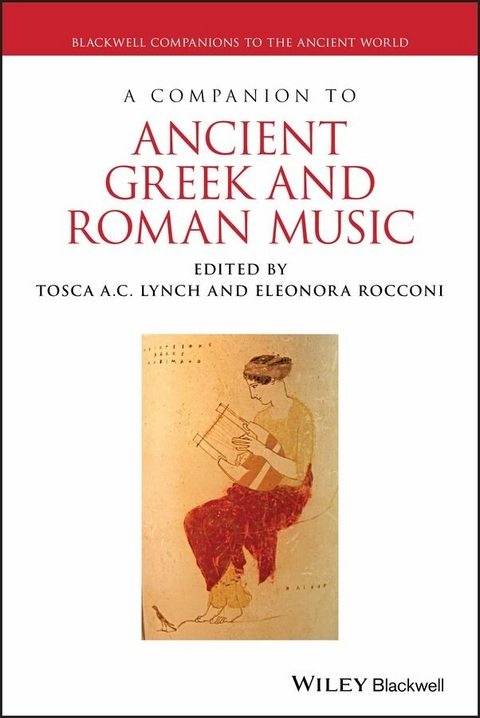
A Companion to Ancient Greek and Roman Music (eBook)
John Wiley & Sons (Verlag)
978-1-119-27550-3 (ISBN)
A COMPANION TO ANCIENT GREEK AND ROMAN MUSIC
A comprehensive guide to music in Classical Antiquity and beyond
Drawing on the latest research on the topic, A Companion to Ancient Greek and Roman Music provides a detailed overview of the most important issues raised by the study of ancient Greek and Roman music. An international panel of contributors, including leading experts as well as emerging voices in the field, examine the ancient 'Art of the Muses' from a wide range of methodological, theoretical, and practical perspectives.
Written in an engaging and accessible style, this book explores the pervasive presence of the performing arts in ancient Greek and Roman culture-ranging from musical mythology to music theory and education, as well as archaeology and the practicalities of performances in private and public contexts. But this Companion also explores the broader roles played by music in the Graeco-Roman world, examining philosophical, psychological, medical and political uses of music in antiquity, and aspects of its cultural heritage in Mediaeval and Modern times.
This book debunks common myths about Greek and Roman music, casting light on yet unanswered questions thanks to newly discovered evidence. Each chapter includes a discussion of the tools or methodologies that are most appropriate to address different topics, as well as detailed case studies illustrating their effectiveness. This book
- Offers new research insights that will contribute to the future developments of the field, outlining new interdisciplinary approaches to investigate the importance of performing arts in the ancient world and its reception in modern culture
- Traces the history and development of ancient Greek and Roman music, including their Near Eastern roots, following a thematic approach
- Showcases contributions from a wide range of disciplines and international scholarly traditions
- Examines the political, social and cultural implications of music in antiquity, including ethnicity, regional identity, gender and ideology
- Presents original diagrams and transcriptions of ancient scales, rhythms, and extant scores that facilitate access to these vital aspects of ancient music for scholars as well as practicing musicians
Written for a broad range of readers including classicists, musicologists, art historians, and philosophers, A Companion to Ancient Greek and Roman Music provides a rich, informative and thought-provoking picture of ancient music in Classical Antiquity and beyond.
TOSCA A.C. LYNCH has been Junior Research Fellow in Classics at Jesus College, Oxford (2016-19). She is Visiting Professor in Greek Literature, Metre and Music at the Department of Cultures and Civilisations, University of Verona, and Research Associate at the Classics Faculty, University of Oxford.
ELEONORA ROCCONI is Associate Professor of Greek Language and Literature, Department of Musicology and Cultural Heritage, University of Pavia (Cremona), and editor-in-chief of the journal Greek and Roman Musical Studies.
A COMPANION TO ANCIENT GREEK AND ROMAN MUSIC A comprehensive guide to music in Classical Antiquity and beyond Drawing on the latest research on the topic, A Companion to Ancient Greek and Roman Music provides a detailed overview of the most important issues raised by the study of ancient Greek and Roman music. An international panel of contributors, including leading experts as well as emerging voices in the field, examine the ancient Art of the Muses from a wide range of methodological, theoretical, and practical perspectives. Written in an engaging and accessible style, this book explores the pervasive presence of the performing arts in ancient Greek and Roman culture ranging from musical mythology to music theory and education, as well as archaeology and the practicalities of performances in private and public contexts. But this Companion also explores the broader roles played by music in the Graeco-Roman world, examining philosophical, psychological, medical and political uses of music in antiquity, and aspects of its cultural heritage in Mediaeval and Modern times. This book debunks common myths about Greek and Roman music, casting light on yet unanswered questions thanks to newly discovered evidence. Each chapter includes a discussion of the tools or methodologies that are most appropriate to address different topics, as well as detailed case studies illustrating their effectiveness. This book Offers new research insights that will contribute to the future developments of the field, outlining new interdisciplinary approaches to investigate the importance of performing arts in the ancient world and its reception in modern culture Traces the history and development of ancient Greek and Roman music, including their Near Eastern roots, following a thematic approach Showcases contributions from a wide range of disciplines and international scholarly traditions Examines the political, social and cultural implications of music in antiquity, including ethnicity, regional identity, gender and ideology Presents original diagrams and transcriptions of ancient scales, rhythms, and extant scores that facilitate access to these vital aspects of ancient music for scholars as well as practicing musicians Written for a broad range of readers including classicists, musicologists, art historians, and philosophers, A Companion to Ancient Greek and Roman Music provides a rich, informative and thought-provoking picture of ancient music in Classical Antiquity and beyond.
TOSCA A.C. LYNCH has been Junior Research Fellow in Classics at Jesus College, Oxford (2016-19). She is Visiting Professor in Greek Literature, Metre and Music at the Department of Cultures and Civilisations, University of Verona, and Research Associate at the Classics Faculty, University of Oxford. ELEONORA ROCCONI is Associate Professor of Greek Language and Literature, Department of Musicology and Cultural Heritage, University of Pavia (Cremona), and editor-in-chief of the journal Greek and Roman Musical Studies.
Notes on Contributors
Zoa Alonso Fernández is Assistant Professor of Classical Philology at Universidad Autónoma of Madrid. She is the author of several articles on Roman dance and the reception of Antiquity in the choreographic medium.
Armand D’Angour is an Associate Professor in Classics at the University of Oxford, and Fellow of Jesus College, Oxford. He is author of numerous articles and chapters on the literature and culture of ancient Greece, and of The Greeks and the New (Cambridge: CUP, 2011). He was awarded a British Academy Fellowship in 2013 to reconstruct ancient Greek musical sounds, and he has co‐edited (with Tom Phillips) Music, Text, and Culture in Ancient Greece (Oxford: OUP, 2018). His Socrates in Love: The Making of a Philosopher was published by Bloomsbury in March 2019.
Andrew Barker is Emeritus Professor of Classics at the University of Birmingham. He is the author of eight books and many articles on ancient music and musical theory.
Sheramy D. Bundrick is Professor of Art History at the University of South Florida St. Petersburg. She is the author of Music and Image in Classical Athens (Cambridge University Press, 2005); Athens, Etruria, and the Many Lives of Greek Figured Pottery (University of Wisconsin Press, 2019); and numerous articles concerning ancient Greek vase painting and iconography.
Daniela Castaldo is Associate Professor of Musicology at the University of Salento (Lecce, Italy). Her topics of research include music archaeology in the Greek and Roman world, musical iconography, reception of musical iconography of Classical Antiquity from Renaissance to nineteenth century.
Eric Csapo is Professor of Classics at the University of Sydney. He is author of Actors and Icons of the Ancient Theater (2010), Theories of Mythology (2005), and co‐author of A Social and Economic History of the Theatre to 300 BC. vol. 2 Theatre Beyond Athens (with Peter Wilson 2019) and The Context of Ancient Drama (with W.J. Slater 1995). With Peter Wilson, he is preparing two further volumes of A Social and Economic History of the Theatre to 300 BC for Cambridge University Press.
Paola Dessì is Associate Professor of Musicology and History of Music at the University of Padua. She has published studies on medieval and late antique music, and on the relationship between music and politics investigated from the Ptolemaic era to the Renaissance, especially in relation to the organ and organ art: L’organo tardoantico (2008), L’organo a palazzo nell’impero di Nerone, (Philomusica, 2008), Eventi sonori in età augustea (Ocnus, 2010), Organi orologi e automi musicali: oggetti sonori per il potere (Acta musicologica, 2010).
Marco Ercoles is Senior Researcher (RTD‐B) in Greek Language and Literature at the University of Bologna (Italy). He is author of a volume on Stesichorus (Stesicoro. Le testimonianze antiche, Bologna 2013) and several articles on ancient Greek melic poetry (Alcman, Bacchylides, Timotheus, Melanippides), music, metrics, and on ancient and Byzantine exegesis on Aeschylus.
John C. Franklin is Professor and Chair of Classics at the University of Vermont. He began life as a composer at the New England Conservatory of Music (B.M. 1988), switching to Classics for a PhD from University College London (2002). His research has dealt especially with the cultural, and especially musical, interfaces between early Greece and the Near East (culminating in Kinyras: The Divine Lyre, Hellenic Studies 70, Center for Hellenic Studies, 2015).
Mark Griffith is Professor of Classics and of Theater, Dance, and Performance Studies at the University of California, Berkeley. His work has focused mostly on Greek drama, literature, and music, and includes “Green and Yellow” editions of Prometheus Bound and Antigone, and a book on Greek satyr drama.
Stefan Hagel works as senior researcher at the Institute for the Study of Ancient Culture of the Austrian Academy of Sciences. His interests focus on ancient Greek music and meter, including reconstruction of instruments and performance techniques. He also creates dedicated software for scholarly purposes; his Classical Text Editor received the European Academic Software Award.
Luigi Galasso is Full Professor of Latin Literature at the Università Cattolica del Sacro Cuore, Milano. He has published extensively on Ovid. In addition to numerous articles, he has edited the second book of Ovid’s Epistulae ex Ponto with a commentary (1995) and is the author of a commentary on the entire Metamorphoses (2000).
Giorgio Ieranò is Professor of Greek Literature at the University of Trento (Italy). His main research interests focus on Archaic choral poetry, ancient theatre, and the reception of the ancient Greek world in modern culture. Among several publications, he is the author of Il Ditirambo di Dioniso (1997), Arianna. Storia di un mito (2010), La tragedia greca: origini storia, rinascite (2010), Arcipelago. Isole e miti del Mar Egeo (2018).
Pauline LeVen is Associate Professor of Classics at Yale University (USA). She is the author of The Many‐Headed Muse: Tradition and Innovation in Late Classical Greek Lyric Poetry (Cambridge 2014) and Music and Metamorphosis in Greco‐Roman Thought (forthcoming with Cambridge). She has published articles on late classical lyric, on Hellenistic poetry, on intertextuality, on various aspects of musical culture and on the ancient novel. She is currently co‐editing (with Sean Gurd) the first volume of Bloomsbury’s A Cultural History of Western Music and preparing a monograph on Poetry and the Posthuman.
Tosca A.C. Lynch has been Junior Research Fellow in Classics at Jesus College, Oxford (2016–19). She is currently Visiting Professor at the University of Verona and Research Associate at the Oxford Faculty of Classics. Her research interests include technical and performative issues concerning ancient rhythmics and harmonics, as well as the broader cultural and philosophical significance of mousikē in the ancient world. The interplay of these perspectives informs most of her publications. She has recently advanced new reconstructions of the ancient perception of rhythm and meter (arsis and thesis, CQ 2016), Plato’s musical ēthos (GRMS 2017 and 2020), as well as the intricate harmonic modulations of the so‐called New Music (GRMS 2018).
Maria Chiara Martinelli has worked as researcher at the Scuola Normale Superiore (Pisa), and as Professor of Greek Metrics and Rhythmics at the University of Pisa. Among various contributions on metrics, music, Greek tragedy, and ancient gnomic literature, she published the book Gli strumenti del poeta: Elementi di metrica greca (Bologna 19972) and edited La Musa dimenticata: Aspetti dell'esperienza musicale greca in età ellenistica (Pisa 2009).
Konstantinos Melidis holds a PhD in Greek Studies from the Paris‐Sorbonne University (Paris 4). His research interests include Ancient Greek and Roman music and drama with a focus on vocal art and terminology. He is currently a researcher at the University of Cyprus, working on a project focused on Greek Biblical Epos. He is also working on the publication of his doctoral thesis on Phōnaskoi and Phōnaskia in the Greco‐Roman Antiquity.
Timothy J. Moore is John and Penelope Biggs Distinguished Professor of Classics at Washington University in St. Louis. He is author of Artistry and Ideology: Livy’s Vocabulary of Virtue; The Theater of Plautus; Music in Roman Comedy; Roman Theatre; a translation of Terence’s Phormio; a database of The Meters of Roman Comedy (http://romancomedy.wulib.wustl.edu/); and articles on Greek tragedy, Latin literature, the teaching of Greek and Latin, ancient music, American Musical Theater, and Japanese comedy.
Penelope Murray was a founder member of the Department of Classics at the University of Warwick, retiring as Senior Lecturer in 2008. She has written extensively on ancient poetics and is currently working on classical ideas of creativity, particularly as expressed through myth and metaphor. Recent publications include A Companion to Ancient Aesthetics, edited with Pierre Destrée, Malden MA: John Wiley 2015.
Cecilia Panti is Associate Professor in History of Medieval Philosophy at the University of Rome Tor Vergata. Her studies focus on medieval natural philosophy and the quadrivium. In addition to numerous studies on these topics, her main contributions to the study of medieval theory and philosophy of music deal with, among others, Ugolino of Orvieto, Boethius, Hildegard of Bingen, Augustine, Petrarch. She is the author of the volume Filosofia della musica. Tarda antichità e medioevo (Rome 2008) and editor of Iohannes Tinctoris’ Diffinitorium musicae (Florence 2004).
Francesco Pelosi is Temporary Lecturer in Ancient Philosophy at the University of Pisa (Italy). His main field of research is the interaction between music and philosophy in ancient Greece, with a special focus on the mind‐body relationship and theories of perception. In recent years he has been the principal investigator of a research project devoted to the collection, translation...
| Erscheint lt. Verlag | 29.6.2020 |
|---|---|
| Reihe/Serie | Blackwell Companions to the Ancient World |
| Blackwell Companions to the Ancient World | Blackwell Companions to the Ancient World |
| Sprache | englisch |
| Themenwelt | Geschichte ► Allgemeine Geschichte ► Altertum / Antike |
| Schlagworte | Ancient & Classical History • Ancient Greek Music • ancient Roman music • Antike • Antike u. klassische Geschichte • Art & Applied Arts • Classical Greek Culture • Classical Studies • history of Greek music • history of Roman music • Humanistische Studien • Kultur • Kultur der griechischen Antike • Kunst u. Angewandte Kunst • music • Musik • politics of Greek and Roman music • practices of Greek and Roman music • Structure of Greek and Roman music • theory of Greek and Roman music |
| ISBN-10 | 1-119-27550-4 / 1119275504 |
| ISBN-13 | 978-1-119-27550-3 / 9781119275503 |
| Informationen gemäß Produktsicherheitsverordnung (GPSR) | |
| Haben Sie eine Frage zum Produkt? |
 EPUB (Adobe DRM)
Kopierschutz: Adobe-DRM
Adobe-DRM ist ein Kopierschutz, der das eBook vor Mißbrauch schützen soll. Dabei wird das eBook bereits beim Download auf Ihre persönliche Adobe-ID autorisiert. Lesen können Sie das eBook dann nur auf den Geräten, welche ebenfalls auf Ihre Adobe-ID registriert sind.
Details zum Adobe-DRM
Dateiformat: EPUB (Electronic Publication)
EPUB ist ein offener Standard für eBooks und eignet sich besonders zur Darstellung von Belletristik und Sachbüchern. Der Fließtext wird dynamisch an die Display- und Schriftgröße angepasst. Auch für mobile Lesegeräte ist EPUB daher gut geeignet.
Systemvoraussetzungen:
PC/Mac: Mit einem PC oder Mac können Sie dieses eBook lesen. Sie benötigen eine
eReader: Dieses eBook kann mit (fast) allen eBook-Readern gelesen werden. Mit dem amazon-Kindle ist es aber nicht kompatibel.
Smartphone/Tablet: Egal ob Apple oder Android, dieses eBook können Sie lesen. Sie benötigen eine
Geräteliste und zusätzliche Hinweise
Buying eBooks from abroad
For tax law reasons we can sell eBooks just within Germany and Switzerland. Regrettably we cannot fulfill eBook-orders from other countries.
aus dem Bereich