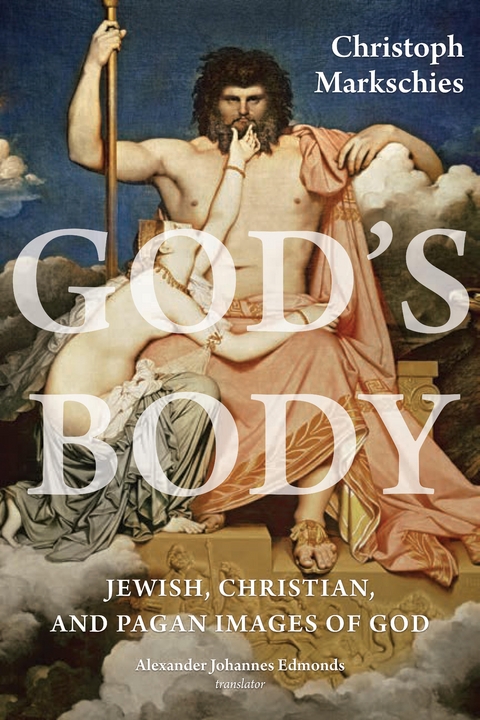
God's Body (eBook)
632 Seiten
Baylor University Press (Verlag)
978-1-4813-1172-4 (ISBN)
God is unbounded. God became flesh.
While these two assertions are equally viable parts of Western Christian religious heritage, they stand in tension with one another. Fearful of reducing God’s majesty with shallow anthropomorphisms, philosophy and religion affirm that God, as an eternal being, stands wholly apart from creation. Yet the legacy of the incarnation complicates this view of the incorporeal divine, affirming a very different image of God in physical embodiment.
While for many today the idea of an embodied God seems simplistic--even pedestrian--Christoph Markschies reveals that in antiquity, the educated and uneducated alike subscribed to this very idea. More surprisingly, the idea that God had a body was held by both polytheists and monotheists. Platonic misgivings about divine corporeality entered the church early on, but it was only with the advent of medieval scholasticism that the idea that God has a body became scandalous, an idea still lingering today.
In God’s Body Markschies traces the shape of the divine form in late antiquity. This exploration follows the development of ideas of God’s corporeality in Jewish and Greco-Roman traditions. In antiquity, gods were often like humans, which proved to be important for philosophical reflection and for worship. Markschies considers how a cultic environment nurtured, and transformed, Jewish and Christian descriptions of the divine, as well as how philosophical debates over the connection of body and soul in humanity provided a conceptual framework for imagining God. Markschies probes the connections between this lively culture of religious practice and philosophical speculation and the christological formulations of the church to discover how the dichotomy of an incarnate God and a fleshless God came to be.
By studying the religious and cultural past, Markschies reveals a Jewish and Christian heritage alien to modern sensibilities, as well as a God who is less alien to the human experience than much of Western thought has imagined. Since the almighty God who made all creation has also lived in that creation, the biblical idea of humankind as image of God should be taken seriously and not restricted to the conceptual world but rather applied to the whole person.
Christoph Markschies is Chair of Ancient Christianity in the Faculty of Theology at Humboldt University of Berlin.
1. The Body of God after Antiquity
2. The Body of God in the Judeo-Christian Bible and the Early Christian Theologians
3. The Body of God and Divine Statues in Antiquity
4. The Bodies of Gods and the Bodies of Souls in Late Antiquity
5. The Body of God and Late Antique Jewish Mysticism
6. The Body of God in Late Antique Christian Theology
7. The Body of God and Antique Christology
Conclusion: Settled Conceptions of God?
| Erscheint lt. Verlag | 15.10.2019 |
|---|---|
| Übersetzer | Alexander Johannes Edmonds |
| Zusatzinfo | 3 b&w illus., 12 b&w photos |
| Verlagsort | Waco |
| Sprache | englisch |
| Themenwelt | Geschichte ► Allgemeine Geschichte ► Altertum / Antike |
| Religion / Theologie ► Christentum ► Kirchengeschichte | |
| Geisteswissenschaften ► Religion / Theologie ► Judentum | |
| Schlagworte | Ancient religion, ancient Christianity, Paganism and Christianity, Historical Theology, ancient Christian theology, ancient Paganism, the doctrine of God, Christian philosophy, Western philosophy, monotheism, Greco-Roman religion, Jewish mysticism, Anthropomorphism, Platonism, Epicureanism, Stoicism, Aristotelianism, Origen, Incarnation, Christology, Neoplatonism, Merkavah, Hekhalot, Shi'ur Qoma, The Anthropomorphite Controversy, Demythologization |
| ISBN-10 | 1-4813-1172-7 / 1481311727 |
| ISBN-13 | 978-1-4813-1172-4 / 9781481311724 |
| Informationen gemäß Produktsicherheitsverordnung (GPSR) | |
| Haben Sie eine Frage zum Produkt? |
 PDF (Adobe DRM)
Kopierschutz: Adobe-DRM
Adobe-DRM ist ein Kopierschutz, der das eBook vor Mißbrauch schützen soll. Dabei wird das eBook bereits beim Download auf Ihre persönliche Adobe-ID autorisiert. Lesen können Sie das eBook dann nur auf den Geräten, welche ebenfalls auf Ihre Adobe-ID registriert sind.
Details zum Adobe-DRM
Dateiformat: PDF (Portable Document Format)
Mit einem festen Seitenlayout eignet sich die PDF besonders für Fachbücher mit Spalten, Tabellen und Abbildungen. Eine PDF kann auf fast allen Geräten angezeigt werden, ist aber für kleine Displays (Smartphone, eReader) nur eingeschränkt geeignet.
Systemvoraussetzungen:
PC/Mac: Mit einem PC oder Mac können Sie dieses eBook lesen. Sie benötigen eine
eReader: Dieses eBook kann mit (fast) allen eBook-Readern gelesen werden. Mit dem amazon-Kindle ist es aber nicht kompatibel.
Smartphone/Tablet: Egal ob Apple oder Android, dieses eBook können Sie lesen. Sie benötigen eine
Geräteliste und zusätzliche Hinweise
Buying eBooks from abroad
For tax law reasons we can sell eBooks just within Germany and Switzerland. Regrettably we cannot fulfill eBook-orders from other countries.
aus dem Bereich