


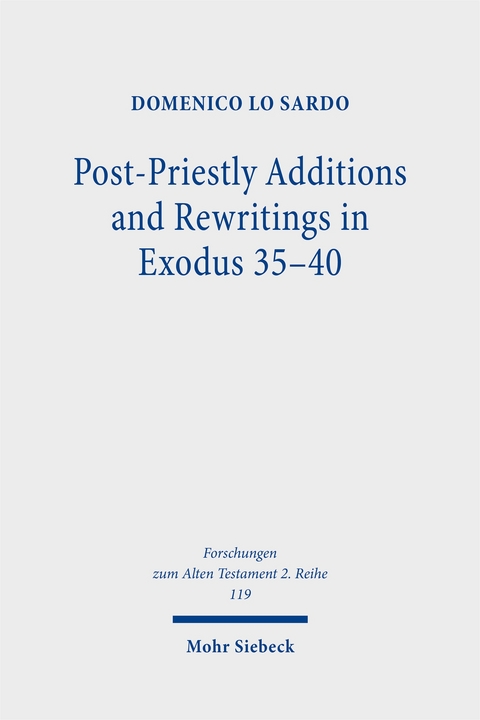
Post-Priestly Additions and Rewritings in Exodus 35-40
An Analysis of MT, LXX, and Vetus Latina
Seiten
2020
Mohr Siebeck (Verlag)
978-3-16-159586-8 (ISBN)
Mohr Siebeck (Verlag)
978-3-16-159586-8 (ISBN)
Die Textgeschichte von Ex 35-40 ist komplex. Domenico Lo Sardo argumentiert in dieser Studie für die Präzedenz der in der Vetus Latina übersetzten Textfassung und den Masoretischen Text als erweiterte Legitimationserzählung für den einen Tempel in Jerusalem.
In this study, Domenico Lo Sardo shows that the section of MT Exod 35-40 dedicated to the construction of the Tabernacle involves textual and literary problems. It has different textual forms according to MT, LXX, and Vetus Latina (Monacensis ms): LXX Exod 35-40 shows a different order of the literary material and its extension is shorter than the MT. One of the most important differences is the absence of MT Exod 36:8b-34 in the LXX. The Monacensis ms is even shorter than the Greek text. In a text-critical analysis, the author demonstrates that the 'Short Hebrew Vorlage' behind the Latin manuscript is the oldest text. In the MT there was post-priestly editorial work marked by expansions, rewritings, and reinterpretations. Employing literary criticism, the author proves that with the expansion of Exod 36:8b-34 and the stressed use of the term miskan (Tabernacle), MT points to legitimate the centralization of the Jerusalem Temple.
In this study, Domenico Lo Sardo shows that the section of MT Exod 35-40 dedicated to the construction of the Tabernacle involves textual and literary problems. It has different textual forms according to MT, LXX, and Vetus Latina (Monacensis ms): LXX Exod 35-40 shows a different order of the literary material and its extension is shorter than the MT. One of the most important differences is the absence of MT Exod 36:8b-34 in the LXX. The Monacensis ms is even shorter than the Greek text. In a text-critical analysis, the author demonstrates that the 'Short Hebrew Vorlage' behind the Latin manuscript is the oldest text. In the MT there was post-priestly editorial work marked by expansions, rewritings, and reinterpretations. Employing literary criticism, the author proves that with the expansion of Exod 36:8b-34 and the stressed use of the term miskan (Tabernacle), MT points to legitimate the centralization of the Jerusalem Temple.
Born 1978; 2009 B.S. from the Theology Faculty of Sicily (Palermo); 2013 S.S.L. from the Pontifical Biblical Institute (Rome); 2018 S.S.D. from the Pontifical Biblical Institute; since 2018 Visiting Professor at the Franciscan Institute of Spirituality of the Pontifical University of Antonianum (Rome).
| Erscheinungsdatum | 11.07.2020 |
|---|---|
| Reihe/Serie | Forschungen zum Alten Testament 2. Reihe |
| Verlagsort | Tübingen |
| Sprache | englisch |
| Maße | 156 x 232 mm |
| Gewicht | 506 g |
| Themenwelt | Religion / Theologie ► Christentum ► Bibelausgaben / Bibelkommentare |
| Schlagworte | Literary criticism • old Latin • Post-Priestly Redaction • Templar Ideology • Textual criticism |
| ISBN-10 | 3-16-159586-6 / 3161595866 |
| ISBN-13 | 978-3-16-159586-8 / 9783161595868 |
| Zustand | Neuware |
| Informationen gemäß Produktsicherheitsverordnung (GPSR) | |
| Haben Sie eine Frage zum Produkt? |
Mehr entdecken
aus dem Bereich

aus dem Bereich
Buch | Softcover (2021)
De Gruyter (Verlag)
CHF 44,90


