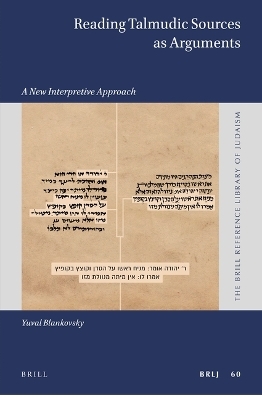
Reading Talmudic Sources as Arguments
Brill (Verlag)
978-90-04-43003-7 (ISBN)
- Keine Verlagsinformationen verfügbar
- Artikel merken
Reading Talmudic Sources as Arguments: A New Interpretive Approach elucidates the unique characteristics of Talmudic discourse culture. Approaching Talmudic literature from a linguistic perspective, the book shows the extensive and hidden ways in which later rabbis used early formulations. Applying Quentin Skinner's interpretive question “What was the author doing in composing the text in this particular way?" to Talmudic literature reveals that Talmudic debate is not only about ideas, concepts and laws but also about the latter's connection to pre-existing formulations. These early traditions, rather than only being accepted or not, are used by later generations to build their own arguments. The book articulates the function of tradition at the time that Rabbinic Judaism was forged.
Yuval Blankovsky, Ph.D. (1978), served as a research fellow at NYU Law School and The Hebrew University of Jerusalem. He has published monographs and articles including "A Silent Revolution: Talmudic Discussion about Tort Law" (Jewish Quarterly Review 109.1) and Sin for the Sake of God (Magnes 2017, Heb.).
Preface
Introduction: Three Contexts for This Book’s Interpretive Mission
1 Quentin Skinner’s Methodology and the Synoptic Problem in Rabbinic Literature
2 Incorporating Uncertainties: Sussmann’s Iconic Paper and Reading Talmudic Literature
3 Henshke’s Methodological Rebellion: the Internal Dynamic in Talmudic Literature
4 The Book’s Structure
1 Reading Talmudic Sources as Arguments
1 The Text as an Active Participant
2 Clarifying ‘Linguistic Environment’ and ‘Concrete Cultural Context’
3 Reading Talmudic Sources as Arguments
4 Similar Formulations and the Synoptic Problem
5 A Note about the Concept of ‘Concrete Cultural Context’ as Applied to Rabbinic Literature
6 The Rhetoric of the Opponent
7 The Mobility of Tradition
2 A Silent Revolution: the Talmudic Discussion of Tort Law
1 Introduction
2 The Mishnah of the Four Primary Categories of Torts
3 Shabbat, Impurity and Tort Law: a Talmudic Comparison
4 The Fifth “Father of Damage”
5 Talmudic Camouflage
6 The Two Concepts of the Cause of Liability: Mishnah versus Bavli
7 The Status of the Pit
8 The Status of Fire
9 The Amoraic Dispute about the Status of Fire
10 The Conclusion of the Talmudic Discussion
11 Reading the Talmudic Discussion as an Introduction to Tractate Baba Kama
12 The Law of Pebbles and Its Origin
13 A Logical Sleight-of-Hand by the Sugya’s Authors
14 The Case of Pebbles as an Offspring of Foot
15 Conclusion
3 The Function of Tradition in Talmudic Culture: the Debate on Execution by Decapitation
1 What Is It All About?
2 Parallel Sources as Arguments
3 Mishnah versus Tosefta: Conflicting or Complementary Sources
4 Disputing How to Present the Dispute
5 Rethinking the Synoptic Problem in Rabbinic Literature
6 The Presentation of R. Yehuda’s Argument in the Talmudim
7 The Biblical Source for Execution by Decapitation
8 The Biblical Source for Decapitation According to the Yerushalmi
9 Reading the Bavli’s Discussion in Context
10 The Mobility of Tradition
11 The Teaching from the Atoning Heifer
12 Reading Talmudic Sources as Arguments
13 The Meanings of the Teaching “Choose a Kind Death for Him”
14 The Function of Tradition
4 In Search of the Essence of a Talmudic Debate: the Case of Water Used by a Baker
1 Introduction
2 The Case Study of Water Used by a Baker: Reading the Sources as Arguments
3 Friedman’s and Brody’s Harmonizing Approaches
4 The Baraitot in the Talmudim
5 Similarities and Differences between My Approach and Those of Friedman and Brody
6 The Implications of Our Approach for Reading Talmudic Discussions
7 The Talmudic Discussions about Water Used by a Baker
8 The Yerushalmi’s Forced Explanation
9 Halivni’s and Friedman’s Approach to Forced Explanations
10 Kahana’s Approach to Forced Explanations
11 Reading the Sugya as a Substantive Debate That Makes Use of Early Traditions
12 A Substantive Explanation of the Tosefta’s Corrupt Text
13 Conclusion
5 Rethinking the Synoptic Problem in Tannaitic Literature
1 Introduction
2 Oral Conception of Parallel Sources: Alexander’s Approach
3 Hauptman’s Theory and Neusner’s Criticism
4 The Mishnah’s Inconsistency: the Opening of Tractate Baba Kama
5 Conclusion: Rethinking the Synoptic Problem in Tannaitic Literature
6 A Conceptual Approach to Talmudic Literature: The Case of Amoraic Interpretation of Tannaitic Sources
1 Introduction: Fisch’s Approach to the Amoraic Interpretation of Tannaitic Sources
2 Furstenberg’s Reading and the Bavli’s Sophistication
3 Fisch’s Explanations of the Bavli’s Relationship to Tradition
4 The Rabbis’ Attitude towards Scripture and Early Rabbinic Traditions
5 Conclusion
7 Talmudic Scholasticism and the Agenda of a Sugya’s Authors
1 The State of Research on the Bavli’s Characterization
2 Tzrichuta: a Unique Feature of the Bavli’s Anonymous Layer
3 The Sugya’s Authors’ Agendas
4 Forced Relationships among Early Rabbinic Traditions
5 Rethinking Talmudic Conceptuality
6 An Implicit Tzrichuta: the General Agenda of the Sugya’s Authors
7 The Discourse Culture of the Bavli’s Anonymous Layer
8 The Attitude of the Bavli’s Anonymous Layer toward Early Rabbinic Traditions
Conclusion: A Model of a Satisfactory Explanation of Talmudic Sources
1 Directions for Future Research
2 A Model for a Satisfactory Explanation of Talmudic Sources
Appendix: Bdikot and hakirot in Mishnah Sanhedrin and R. Hisda’s Stance
Bibliography
Index
| Erscheinungsdatum | 11.09.2020 |
|---|---|
| Reihe/Serie | The Brill Reference Library of Judaism ; 60 |
| Verlagsort | Leiden |
| Sprache | englisch |
| Maße | 155 x 235 mm |
| Gewicht | 381 g |
| Themenwelt | Geisteswissenschaften ► Religion / Theologie ► Judentum |
| Geisteswissenschaften ► Sprach- / Literaturwissenschaft ► Anglistik / Amerikanistik | |
| Geisteswissenschaften ► Sprach- / Literaturwissenschaft ► Literaturwissenschaft | |
| Geisteswissenschaften ► Sprach- / Literaturwissenschaft ► Sprachwissenschaft | |
| ISBN-10 | 90-04-43003-2 / 9004430032 |
| ISBN-13 | 978-90-04-43003-7 / 9789004430037 |
| Zustand | Neuware |
| Informationen gemäß Produktsicherheitsverordnung (GPSR) | |
| Haben Sie eine Frage zum Produkt? |
aus dem Bereich