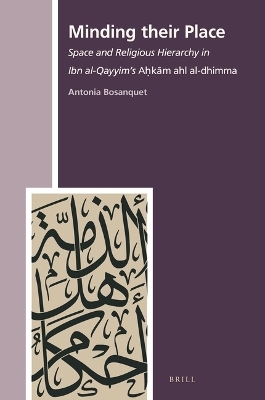
Minding their Place
Brill (Verlag)
978-90-04-42369-5 (ISBN)
Antonia Bosanquet’s Minding Their Place is the first full-length study of Ibn al-Qayyim’s (d. 751/1350) collection of rulings relating to non-Muslim subjects, Aḥkām ahl al-dhimma. It offers a detailed study of the structure, content and authorial method of the work, arguing that it represents the author’s personal composition rather than a synthesis of medieval rulings, as it has often been understood. On this basis, Antonia Bosanquet analyses how Ibn al-Qayyim’s presentation of rulings in Aḥkām ahl al-dhimma uses space to convey his view of religious hierarchy. She considers his answer to the question of whether non-Muslims have a place in the Abode of Islam, how this is defined and how his definition contributes to Ibn al-Qayyim’s broader theological world-view.
Antonia Bosanquet, PhD (2016), Freie Universität Berlin, is a research associate at Hamburg University. Her previous publications focus on inter-religious relations in Islamic thought, ranging from the 14th-century author Ibn al-Qayyim to the 20th-century author, Muḥammad Quṭb.
Acknowledgements
List of Figure and Tables
Introduction
1 Questions Raised in this Study
2 Terms and Concepts
3 Space and Aḥkām ahl al-dhimma
4 Text as Space?
5 Significance of this Study
6 Method and Chapter Outline
part 1: Aḥkām ahl al-dhimma: Text and Content
1 Author, Text and Reception
1 Ibn Qayyim al-Jawziyya
2 The Text of Aḥkām ahl al-dhimma
3 Reception
4 Manuscripts and Editions
2 Historical Background
1 Muslims and non-Muslims in the Mamluk Empire
2 The ʿUlamāʾ in the Mamluk Period
3 Literary Precedents
1 The Pact of ʿUmar and the Contract Genre
2 The Fiqh Compendia
3 Juristic Literature Focusing on the Ahl al-Dhimma
4 Manuals of Governance and Statecraft
5 Ādāb al-Muḥtasib
6 Mamluk Prescriptive Literature
7 Similarities and Differences Between the Literary Precedents for Aḥkām ahl al-dhimma
8 Conclusions: Locating Aḥkām ahl al-dhimma
4 Structure and Method
1 Structure and Subject Division Within Aḥkām ahl al-dhimma
2 Sources and Method
3 Sources for Aḥkām Ahl al-Dhimma
4 Source Incorporation and Authorial Agency
5 The Dialectical Method
6 Digression: its Uses and Functions
7 Qur’anic Verses and Hadith
8 Conclusion to Part One
part 2: Space in Aḥkām ahl al-dhimma
5 Separate Space
1 Mosques, Churches and Dhimmi Homes
2 Geographical Boundaries and Muslim Space
3 Ṣulḥ Land, ʿAnwa Land and Dhimmi Space
4 Tax
5 Employment in State Administration
6 Festivals
7 Dhimmi Marriage
8 The Dhimmi Wife and the Female Body
9 Death, Burial and the Afterlife
10 Conclusion: Separate Space and Private Space in Aḥkām ahl al-dhimma
6 The Relational Space of Personal Interaction
1 Greeting
2 Visiting the Sick and Attending Funerals
3 Commercial Exchange and Business Partnerships
4 Conversion to Islam and Marriage Relations
5 The Female Convert’s Relations with her Non-Muslim Family
6 The Male Convert’s Relations with his Non-Muslim Family
7 Mixed Marriages and Shared Households
8 Conclusion: The Characterisation of the Dhimmi
7 The Relational Space of Public Performance
1 Structural Incorporation of the Pact of ʿUmar in Aḥkām Ahl al-Dhimma
2 Ibn al-Qayyim’s Sources for the Pact of ʿUmar
3 Ibn al-Qayyim’s Presentation of the Pact of ʿUmar
4 Stage Props: Movable Religious Symbols
5 Stage Backdrop: Non-Movable Religious Symbols
6 Scripting Dhimmi Performance: Regulating Appearance and Comportment
7 Conclusion
8 The Contested Space of Non-Muslim Children
1 Aḥkām Ahl al-Dhimma and the Question of Dhimmi Children
2 Sources and Framing
3 Children in This Abode: Legal Responsibility and Religious Education
4 Legitimising the Non-Muslim Status of the Child
5 Legitimising the Conversion of the Non-Muslim Child
6 Sunni Positions on the Fate of Non-Muslim Children After Death
7 Ibn al-Qayyim’s Review of the Positions
8 Conclusion
Conclusion: Space, Religious Difference and Aḥkām ahl al-dhimma
1 Space in Aḥkām ahl al-dhimma
2 Muslims and non-Muslims in Aḥkām Ahl al-Dhimma
3 The Place of Dhimmis in the Abode of Islam
4 Identity, Alterity and Power
5 Aḥkām Ahl al-Dhimma, Regulatory Discourse about Dhimmis and Ibn al-Qayyim
Bibliography
Author Index
Subject Index
| Erscheinungsdatum | 28.08.2020 |
|---|---|
| Reihe/Serie | The History of Christian-Muslim Relations ; 42 |
| Verlagsort | Leiden |
| Sprache | arabisch; englisch |
| Maße | 155 x 235 mm |
| Gewicht | 797 g |
| Themenwelt | Geisteswissenschaften ► Archäologie |
| Geschichte ► Allgemeine Geschichte ► Mittelalter | |
| Religion / Theologie ► Christentum ► Kirchengeschichte | |
| ISBN-10 | 90-04-42369-9 / 9004423699 |
| ISBN-13 | 978-90-04-42369-5 / 9789004423695 |
| Zustand | Neuware |
| Informationen gemäß Produktsicherheitsverordnung (GPSR) | |
| Haben Sie eine Frage zum Produkt? |
aus dem Bereich