Die vermeintlich pergamenische Importkeramik in Ephesos
Access Archaeology (Verlag)
978-1-78969-609-7 (ISBN)
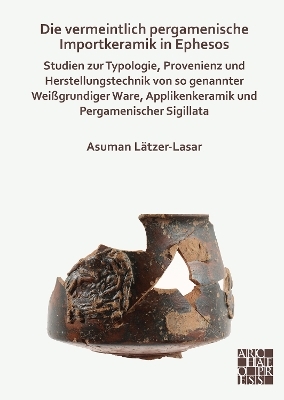
Die vermeintlich pergamenische Importkeramik in Ephesos is the first comparative study of three ceramic ware groups, namely Appliqué Ware, White-grounded ware and Pergamene Sigillata, which appear in Ephesos (on the Aegean coast of modern day Turkey) but, until now, were considered to be products made in and imported from Pergamon; one ware group was even named after the city. However, using intensive archaeometrical analysis tools, such as thin-section and microscopy, this study seeks to demonstrate that most of the ceramic objects were produced locally. Futhermore, the book presents stunning new data that showing the very differing technical knowledge among the ancient potters of Western Asia Minor. Emerging out of the archaeometrical analyses, the book provides a list of concrete parameters for the identification of provenance in the field. Furthermore, this study encompasses the first typochronology for the three ware groups, which allows future excavations in the wider region to set up a fine chronology of their contexts based on ceramic evidences.
Asuman Lätzer-Lasar is currently a research associate at the Max Weber Centre for Advanced Cultural and Social Studies at the University of Erfurt. At the same time, she is also a member of the DFG-Center for Advanced Studies ‘Religion and Urbanity. Reciprocal transformations’. Previously, she has been the Assistant Director of the International Center for Advanced Studies Morphomata at the University of Cologne, where she also graduated in Archaeology of the Roman Provinces, Classical Archaeology and Ancient Sinology. Her PhD-project was financed by the a.r.t.e.s. Graduate School of the University of Cologne.
Allgemeine Abkürzungen ;
1 Einleitung ;
2 Methode und Vorgehensweise ;
3 Forschungsgeschichte ;
4 Fundkontexte ;
4.1 Staatsmarkt/Agora ;
4.2 Brunnen auf dem Staatsmarkt ;
4.3 Basilika auf dem Staatsmarkt ;
4.4 Tetragonos-Agora ;
4.5 Prytaneion ;
4.6 Der Embolos oder die so genannte Kuretenstraße ;
4.7 Hellenistisch-frührömische Befunde unter dem Hanghaus 1 ;
4.8 Hanghaus 2 ;
4.9 Insula M01 ;
5 Die Warengruppen ;
5.1 Definition und Terminologie ;
5.2 Definition von Gefäßformen ;
5.3 Die Weißgrundige Keramik ;
5.4 Applikenkeramik ;
5.5 Die so genannte Pergamenische Sigillata ;
6 Archäometrische Untersuchungen ;
6.1 Auswahl und Methodik der archäometrischen Untersuchungen ;
6.2 Mikroskopische Gruppen von Fabrics ;
6.3 Petrographie (Petrofabricgruppen und Dünnschliffuntersuchungen) ;
7 Auswertung der Keramik ;
7.1 Verteilung ;
7.2 Provenienz und Produktionsräume: Pergamon und Ephesos ;
7.3 Werkstatt und Arbeitsabläufe ;
7.4 Bedeutung der Gefäße für den sozio-kulturellen Nutzungskontext ;
8 Zusammenfassung und Schlussbemerkung ;
Literatur- und Abkürzungsverzeichnis ;
Tafelverzeichnis ;
Tafeln ;
Katalog
| Erscheinungsdatum | 07.09.2020 |
|---|---|
| Zusatzinfo | 18 figures, 4 tables plus 64 plates (74 colour pages) |
| Verlagsort | Oxford |
| Sprache | deutsch |
| Maße | 205 x 290 mm |
| Gewicht | 1620 g |
| Themenwelt | Geisteswissenschaften ► Archäologie |
| Geschichte ► Allgemeine Geschichte ► Altertum / Antike | |
| ISBN-10 | 1-78969-609-7 / 1789696097 |
| ISBN-13 | 978-1-78969-609-7 / 9781789696097 |
| Zustand | Neuware |
| Informationen gemäß Produktsicherheitsverordnung (GPSR) | |
| Haben Sie eine Frage zum Produkt? |
aus dem Bereich