


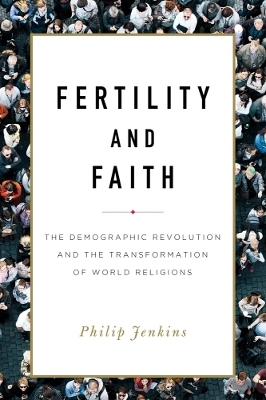
Fertility and Faith
The Demographic Revolution and the Transformation of World Religions
Seiten
2020
Baylor University Press (Verlag)
978-1-4813-1131-1 (ISBN)
Baylor University Press (Verlag)
978-1-4813-1131-1 (ISBN)
Maps the demographic revolution that has taken hold of many countries around the globe in recent decades and explores the implications for the future development of the world's religions.
Demography drives religious change. High-fertility societies, like most of contemporary Africa, tend to be fervent and devout. The lower a population's fertility rates, the greater the tendency for people to detach from organized or institutional religion. Thus, fertility rates supply an effective gauge of secularization trends. In Fertility and Faith, Philip Jenkins maps the demographic revolution that has taken hold of many countries around the globe in recent decades and explores the implications for the future development of the world's religions.
Demographic change has driven the secularization of contemporary Western Europe, where the revolution began. Jenkins shows how the European trajectory of rapid declines in fertility is now affecting much of the globe. The implications are clear: the religious character of many non-European areas is highly likely to move in the direction of sweeping secularization. And this is now reshaping the United States itself.
This demographic revolution is reshaping Christianity, Buddhism, Islam, Hinduism, and Judaism. In order to accommodate the new social trends, these religions must adapt to situations where large families are no longer the norm. Each religious tradition will develop distinctive emphases concerning morality, gender, and sexuality, as well as the roles of clergy and laity in the faith's institutional structures.
Radical change follows great upheaval. The tidal shift is well underway. With Fertility and Faith, Philip Jenkins describes this ongoing phenomenon and envisions our collective religious future.
Demography drives religious change. High-fertility societies, like most of contemporary Africa, tend to be fervent and devout. The lower a population's fertility rates, the greater the tendency for people to detach from organized or institutional religion. Thus, fertility rates supply an effective gauge of secularization trends. In Fertility and Faith, Philip Jenkins maps the demographic revolution that has taken hold of many countries around the globe in recent decades and explores the implications for the future development of the world's religions.
Demographic change has driven the secularization of contemporary Western Europe, where the revolution began. Jenkins shows how the European trajectory of rapid declines in fertility is now affecting much of the globe. The implications are clear: the religious character of many non-European areas is highly likely to move in the direction of sweeping secularization. And this is now reshaping the United States itself.
This demographic revolution is reshaping Christianity, Buddhism, Islam, Hinduism, and Judaism. In order to accommodate the new social trends, these religions must adapt to situations where large families are no longer the norm. Each religious tradition will develop distinctive emphases concerning morality, gender, and sexuality, as well as the roles of clergy and laity in the faith's institutional structures.
Radical change follows great upheaval. The tidal shift is well underway. With Fertility and Faith, Philip Jenkins describes this ongoing phenomenon and envisions our collective religious future.
Philip Jenkins is Distinguished Professor of History at Baylor University.
Introduction
1. Fertility and Faith
How Changes in Fertility Shape Religious Structures and Behavior
Part 1
2. Europe's Revolution
The Demographic Revolution Begins
3. Spiritual and Secular
The Decline of Europe's Faith
4. The Revolution Goes Global
New Patterns of Fertility and Faith Spread Rapidly around the World
5 The United States
Between Two Worlds?
Part 2
6. Africa
High Fertility and Strong Faith
7. Two-Tier Islam
Uneven Demographic Transitions
8. Go Forth and Divide
Populism, Faith, and Fertility
Conclusion
9. Living in a Low-Fertility World
Can Religions Adapt to the New Society?
| Erscheinungsdatum | 01.09.2020 |
|---|---|
| Verlagsort | Waco |
| Sprache | englisch |
| Maße | 160 x 228 mm |
| Gewicht | 610 g |
| Themenwelt | Geisteswissenschaften ► Religion / Theologie |
| Sozialwissenschaften ► Soziologie ► Allgemeines / Lexika | |
| Sozialwissenschaften ► Soziologie ► Empirische Sozialforschung | |
| Sozialwissenschaften ► Soziologie ► Spezielle Soziologien | |
| ISBN-10 | 1-4813-1131-X / 148131131X |
| ISBN-13 | 978-1-4813-1131-1 / 9781481311311 |
| Zustand | Neuware |
| Informationen gemäß Produktsicherheitsverordnung (GPSR) | |
| Haben Sie eine Frage zum Produkt? |
Mehr entdecken
aus dem Bereich


aus dem Bereich
Gebundene Ausgabe 2025
Buch | Hardcover (2025)
C.H.Beck (Verlag)
CHF 68,60
Vom Verschwinden des Spielraums
Buch | Hardcover (2026)
Suhrkamp (Verlag)
CHF 34,95


