


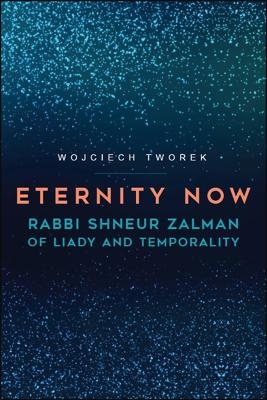
Eternity Now
Rabbi Shneur Zalman of Liady and Temporality
Seiten
2020
State University of New York Press (Verlag)
978-1-4384-7554-7 (ISBN)
State University of New York Press (Verlag)
978-1-4384-7554-7 (ISBN)
Demonstrates that Rabbi Shneur Zalman's teachings regarding time and history enabled Habad's growth into a mass Jewish movement.
The Habad movement, formed in eighteenth-century Belarus, has developed into one of the most influential streams of Hasidic Judaism. Drawing on both mystical sermons and legal writings of its founder, Rabbi Shneur Zalman of Liady (1745–1812), Eternity Now provides the first account of the historiosophical dimensions of early Habad doctrine. Challenging the commonly held view that Shneur Zalman was primarily concerned with supratemporal transcendence, Wojciech Tworek reveals the importance of time and history in his teachings. Tworek argues that the worldly dimensions of Shneur Zalman's thought were largely responsible for the rapid growth of Habad at the turn of the nineteenth century and fostered its transformation from an elitist circle into a mass movement. Tworek's readings of Hebrew and Yiddish sources demonstrate the implications of these ideas not only for male scholars but also for non-scholars, Jewish women, and even non-Jews. Philosophical and kabbalistic thought joined together to form a model of religious experience attractive to a broad audience, laying an ideological foundation for the missionary messianism that was to become a hallmark of Habad in the twentieth century.
The Habad movement, formed in eighteenth-century Belarus, has developed into one of the most influential streams of Hasidic Judaism. Drawing on both mystical sermons and legal writings of its founder, Rabbi Shneur Zalman of Liady (1745–1812), Eternity Now provides the first account of the historiosophical dimensions of early Habad doctrine. Challenging the commonly held view that Shneur Zalman was primarily concerned with supratemporal transcendence, Wojciech Tworek reveals the importance of time and history in his teachings. Tworek argues that the worldly dimensions of Shneur Zalman's thought were largely responsible for the rapid growth of Habad at the turn of the nineteenth century and fostered its transformation from an elitist circle into a mass movement. Tworek's readings of Hebrew and Yiddish sources demonstrate the implications of these ideas not only for male scholars but also for non-scholars, Jewish women, and even non-Jews. Philosophical and kabbalistic thought joined together to form a model of religious experience attractive to a broad audience, laying an ideological foundation for the missionary messianism that was to become a hallmark of Habad in the twentieth century.
Wojciech Tworek is Ray D. Wolfe Postdoctoral Fellow at the Anne Tanenbaum Centre for Jewish Studies at the University of Toronto.
Acknowledgments
A Note on the Presentation of Source Materials
Introduction
1. Toward a Definition of Time
2. History: From Creation to the End of Time
3. The End of Days
4. Time and Religious Praxis
5. Time’s Gender Twist
Conclusion
Notes
Bibliography
Index
| Erscheinungsdatum | 15.05.2020 |
|---|---|
| Verlagsort | Albany, NY |
| Sprache | englisch |
| Maße | 152 x 229 mm |
| Gewicht | 390 g |
| Themenwelt | Geschichte ► Teilgebiete der Geschichte ► Religionsgeschichte |
| Geisteswissenschaften ► Religion / Theologie ► Judentum | |
| ISBN-10 | 1-4384-7554-3 / 1438475543 |
| ISBN-13 | 978-1-4384-7554-7 / 9781438475547 |
| Zustand | Neuware |
| Informationen gemäß Produktsicherheitsverordnung (GPSR) | |
| Haben Sie eine Frage zum Produkt? |
Mehr entdecken
aus dem Bereich


aus dem Bereich
von der Antike bis zur Gegenwart
Buch | Softcover (2025)
C.H.Beck (Verlag)
CHF 16,80


