


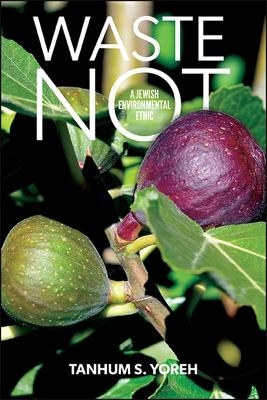
Waste Not
A Jewish Environmental Ethic
Seiten
2020
State University of New York Press (Verlag)
978-1-4384-7670-4 (ISBN)
State University of New York Press (Verlag)
978-1-4384-7670-4 (ISBN)
Traces the development of bal tashḥit, the Jewish prohibition against wastefulness and destruction, from its biblical origins to the contemporary environmental movement.
Winner of the 2020 Canadian Jewish Literary Award in the category of Jewish Thought and Culture
Bal tashḥit, the Jewish prohibition against wastefulness and destruction, is considered to be an ecological ethical principle by contemporary Jewish environmentalists. Waste Not provides a comprehensive intellectual history of this concept, charting its evolution from the Bible through classical rabbinic literature, commentaries, codes of law, responsa, and the works of modern environmentalists. Tanhum S. Yoreh uses the methodology of tradition histories to identify pivotal moments in the development of the prohibition-in particular, its transition into an economic framework. He finds that bal tashḥit's earliest stages of conceptualization connect the prohibition against wastefulness with avoidance of self-harm. This connection is commonplace within contemporary environmental thought and a universalizing Jewish principle with important contributions to be made to Jewish and general societal ecological discourse. This narrative provides a foundation for understanding bal tashḥit as an environmental ethic for today and tomorrow.
Winner of the 2020 Canadian Jewish Literary Award in the category of Jewish Thought and Culture
Bal tashḥit, the Jewish prohibition against wastefulness and destruction, is considered to be an ecological ethical principle by contemporary Jewish environmentalists. Waste Not provides a comprehensive intellectual history of this concept, charting its evolution from the Bible through classical rabbinic literature, commentaries, codes of law, responsa, and the works of modern environmentalists. Tanhum S. Yoreh uses the methodology of tradition histories to identify pivotal moments in the development of the prohibition-in particular, its transition into an economic framework. He finds that bal tashḥit's earliest stages of conceptualization connect the prohibition against wastefulness with avoidance of self-harm. This connection is commonplace within contemporary environmental thought and a universalizing Jewish principle with important contributions to be made to Jewish and general societal ecological discourse. This narrative provides a foundation for understanding bal tashḥit as an environmental ethic for today and tomorrow.
Tanhum S. Yoreh is Assistant Professor at the School of the Environment at the University of Toronto.
Transliteration and Abbreviations
Preface
Acknowledgements
Introduction
1. Classical Rabbinic Texts
2. Bible and Biblical Commentaries
3. Codes and their Cognates
4. Responsa
Conclusions
Appendix
Bibliography
Concept Index
Name Index
Source Index
| Erscheinungsdatum | 15.05.2020 |
|---|---|
| Verlagsort | Albany, NY |
| Sprache | englisch |
| Maße | 152 x 229 mm |
| Gewicht | 372 g |
| Themenwelt | Geschichte ► Teilgebiete der Geschichte ► Religionsgeschichte |
| Geisteswissenschaften ► Religion / Theologie ► Judentum | |
| ISBN-10 | 1-4384-7670-1 / 1438476701 |
| ISBN-13 | 978-1-4384-7670-4 / 9781438476704 |
| Zustand | Neuware |
| Informationen gemäß Produktsicherheitsverordnung (GPSR) | |
| Haben Sie eine Frage zum Produkt? |
Mehr entdecken
aus dem Bereich


aus dem Bereich
von der Antike bis zur Gegenwart
Buch | Softcover (2025)
C.H.Beck (Verlag)
CHF 16,80


