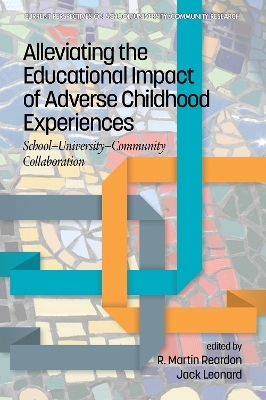
Alleviating the Educational Impact of Adverse Childhood Experiences
Information Age Publishing (Verlag)
978-1-64802-113-8 (ISBN)
Recent crises—whether policy-induced (e.g., family separation at the Mexico/U.S. border) or natural disaster-related (e.g., hurricanes in Florida and North Carolina and wildfires in California)—have galvanized the attention of the U.S. and international public on the plight of children who endure these traumatic events. The sheer enormity of such wrenching events tend to overshadow the trauma endured by many children whose everyday life circumstances fall short of affording them a safe, stable, and nurturing environment.
At the national level, three rounds of data collection spanning January 2008 through April 2014 constituted the National Survey of Children’s Exposure to Violence (NatSCEV) that—according to Finkelhor, Turner, Shattuck, and Hambly (2013) in reporting on the 2011 round—assessed “a wide range of childhood victimizations” (pp. 614-615). Among many other findings, Finkelor et al. concluded that “overall, 57.7% of the children and youth had experienced or witnessed at least 1 to 5 aggregate exposures (assaults and bullying, sexual victimization, maltreatment by a caregiver, property victimization, or witnessing victimization) in the year before this survey” (p. 619). According to the recent re-visiting of NatSCEV II by Turner et al. (2017), “almost 1 in 4 children and adolescents ages 5-15 in the United States lived in family environments with only modest levels of safety, stability, and nurturance, while about 1 in 15 had consistently low levels across multiple domains” (p. 8).
Adverse childhood events (ACEs) have both immediate and long-term impacts on children’s health and well-being (Banyard, Hambly, & Grych, 2017; Bowen, Jarrett, Stahl, Forrester, & Valmaggia, 2018; Walker & Walsh, 2015). Children do not shed their entanglement with ACEs at the schoolroom door. To highlight just one study, Jimenez, Wade, Lin, Morrow, & Reichman (2016) conducted a secondary analysis of a national urban birth cohort and found that experiencing ACEs in early childhood was “associated with below-average, teacher-reported academic and literacy skills and [more] behavior problems in kindergarten” (p. 1).
R. Martin Reardon, East Carolina University. Jack Leonard,University of Massachusetts-Boston.
Introduction.
Chapter 1. North Carolina Resilience and Learning Project; Katie Rosanbalm, Elizabeth DeKonty, and Sheronda Fleming.
Chapter 2. Trauma-Informed Partnering; Jack Leonard.
Chapter 3. Our School Behavioral Health Y'Alliance: The Development of a Rural School-Community-University Collaboration Focused on Supporting Children Who Have Experienced Trauma; Travis Lewis, Karen D. Jones, Karen Koch, Kia Glosson, and Karen Harrington.
Chapter 4. Pedagogy and Adverse Childhood Experiences: A Teacher's Action-Learning Journey in Mitigating the Impact of Trauma Through Changing Teaching Practice; Michelle Montgomery, Roberto H. Parada, and Brenda Dobia.
Chapter 5. Systemic School Reform Partnership to Address Adverse Childhood Experiences in Flint, Michigan; Bryan Beverly, Nicole Ellefson, and Brian J. Boggs.
Chapter 6. River of Emotions: Reflecting on a University-School-Community Partnership to Support Children's Emotional Processing in a Post-Disaster Context; Carol Mutch, Jason Miles, and Sarah Yates.
Chapter 7. Increasing Trauma-Informed Practices in a High Poverty Elementary School: A School, University, and Community Partnership; Betty V. DeBoer and Alyssa M. Boardman.
Chapter 8. Schoolwide Trauma Informed Professional Development: We Can! Building Relationships and Resilience; Armeda Stevenson Wojciak, Jan Powers, and Laura Medberry.
Chapter 9. An Integrated Approach to Mitigating Adverse Childhood Experiences Through Trauma-Informed Yoga; Lauren Dotson Davis and Rebecca Buchanan.
Chapter 10. Bridging Education and Neuroscience to Support Transformation in Teaching and Learning: A Design-Based Approach; Alison Wishard Guerra, Shana R. Cohen, Amanda Datnow, Timothy Brown, Terry Jernigan, Matt Doyle, and Alan Daly.
Chapter 11. Coalescing Streams: Interrupting the Progression of Adversity Through Cross-Sector Mobilization and Systems Alignment; John T. King, Aprille Phillips, Todd Bloomquist, and Peter Buckley.
Chapter 12. A Research-Practice Partnership Serving Students Experiencing Trauma: Best Practices Revealed by an Investigation of a Dropout Prevention Alternative School; Nicole Ralston, Rebecca Smith, Cara Megan Wright, and Jacqueline Waggoner.
Chapter 13. Creating Holistic Trauma-Informed Schools: School-Based Health Centers; Sherry Shamblin, Dawn Graham, and Erin Lucas.
About the Contributors.
| Erscheinungsdatum | 30.06.2020 |
|---|---|
| Reihe/Serie | Current Perspectives on School/University/Community Research |
| Mitarbeit |
Herausgeber (Serie): R. Martin Reardon, Jack Leonard |
| Sprache | englisch |
| Maße | 156 x 234 mm |
| Gewicht | 689 g |
| Themenwelt | Geisteswissenschaften ► Psychologie |
| ISBN-10 | 1-64802-113-1 / 1648021131 |
| ISBN-13 | 978-1-64802-113-8 / 9781648021138 |
| Zustand | Neuware |
| Informationen gemäß Produktsicherheitsverordnung (GPSR) | |
| Haben Sie eine Frage zum Produkt? |
aus dem Bereich