


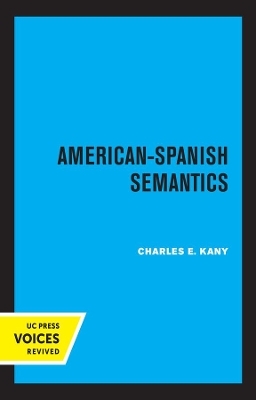
American-Spanish Semantics
Seiten
2021
University of California Press (Verlag)
978-0-520-36705-0 (ISBN)
University of California Press (Verlag)
978-0-520-36705-0 (ISBN)
- Lieferbar (Termin unbekannt)
- Versandkostenfrei
- Auch auf Rechnung
- Artikel merken
American-Spanish Semantics examines how Spanish language in the New World evolved from its sixteenth-century roots in Spain, adapting to diverse social and environmental changes. Spanish conquerors and settlers came from varied regions of Spain, leading to a blend of regional dialects. They avoided regional expressions that could hinder mutual understanding, opting for universally known terms. Upon arriving in the Americas, they adapted familiar words for new landscapes, using terms like piña (pineapple), pavo (turkey), and león (puma). As contact with indigenous populations grew, Spanish speakers incorporated native terms into their vocabulary, leading to variations like cuy for conejillo de Indias and ají for pimienta. Each region developed unique linguistic traits, informed by the native languages—Nahuatl, Quechua, Mapuche—that contributed to the distinct vocabulary and expressions in various parts of Spanish-speaking America.
The adaptation process extended beyond vocabulary to encompass the semantic shifts and unique connotations that formed American Spanish. While Spain maintained cultural influence over colonial centers like Mexico City and Lima, distant regions such as Argentina and Chile experienced more linguistic independence. Without Spain’s viceroy-led structure, local dialects, rural speech patterns, and immigrant influences—from Italians in Argentina to Basques in Venezuela—shaped the evolution of Spanish in different regions. Words changed in meaning, some acquiring regional specificity, and a balance between Spanish norms and American adaptations emerged, especially in regions with less direct oversight from Spain.
American Spanish thus grew into a vibrant linguistic system, enriched by indigenous contributions, local dialects, and evolving cultural values. This resulted in five main linguistic zones across Latin America, each with its unique lexical features and regional expressions, reflecting the distinctive social, cultural, and economic dynamics of each area. The text underscores that American Spanish is a dynamic language shaped by its speakers, who constantly modify and adapt it to new realities, creating a language that is at once rooted in Spain but distinctively transformed by the New World.
This title is part of UC Press's Voices Revived program, which commemorates University of California Press’s mission to seek out and cultivate the brightest minds and give them voice, reach, and impact. Drawing on a backlist dating to 1893, Voices Revived makes high-quality, peer-reviewed scholarship accessible once again using print-on-demand technology. This title was originally published in 1960.
The adaptation process extended beyond vocabulary to encompass the semantic shifts and unique connotations that formed American Spanish. While Spain maintained cultural influence over colonial centers like Mexico City and Lima, distant regions such as Argentina and Chile experienced more linguistic independence. Without Spain’s viceroy-led structure, local dialects, rural speech patterns, and immigrant influences—from Italians in Argentina to Basques in Venezuela—shaped the evolution of Spanish in different regions. Words changed in meaning, some acquiring regional specificity, and a balance between Spanish norms and American adaptations emerged, especially in regions with less direct oversight from Spain.
American Spanish thus grew into a vibrant linguistic system, enriched by indigenous contributions, local dialects, and evolving cultural values. This resulted in five main linguistic zones across Latin America, each with its unique lexical features and regional expressions, reflecting the distinctive social, cultural, and economic dynamics of each area. The text underscores that American Spanish is a dynamic language shaped by its speakers, who constantly modify and adapt it to new realities, creating a language that is at once rooted in Spain but distinctively transformed by the New World.
This title is part of UC Press's Voices Revived program, which commemorates University of California Press’s mission to seek out and cultivate the brightest minds and give them voice, reach, and impact. Drawing on a backlist dating to 1893, Voices Revived makes high-quality, peer-reviewed scholarship accessible once again using print-on-demand technology. This title was originally published in 1960.
| Erscheinungsdatum | 08.02.2021 |
|---|---|
| Verlagsort | Berkerley |
| Sprache | englisch |
| Maße | 148 x 210 mm |
| Themenwelt | Geisteswissenschaften ► Archäologie |
| Sozialwissenschaften ► Ethnologie | |
| Sozialwissenschaften ► Soziologie | |
| ISBN-10 | 0-520-36705-7 / 0520367057 |
| ISBN-13 | 978-0-520-36705-0 / 9780520367050 |
| Zustand | Neuware |
| Informationen gemäß Produktsicherheitsverordnung (GPSR) | |
| Haben Sie eine Frage zum Produkt? |
Mehr entdecken
aus dem Bereich


aus dem Bereich
maternal health science and the reproduction of harm
Buch | Softcover (2024)
University of California Press (Verlag)
CHF 52,35
long-lasting legacies of colonialism and nationalism in Israel, …
Buch | Softcover (2025)
Vernon Press (Verlag)
CHF 109,95


